[Straits Times – Opinion] Forum: Concerns arise from misunderstanding of Foreign Interference (Countermeasures) Bill (reply by Ministry of Home Affairs)

2 October 2021

PUBLISHED OCT 2, 2021, 12:00 AM SGThttps://www.straitstimes.com/opinion/forum/forum-concerns-arise-from-misunderstanding-of-foreign-interference-countermeasures

Mr Harpreet Singh Nehal expressed some concerns on the Foreign Interference (Countermeasures) Bill (Anti-foreign interference Bill – 3 areas of concern, Sept 28).

Mr Singh’s concerns arise from a basic misunderstanding of the Bill and its provisions.

He says that the broad language of the Bill may capture “perfectly legitimate collaborative activity” undertaken by Singapore citizens and non-governmental organisations, which seek to “influence and improve” our laws and policies.

He also says that directions under Part 3 of the Bill could be issued against “legitimate online activity”, even in the absence of any manipulation or influence by a foreign government or its agents.

These assertions are quite inaccurate.

The Bill does not apply to Singaporeans discussing issues, or advocating any matter (regardless of what the Government or anyone else thinks about that).

The Bill will also not cover the vast array of collaborations between Singaporeans and foreigners, on many matters.

However, if a Singaporean acts on behalf of a foreign principal, and if such actions are contrary to public interest, then directions can be issued to such a person.

One example of this would be if a foreign government agency pays a Singaporean to conduct an online campaign, to create discord and unrest among Singaporeans. Such modus operandi have been repeatedly used around the world.

If the above involves covert activity, the persons involved can be prosecuted.

The philosophy underpinning the Bill is a longstanding one – we should not allow foreign subversion of our country and society.

The Bill complements our existing legislation, by providing a targeted and calibrated approach to be used against hostile information campaigns, conducted by foreign agencies and foreigners.

More information on the Bill can be found on the Ministry of Home Affairs’ website: https://www.mha.gov.sg/mediaroom/press-releases/first-reading-of-foreign…

Mr Singh also says that the Bill restricts the role of the Singapore courts to review some actions.

The offences in the Bill relating to criminal conduct are all required to be prosecuted in the courts.

For directions against hostile information campaigns, the oversight will be by a tribunal, headed by a Supreme Court Judge.

Such provisions are not new, and exist in several pieces of legislation.

The matters to be considered in the issuance of directions, (including information obtained through intelligence) may often have to be kept highly confidential.

The courts have also recognised, on several occasions, including in the Nagaenthran case (which Mr Singh refers to), that the judicial process may not be best suited to deal with such issues. Instead, as stated earlier, a tribunal headed by a High Court judge will deal with these matters.

Sam Tee
Senior Director, Joint Operations Group
Ministry of Home Affairs


[Straits Times – Opinion] Anti-foreign interference Bill – a sharper tool for the digital age [by Ong Keng Yong and Stanley Lai]

2 October 2021

PUBLISHED OCT 1, 2021, 5:00 AM SGT – https://www.straitstimes.com/opinion/anti-foreign-interference-bill-a-sharper-tool-for-the-digital-age

A rebuttal to points raised about over-broad language and restrictions on courts’ role

We refer to the article “Anti-foreign interference Bill – 3 areas of concern” by Senior Counsel Harpreet Singh Nehal in The Straits Times on Tuesday. We wish to share our perspectives on the subject and respond to some of the points he makes.

Mr Singh makes two primary points in his articulation of concerns about the Foreign Interference (Countermeasures) Act (Fica).

First, he says the Bill suffers from “extremely broad language” and risks capturing “perfectly legitimate collaborative activities” undertaken by Singapore citizens and local non-governmental organisations.

Second, he says that the Bill “restricts the role of the Singapore courts to review the legality of the Government’s exercise of powers”. Instead, appeals against Part 3 directions provided for under the Bill are made to a reviewing tribunal, which is governed by its own procedural rules.

We do not agree with his interpretation of the Bill.

As regards the “broad language” of Fica, we do not see how the examples of “legitimate” collaborations with foreigners referred to by Mr Singh in his article can be proscribed under the Bill. (He cites public policy issues such as climate change and women’s rights).

One of the key purposes of the Bill is the protection of the public interest. It includes countermeasures against hostile information campaigns on electronic platforms.

However, before the powers under the Bill can be invoked, the following conditions must be met: First, there is an online communications activity, or planning for such an activity. Second, the activity is conducted by or on behalf of a foreign principal. Third, it must be determined that it is in the public interest for a direction (provided in the Bill) to be issued.

The Bill prescribes a statutory regimen requiring a foreign element, and it also must be considered necessary to protect the public interest against this foreign interference.

For the rest of the article, please visit https://www.straitstimes.com/opinion/anti-foreign-interference-bill-a-sharper-tool-for-the-digital-age


[Straits Times – Opinion] Anti-foreign interference Bill – 3 areas of concern (by Harpreet Singh Nehal)

2 October 2021

PUBLISHED SEP 28, 2021, 5:00 AM SGT – https://www.straitstimes.com/opinion/anti-foreign-interference-bill-3-areas-of-concern

The Fica Bill as currently drafted is problematic because of its extremely broad language, restrictions on judicial review and questionable procedural rules.

The Foreign Interference (Countermeasures) Bill (Fica) was recently introduced in Parliament. It seeks to reduce the risk of acts of foreign interference by strengthening the Government’s ability to prevent, detect and disrupt such interference.

The Bill creates new offences which target clandestine online activity. It also imposes substantial financial reporting obligations on politically significant persons, as well as obligations on parties providing social media services and online content.

Foreign interference is a matter of growing concern, especially for small states, in a fast-changing geopolitical context where significant players are seeking to strengthen their reach and carve out spheres of influence. Any responsible government needs to be adequately equipped to protect the public interest by counteracting such acts of foreign interference.

The challenge is to craft balanced legislation that effectively addresses undesirable foreign influence while not curtailing legitimate citizen-led activity. Here are three aspects of the Bill which give cause for grave concern.

For the rest of the article, please visit https://www.straitstimes.com/opinion/anti-foreign-interference-bill-3-areas-of-concern


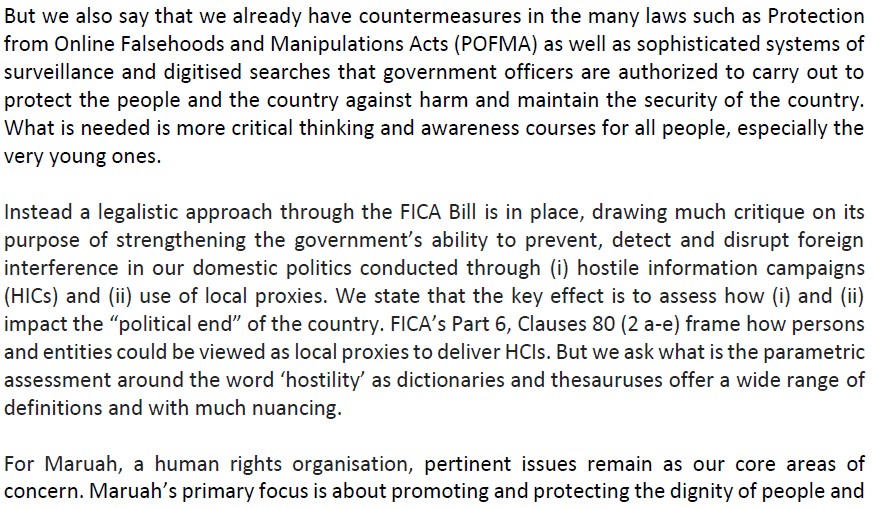
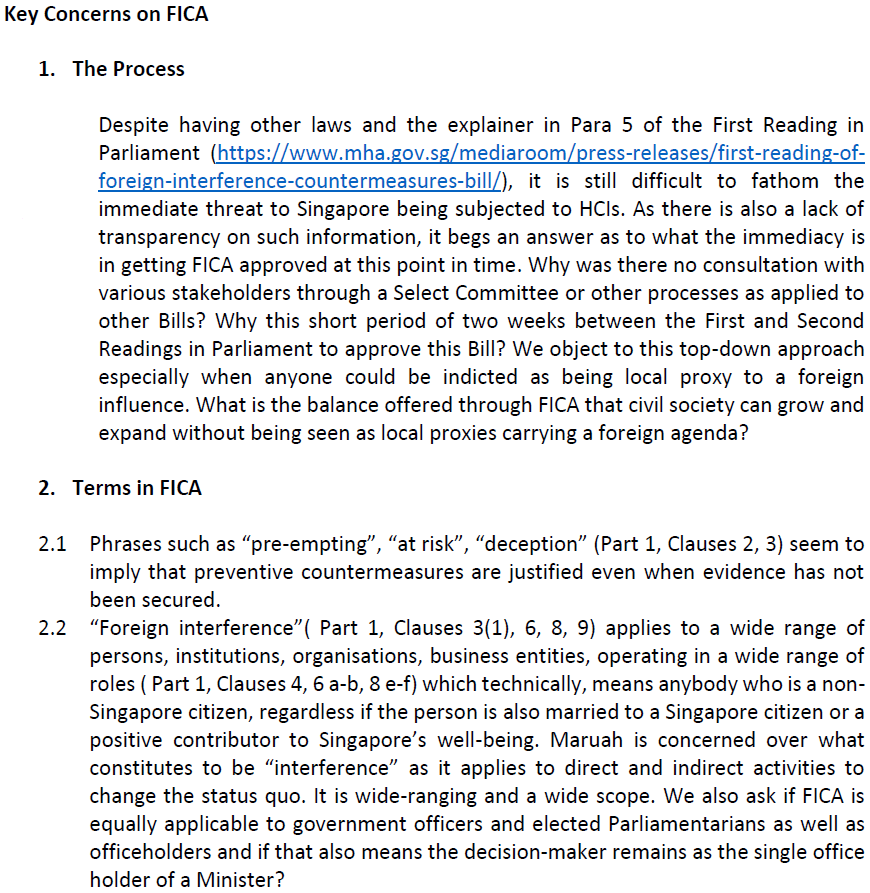
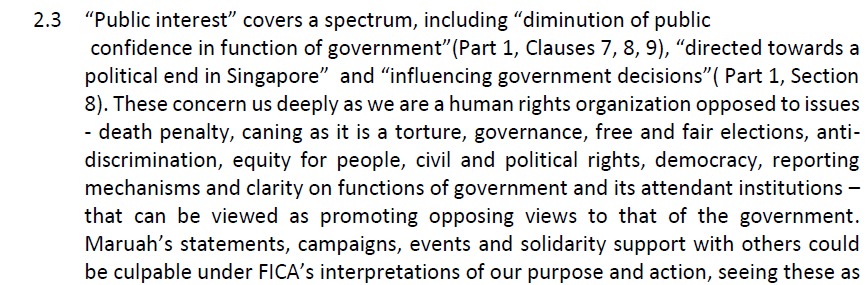
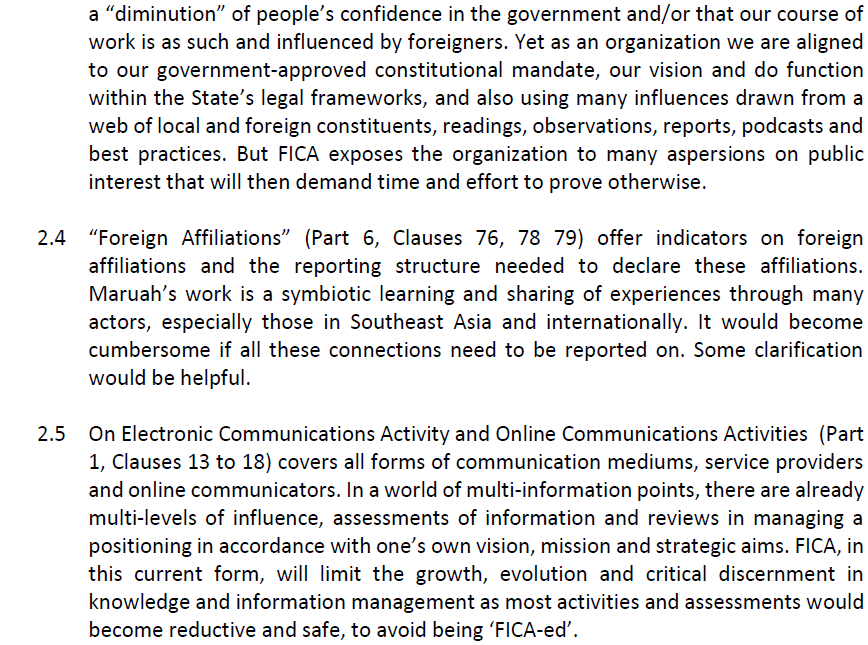
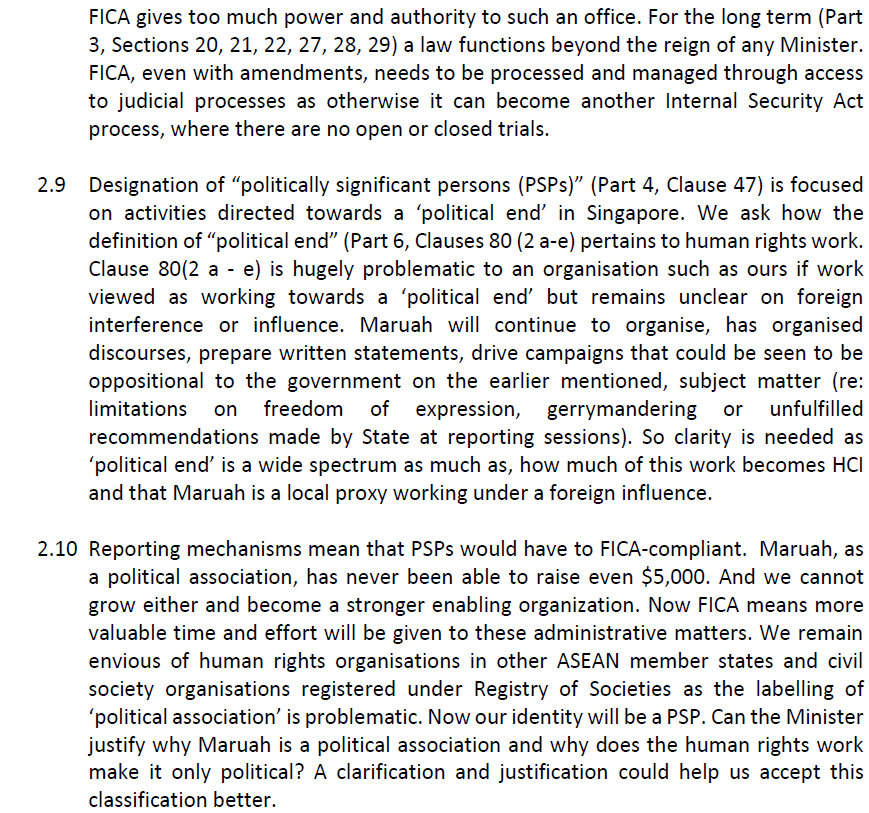
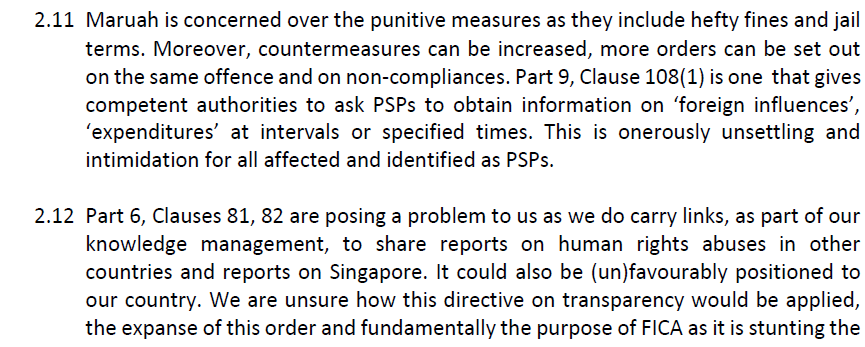
MARUAH’s Statement on the Foreign Interference (Countermeasures) Bill

2 October 2021

Please click here to download MARUAH’s statement in PDF.


[TODAY] Beware of collateral damage of Fica

30 September 2021

Published SEPTEMBER 29, 2021

Earlier this month, the Government tabled a Bill to enact the Foreign Interference (Countermeasures) Act (Fica).

The legislation, if passed, will provide the Government with the powers to act against foreign interference that comes in the forms of hostile information campaigns and local proxies by foreign entities.

The Bill is underscored by the recognition that foreign interference takes place in both online and offline settings.

The swathe of provisions proposed will provide the Government, specifically the Minister for Home Affairs, with different mechanisms to prevent, detect and disrupt actions by foreign actors who interfere with domestic politics through influence operations.

The directives will be issued to social media companies, electronic services such as instant messaging apps and Internet access providers, and individuals who own or manage websites and blogs.

Given the rise of influence operations — also known as cyber-enabled foreign interference — globally, this Bill does not come as a surprise.

However, while Fica upgrades the Government’s arsenal to counter foreign interference in a digitalised age, it should not do so at the expense of people’s trust in the Government and diminish Singapore’s position as a global hub.

FIGHTING AN EVOLVING THREAT

Tabled two years after the passing of the Protection from Online Falsehoods and Manipulation Act (Pofma), some might wonder what took Singapore so long to legislate against influence operations, given the prevalence of the problem in other countries.

In the past few years, countries such as Australia, Canada and the United States have introduced or passed bills to curtail foreign interference in elections and infrastructures.

The rapidly evolving nature of influence operations — in terms of the who, how and why — renders existing laws such as Pofma and the Political Donations Act toothless in countering hostile foreign actors.

There is a tendency for people to think of foreign powers as the main perpetrators of foreign influence.

The trend is evident from actions that have been taken by social media companies like Facebook, Twitter and Google (YouTube) to eradicate inauthentic behaviour originating from Russia, Iran, China and Turkey in the past few years.

However, hostile actors are not limited to foreign governments.

Facebook recently shared that most of the covert influence operations in Asia-Pacific are domestic. Research conducted by the Australian Strategic Policy Institute uncovered “apolitical disinformation entrepreneurs” as masterminds.

The toolbox used by perpetrators of influence operations has also expanded.

While the “basic” and more crude forms of tactics, such as bots and fake accounts, are still being used, more covert techniques such as buzz accounts and pop culture fan communities are emerging.

Furthermore, hostile actors are often very adept at mixing and matching tactics, combining them to achieve devastating consequences.

PROTECTING PUBLIC TRUST AND GLOBAL HUB STATUS

To detect, disrupt and stop hostile information campaigns, the Bill includes a wide range of directives.

These include directing social media platforms to disclose information even before the content is published, requiring a person or an Internet intermediary to stop communicating hostile information campaign contents, and requiring services and platforms to restrict the dissemination of such additional content.

Internet service providers can also be ordered to block access to content.

Since the first reading of the Fica Bill, concerns have been raised by different quarters pertaining to the overly broad and expansive definitions of foreign interference and what constitutes political activities.

A petition against Fica which calls for more public consultation via a multi-party parliamentary Select Committee has also been launched.

A provision that merits special discussion is the Technical Assistance Direction that will allow the Government to act on an anticipatory basis.

Research on rumours and conspiracy theories found that the inoculation strategy — exposing individuals to fallacies to prepare them — has been shown to heighten people’s vigilance and scepticism towards false information.

While this directive will help the Government prevent the slow drip effect of influence operations and make a pre-emptive strike as soon as it is aware of suspicious activities, there could be concerns about its opacity and potential overreach.

According to the Bill, a “Technical Assistance Direction can be issued if the Minister suspects that there are preparations or plans to undertake an online communication activity in Singapore by or on behalf of a foreign principal, and the Minister is of the opinion that it is in the public interest to issue the direction”.

The ongoing tussle between the Indian government and WhatsApp over a new law that requires the platform to identify the “first originator of information” when the authorities demand it highlights the potential pushback.

While the Indian government emphasises that the law will only be used to unmask people credibly accused of wrongdoing, WhatsApp has said that the law would require it to break encryption for message receivers as well as message originators.

This will potentially breach privacy protections on the platform.

Fica should specify the situations and the purposes that warrant the issuance of such a direction, or other directions for the matter.

This will help put the public’s mind at ease and promote cooperation from tech platforms.

At the international level, the Government needs to consider the potential effects Fica might have on Singapore as an international hub as well as criticisms about the lack of clarity on what “collaboration” entails.

Part of the wonder of cyberspace is its transboundary nature which makes collaborations on an unprecedented scale possible.

It has spurred the growth of the digital economy, sparked entrepreneurship, advanced academic collaboration and scholarship, and strengthened political alliances.

For example, the free-flowing exchange of ideas and resources form the backbone of the global climate movement.

The movement sparked off the people’s climate march, industry-wide climate activism efforts in different countries as well as grassroots campaigns.

While one cannot establish causation, the sharp gain in the momentum of transnational collaboration could have contributed to the energised global action on climate change.

Therefore, the definition of foreign interference and its measurements would have to be sharp and clear so as not to diminish Singapore’s position as a node in the global network of collaboration and creation.

Since the first reading of the Fica Bill, legal practitioners, activists and academics have raised concerns and offered suggestions on how to refine the Bill.

The Government should take heed and consider how it can strengthen the proposed Act so that it can keep foreign interference at bay while safeguarding people’s trust in it and Singapore’s hub status.

ABOUT THE AUTHOR:

Dr Carol Soon is a senior research fellow at the Institute of Policy Studies where she heads the Society and Culture department.

Read more at https://www.todayonline.com/commentary/beware-collateral-damage-fica


[TODAY] Draft foreign interference law: Workers’ Party proposes changes to prevent abuse and enhance oversight over powers

30 September 2021

Published SEPTEMBER 29, 2021

  • A draft law to protect Singapore from foreign interference gives the Government power to deal with such acts
  • The Workers’ Party said it believes in countering foreign threats, but disagrees on the Bill’s wording 
  • The party’s parliamentarians filed a notice to amend the Bill
  • One proposed change is to exempt activities where foreign individuals or publications comment on Singapore politics in an “open, transparent and attributable way”

Read more at https://www.todayonline.com/singapore/workers-party-disagrees-proposed-foreign-interference-law-files-changes-prevent-abuse-and-enhance-oversight-powers


[change.org] Say no to unfettered power! Rethink FICA!

30 September 2021

Sign this petition now!

Singapore’s proposed Foreign Interference (Countermeasures) Act (FICA) is an overly broad law that grants the Minister for Home Affairs vast powers, with serious repercussions for civil society, independent media, and public discourse.

The bill was introduced in Parliament on 13 September 2021, with its second reading scheduled for 4 October 2021.

We, the undersigned, would like to express the following concerns:

1. An overly broad, expansive law

FICA contains extremely broad definitions that serve as a catch-all for a wide range of activities. If enacted, the law will have serious ramifications for multiple stakeholders and large sections of society, including academia, business, civil society, and the media.

2. Powers to censor, impose restrictions, and demand information

FICA allows the Minister for Home Affairs vast powers to issue directives that can censor online content and even shut down media outlets. All that is required for the issuance of such directions is for the Minister to be of the opinion that online communications activity has been undertaken, or has been suspected of being undertaken, on behalf of a foreign principal, and that it is in the public interest to take action. Compliance with these directions are mandatory; failure to comply will attract heavy fines and/or imprisonment. The offence of non-compliance is arrestable and non-bailable.

The Minister can also declare an online location a “proscribed online location”. This would then make it illegal to monetise, finance, or form commercial partnerships with the platform. In other words, the Minister can effectively shut down any independent media business or initiative by cutting off its sources of funding.

The proposed legislation allows an authority appointed by the Minister to designate individuals or entities “politically significant persons”, who are then subject to reporting obligations and restrictions regarding donations. This designation can only be appealed to the Minister who appointed the authority in the first place.

FICA also grants authorities the right to demand information from any individual, whether inside Singapore or out, for enforcement purposes. Such a broad power can lead to gross violations of privacy.

3. Absence of meaningful oversight of powers granted under FICA

FICA limits the sources of appeal for the exercise of powers under the bill. Appeals are first directed to the Minister for Home Affairs, who can also choose not to consider an appeal if he deems it “frivolous or vexatious”.

The second source of appeal, the Reviewing Tribunal, is appointed by the President on the advice of the Cabinet. However, the Minister for Home Affairs makes the rules followed by the Reviewing Tribunal.

FICA further restricts judicial review in open court to only procedural matters.

4. Our demands

FICA, in its current state, is an example of state overreach without adequate oversight. Given the serious ramifications that such a wide-ranging law will have on multiple segments of society, it is crucial that such a bill be closely scrutinised and thoroughly debated before any decision can be taken as to whether such a far-reaching piece of legislation is even necessary.

It is therefore unacceptable that the bill – which is 249 pages long – is scheduled for its second, and likely third, reading on 4 October. That’s a mere three weeks after it was first introduced in Parliament. This is nowhere near enough time for Members of Parliament, as well as Singaporeans, to have read, analysed, and be consulted on the proposed law.

A multi-party Select Committee should instead be appointed to carry out extensive public consultation on the issue of “foreign interference”. The term should be clearly defined, and measures enacted should take into consideration with best practices in accordance with international human rights standards.

While legislation to combat malign foreign interference is not inherently unreasonable, national security should not be seen as an excuse to concentrate power in the hands of the state. Any law that is enacted should therefore not be overly broad and ambiguous, but targeted, precise, and subject to adequate oversight and restraints on power.


[TODAY] Draft law doesn’t bar meetings by groups with foreigners who have no control over them: MHA

30 September 2021

Published SEPTEMBER 26, 2021

  • MHA made these clarifications in response to concerns from human rights groups Maruah and Think Centre
  • They had questioned whether their activities will come under greater scrutiny under the proposed law on foreign interference
  • MHA said the intent of Fica is not to stifle political expression or activity but to prevent foreign influence via local proxies 

Read more at https://www.todayonline.com/singapore/draft-foreign-interference-law-does-not-bar-meetings-maruah-and-think-centre-foreigners-no


Dr Tan Cheng Bock on the proposed Foreign Interference (Countermeasures) Act 2021

30 September 2021

38th Session of the Universal Periodic Review – Review of Singapore [Wed 12 May 3 – 6.30pm (SG time)]

9 May 2021

The Review of Singapore will be broadcast live at http://webtv.un.org/.

Please click here to add a reminder to watch the review live on UN Web TV.


What is the Universal Periodic Review?

The Universal Periodic Review (UPR) is a unique process which involves a review of the human rights records of all UN Member States. The UPR is a State-driven process, under the auspices of the Human Rights Council, which provides the opportunity for each State to declare what actions they have taken to improve the human rights situations in their countries and to fulfil their human rights obligations. 

As one of the main features of the Council, the UPR is designed to ensure equal treatment for every country when their human rights situations are assessed. The ultimate aim of this mechanism is to improve the human rights situation in all countries and address human rights violations wherever they occur. Currently, no other universal mechanism of this kind exists.

Please click here for more information on the UPR.