[Repost] Singapore supports 243 human rights recommendations, including stronger migrant worker protections – Channel News Asia

29 September 2026

https://www.channelnewsasia.com/singapore/migrant-workers-human-rights-un-6414541

29 September 2026

The country supported about 71 per cent of the recommendations it received, but did not back changes to domestic worker laws, the death penalty or free speech legislation.

SINGAPORE: Singapore supported recommendations from other United Nations member states on Monday (Sep 28) to strengthen migrant worker protections and improve mental health support for children, as part of its latest review of the country’s human rights record.

It also supported calls to consider ratifying international conventions covering migrant and domestic workers, ensure new technologies comply with human rights standards, and include vulnerable groups in climate change policies.

The commitments are among 243 recommendations Singapore supported following its fourth Universal Periodic Review, a UN mechanism that reviews each member state’s human rights record every four-and-a-half years. 

They account for about 71 per cent of the 342 recommendations Singapore received, up from 65 per cent during its previous review in 2021. 

Singapore’s permanent representative to the United Nations in Geneva, Mr Jaya Ratnam, said the country viewed the process as a platform for frank dialogue and approached it with an open mind.

“Our approach to human rights rests on a simple premise: progress should always be measured by tangible outcomes for our people,” he said at the adoption of Singapore’s Universal Periodic Review report in Geneva.

Singapore supported recommendations that complemented its efforts to build a more inclusive, cohesive and resilient society, Mr Ratnam added, citing education, public healthcare, support for lower-income groups, migrant worker welfare, labour rights and digital inclusion.

He said the country’s approach rested on two pillars – pragmatism and the rule of law – and that countries would take different paths to advancing human rights based on their circumstances.

“What matters is whether these approaches deliver meaningful progress for their people,” he said.

DOMESTIC WORKERS

Among the more specific recommendations supported by Singapore was one from the United Kingdom to mandate rest periods and create digital recruitment and wage-payment processes for foreign domestic workers. 

Singapore also supported recommendations to strengthen migrant workers’ protections in areas such as working conditions, healthcare, social protection, access to justice and safeguards against exploitation. These included improving migrant domestic workers’ legal protections, access to healthcare and mental health support.

However, it did not support some recommendations seeking specific changes to legal protections.

These included recommendations from Canada and Norway to extend protections under the Employment Act and Work Injury Compensation Act to domestic workers, and a recommendation to establish a government-run recruitment system to prevent deceptive hiring and contract substitution. 

Singapore also did not support a recommendation to give foreign domestic workers public holidays, regulated working hours and paid leave, and to end mandatory pregnancy and HIV testing.

In its response, Singapore said migrant domestic workers required “additional protection” and that their particular working environments were addressed through customised legislation under the Employment of Foreign Manpower Act. 

MENTAL HEALTH, WOMEN’S EMPOWERMENT

Singapore supported several recommendations on mental health, including calls to strengthen school-based support services for young people, increase awareness and develop community services.

It also backed a recommendation to protect children and older people from cyber harms while maintaining non-digital access to essential services.

Singapore also supported a broad range of recommendations on advancing women’s empowerment, including increasing women’s representation in public and political life, narrowing gender inequalities at work and strengthening support for women in leadership roles.

Other supported recommendations focused on balancing work and caregiving with stronger workplace protections relating to maternity, caregiving responsibilities and flexible work arrangements to raise women’s workforce participation.

In its national report for the review, Singapore pointed to measures such as the Workplace Fairness Act and expanded parental leave. Government-paid paternity leave doubled from two to four weeks last year, while shared parental leave rose to 10 weeks from April.

DEATH PENALTY, LGBT PROPOSALS NOT ACCEPTED

Most of the recommendations Singapore did not support fell into three broad areas: ratification of additional human rights treaties, abolition or restriction of the death penalty, and freedom of expression and assembly.

About a third of the recommendations it noted related to treaty ratification, Mr Ratnam said. 

Singapore does not regard treaty obligations as “an aspirational exercise”, he said, adding that the country would accede to treaties only when it was sure it could fully implement every aspect.

For many of the other recommendations, Singapore already had legislation and policies addressing their underlying objectives in ways suited to its social and cultural context, he added.

Singapore noted recommendations calling for a moratorium on or abolition of the death penalty. It said capital punishment was reserved for the most serious crimes, including murder and trafficking significant quantities of drugs, and was applied with due process and judicial safeguards.

It also did not support recommendations to legalise same-sex marriage, ban conversion practices or add sexual orientation and gender identity as protected characteristics under the Workplace Fairness Act.

In its formal response, Singapore said: “All Singapore citizens, regardless of their sexual orientation or gender identity, are protected under our laws from discrimination and harassment. We will continue to address the concerns of the LGBT community in a sensitive and pragmatic way, protect the vulnerable, uphold the family and preserve the common space for the diverse communities in Singapore.”

On freedom of expression and assembly, Singapore supported recommendations to protect these rights and ensure relevant laws and policies comply with international human rights standards.

However, it did not support several recommendations calling for specific changes to laws such as the Protection from Online Falsehoods and Manipulation Act and the Public Order Act. 

The government said the rights to speech, expression and assembly were constitutionally guaranteed but not “unfettered”, and had to be exercised responsibly, particularly given Singapore’s multi-racial and multi-religious context.

Singapore said it was committed to implementing the 243 recommendations it supported. 


[Repost] Singapore’s human rights record to be examined by Universal Periodic Review

13 May 2026

https://www.ohchr.org/en/media-advisories/2026/05/singapores-human-rights-record-be-examined-universal-periodic-review

08 May 2026

GENEVA – The human rights record of Singapore will be examined by the United Nations Human Rights Council’s Universal Periodic Review (UPR) Working Group for the fourth time on Tuesday, 12 May 2026, 14:30-18:00 (GMT+2), in a meeting in Geneva that will be webcast live.

Singapore is one of 14 States to be reviewed by the UPR Working Group during its upcoming session from 4 to 15 May 2026. The first, second and third UPR reviews of Singapore took place in May 2011, January 2016, and May 2021, respectively.

The UPR Working Group is comprised of the 47 Member States of the Human Rights Council. However, any UN Member or Observer State can participate in a country review.

The documents on which the reviews are based are: 1) national report – information provided by the State under review; 2) information contained in the reports of independent human rights experts and groups, known as the special procedures, human rights treaty bodies, and other UN entities; 3) information provided by other stakeholders including national human rights institutions, regional organizations, and civil society groups.

The three reports serving as the basis for the review of Singapore can be found here.

Location: Assembly Hall (A Building, third floor), Palais des Nations, Geneva.
Date and time: Tuesday, 12 May 2026, 14:30-18:00 (GMT+2)

The UPR is a peer review of the human rights records of all 193 UN Member States. Since its first meeting was held in April 2008, all 193 UN Member States have been reviewed three times. During the fourth UPR cycle, States are again expected to spell out steps they have taken to implement recommendations posed during their previous reviews which they committed to follow up on and highlight recent human rights developments in the country.

The delegation of Singapore will be led by Ms. Rahayu Binte Mahzam, Minister of State at the Ministry of Digital Development and Information and at the Ministry of Health.

The three country representatives serving as rapporteurs (“troika”) for the review of Singapore are Albania, Benin and Indonesia.

The webcast of the session will be at: https://webtv.un.org/en/asset/k1f/k1f4qowgdz

The list of speakers and all available statements to be delivered during the review of Singapore will be posted on the UPR Extranet.

The UPR Working Group is scheduled to adopt the recommendations made to Singapore on Friday, 15 May 2026, between 14:30 and 18:00 (GMT+2). The State under review may wish to express its positions on recommendations posed to it during its review.

// ENDS //

For more information and media requests, please contact Pascal Sim, Human Rights Council Spokesperson, at simp@un.org and Matthew Brown, Human Rights Council Public Information Officer, at matthew.brown@un.org.

To learn more about the Universal Periodic Review:
www.ohchr.org/en/hr-bodies/upr/upr-main

Sign up for the UN Human Rights Council newsletter “Room 20 Bulletin”:
https://mailchi.mp/a3a538479938/hrc-mailshot-to-ohchr-global

Follow us on social media:
Facebook | Instagram | LinkedIn | X | YouTube


Universal Periodic Review (The Third Cycle) – Stakeholders’ Report to the UN by MARUAH

27 March 2021

In October 2020, MARUAH submitted its Stakeholder’s Report for the third cycle of the Universal Periodic Review focusing on civil and political rights – Freedom of Expression, Freedom of Association, Censorship, Electoral System, Justice (incl minimum working age, corporal punishment, juvenile justice system & death penalty) and Discrimination (incl LGBTQIA, equality of races, women and income inequalities/job opportunities).

We also submitted recommendations in each section based on the SMART framework and draw upon the recommendations made by Human Rights Council to Singapore, our mid-term UPR report (2018), and the past UPRs we have submitted in 2011 and 2015.

Please click here to access the full report.


Increased international interest on Singapore UPR in 2016

4 February 2016

UPR 2016 & 2011
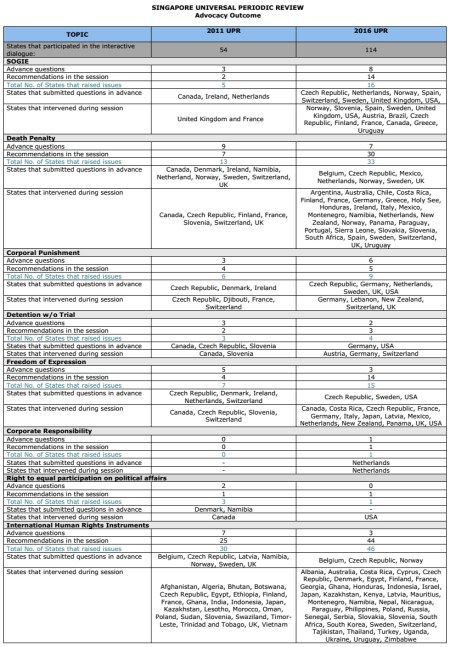
The International Commission of Jurists has compiled a list of countries that participated in Singapore’s Universal Periodic Review (UPR) process. The comparison between the 1st cycle in 2011, and the 2nd cycle in 2016, shows an increased in the number of countries taking an interest in the human rights situation in Singapore.


MARUAH’s forum letter on Singapore’s participation in UPR process

4 February 2016

MARUAH’s forum letter on Singapore’s participation in the second cycle of the Universal Periodic Review (UPR) process, has been published online.

http://www.straitstimes.com/forum/letters-on-the-web/more-meaningful-engagement-needed-on-human-rights

On Jan 27, Singapore participated in the second cycle of the Universal Periodic Review (UPR) process. Ambassador-at-Large Chan Heng Chee led a delegation that comprised civil service officers (“UN praises Singapore’s social policies”; Jan 29).

Absent from the table were ministers and elected government leaders, who ought to take the lead to speak for human rights, explain the Government’s stance and address the issues raised.

Maruah hopes that our government leaders take the UPR process seriously enough to spare time for a discussion on human rights issues.

Singapore’s human rights record should be presented by a minister or deputy minister.

Issues raised during the UPR session included recognising migrant workers and the lesbian, gay, bisexual, transsexual, questioning, intersex, asexual (LGBTQIA) community as people with equal rights, abolishing the death penalty, reviewing the Internal Security Act and certain laws such as Section 377A, removing corporal punishment, and ratifying several international conventions.

Race and security also featured in some observations and questions, with countries asking for clear ratification on the Convention on the Elimination of All Forms of Racial Discrimination.

There were also calls made for a National Human Rights Institution and an independent elections commission to be set up.

These are issues that civil society, Singaporeans and the Government will continue to negotiate on.

However, Maruah finds the approach and stance taken by the Government to certain issues disappointing.

The use of exceptionalism to defend the existence of anachronisms like the death penalty and arbitrary detention without trial shows the Government’s lack of commitment to the core principles of human rights.

Human rights are indivisible, inalienable and interdependent.

Yes, we live in difficult times, where security of the person and a country are real.

All the more we need to have meaningful engagement on these issues between our population and the Government.

Braema Mathi (Ms)
President
Maruah


‘Live’ stream – Universal Periodic Review of Singapore’s human rights record

22 January 2016

Singapore UPR Invite

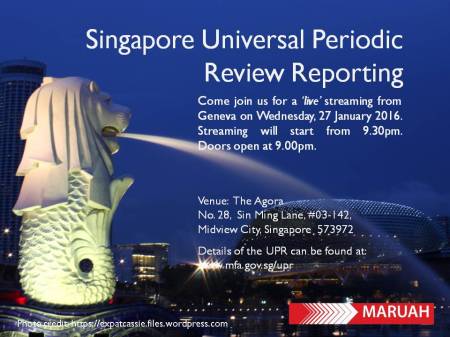
Join us for a ‘live’ streaming from Geneva on Wednesday, 27 January 2016.

Streaming will start from 9.30pm. Doors open at 9.00pm.

Information on this UPR session can be found at the link below.
http://www.ohchr.org/EN/HRBodies/UPR/Pages/SGSession24.aspx

Venue:
The Agora
Block 28 Sin Ming Lane
#03-142 Midview City
Singapore 573972 [map]

Directions:
Take bus 410W or 52 from Bishan Bus Interchange and alight in front of Ai Tong Primary School. Midview City is just behind Ai Tong Primary School.

Please register your attendance, by sending an email to maruahsg@gmail.com with the following details
Name:
Organisation (if any):
Contact (email or mobile):


MARUAH statement at UPR pre-session on Singapore

16 December 2015

Speech by MARUAH for MARUAH and Collective of Singapore NGOs (COSINGO)

DECLARATION MADE BY MARUAH Singapore
UNIVERSAL PERIODIC REVIEW (UPR) PRE-SESSION ON SINGAPORE, GENEVA
16th DECEMBER 2015

Presentation of the Organisation
1. This statement is delivered by MARUAH Singapore, on behalf of Civil Society Organisations and individuals who have participated and followed the UPR process. “MARUAH” is a human rights NGO with special consultative status on the United Nations Economic and Social Council (ECOSOC).

National consultations for the drafting of the national report (if any)
2. There were 2 government-organised consultations held in Singapore.

3. MARUAH held 3 open consultations with various Civil Society Organisations (CSOs), individuals and university students.

Acknowledgment of work done by the Singapore Government
4. Since the 2011 UPR, the Government has ratified the Convention on the Rights of Persons with Disabilities in 2013, acceded to the United Nations Protocol to Prevent, Suppress and Punish Trafficking in Persons, Especially Women and Children (UN TIP Protocol), often known as the Palermo Protocol in 2015, made legislative changes to the mandatory death penalty, thus introducing discretionary approaches and signed onto the Convention on the Elimination of Racial Discrimination.

5. The Government has organised more consultations without CSOs asking for it. Seemingly the government is becoming more open in discussing matters with civil society though the number of people being hauled up under various laws, continues as a deterrent to shut the voices down.

Plan of this Statement
6. The statement addresses the following issues:-
a. Freedom of expression, Freedom of information, Freedom of peaceful assembly and association
b. Impediments to free and fair electoral systems, specifically the GRC system, redrawing of electoral boundaries
c. Lack of Independent Institutions for elections and setting up a National Human Rights Body
d. Ratification of other core international human rights instruments, specifically CERD, and optional protocols for CEDAW, CRC, CRPD
e. Continued usage of preventive detention without trial, under ISA & CLTPA
f. Lack of human rights education in schools

7. This statement will not go into all details but we have introduced footnotes to highlight the notes and evidence. (https://maruah.org/wp-content/uploads/2010/11/maruahupr2015-final.pdf); (https://maruah.org/wp-content/uploads/2010/11/combinedupr-final.pdf)

8. The aim of asking for interventions through questions and recommendations is for people in Singapore to be able to move away from this fear-ridden climate that we are embedded in.

Read the rest of this entry »


Reports submitted for Universal Periodic Review

23 June 2015

MARUAH has submitted 2 reports to the United Nations, as part of the Universal Periodic Review (UPR) process.

The 1st report, a joint submission involving several NGOs, highlights concerns and recommendations covering all areas, including political-security, economic, and socio-cultural domains.

The 2nd report, a MARUAH submission, focuses on electoral systems, death penalty, and preventive detention without trial.

The reports can be accessed below.
combinedupr.final
maruahupr2015.final

Singapore will undergo it’s 2nd UPR session in Jan/Feb 2016. More details on the UPR process can be found at the link below.
http://www.ohchr.org/EN/HRBodies/UPR/Pages/UPRMain.aspx 


It is Time – The 2nd Universal Periodic Review (UPR) Report is Here

19 May 2015

Please come and learn more about Singapore’s human rights track record.

The UPR is a process where UN member states are reviewed on their human rights situation.

Join our forum. Be part of this process. Raise your awareness.

Date: 28th May 2015
Time 7-9 pm
Venue: Blk 28 Midview City #03-142 18 Sin Ming Lane Singapore 573960
Directions: https://www.google.com.sg/maps/place/Midview+City/@1.359109,103.833896,17z/data=!3m1!4b1!4m2!3m1!1s0x31da1725f6ca4f35:0x7ff1fd1b9c84ac7e

Register at the link below
https://docs.google.com/forms/d/1WjwtmD0zsPhkdXIli5fHr0lwGMWgaDOLLZPMkGfOmwg 


MARUAH calls for Singapore to focus on civil and political rights at UN human rights meeting

23 September 2011

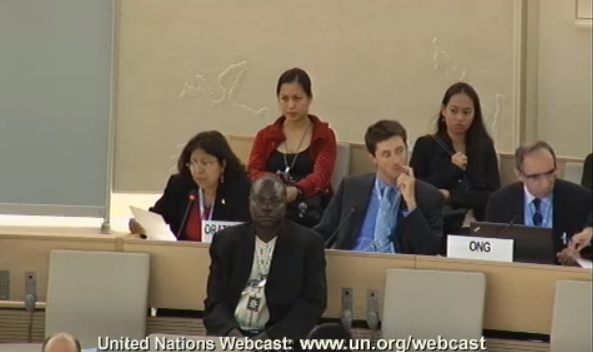
MARUAH Singapore has made an oral statement at the United Nations, as the report on Singapore’s human rights was adopted under the Universal Periodic Review (UPR) process at the 18th session of the Human Rights Council.

Ms Braema Mathi, President of MARUAH, made the first Non-Governmental Organisation (NGO) oral statement under the banner of ARTICLE 19, an international NGO focusing on freedom of expression and information.

In the oral statement, MARUAH highlighted that the 2 recent elections in Singapore have shown that the people want to be engaged; the government too has said that. Hence, it is disheartening that they have not supported the core recommendations on civil and political rights.

MARUAH urged the Singapore government to focus on civil and political rights as a priority over the next 4-year cycle of the UPR process. Read the rest of this entry »