[Repost] Singapore supports 243 human rights recommendations, including stronger migrant worker protections – Channel News Asia

29 September 2026

https://www.channelnewsasia.com/singapore/migrant-workers-human-rights-un-6414541

29 September 2026

The country supported about 71 per cent of the recommendations it received, but did not back changes to domestic worker laws, the death penalty or free speech legislation.

SINGAPORE: Singapore supported recommendations from other United Nations member states on Monday (Sep 28) to strengthen migrant worker protections and improve mental health support for children, as part of its latest review of the country’s human rights record.

It also supported calls to consider ratifying international conventions covering migrant and domestic workers, ensure new technologies comply with human rights standards, and include vulnerable groups in climate change policies.

The commitments are among 243 recommendations Singapore supported following its fourth Universal Periodic Review, a UN mechanism that reviews each member state’s human rights record every four-and-a-half years. 

They account for about 71 per cent of the 342 recommendations Singapore received, up from 65 per cent during its previous review in 2021. 

Singapore’s permanent representative to the United Nations in Geneva, Mr Jaya Ratnam, said the country viewed the process as a platform for frank dialogue and approached it with an open mind.

“Our approach to human rights rests on a simple premise: progress should always be measured by tangible outcomes for our people,” he said at the adoption of Singapore’s Universal Periodic Review report in Geneva.

Singapore supported recommendations that complemented its efforts to build a more inclusive, cohesive and resilient society, Mr Ratnam added, citing education, public healthcare, support for lower-income groups, migrant worker welfare, labour rights and digital inclusion.

He said the country’s approach rested on two pillars – pragmatism and the rule of law – and that countries would take different paths to advancing human rights based on their circumstances.

“What matters is whether these approaches deliver meaningful progress for their people,” he said.

DOMESTIC WORKERS

Among the more specific recommendations supported by Singapore was one from the United Kingdom to mandate rest periods and create digital recruitment and wage-payment processes for foreign domestic workers. 

Singapore also supported recommendations to strengthen migrant workers’ protections in areas such as working conditions, healthcare, social protection, access to justice and safeguards against exploitation. These included improving migrant domestic workers’ legal protections, access to healthcare and mental health support.

However, it did not support some recommendations seeking specific changes to legal protections.

These included recommendations from Canada and Norway to extend protections under the Employment Act and Work Injury Compensation Act to domestic workers, and a recommendation to establish a government-run recruitment system to prevent deceptive hiring and contract substitution. 

Singapore also did not support a recommendation to give foreign domestic workers public holidays, regulated working hours and paid leave, and to end mandatory pregnancy and HIV testing.

In its response, Singapore said migrant domestic workers required “additional protection” and that their particular working environments were addressed through customised legislation under the Employment of Foreign Manpower Act. 

MENTAL HEALTH, WOMEN’S EMPOWERMENT

Singapore supported several recommendations on mental health, including calls to strengthen school-based support services for young people, increase awareness and develop community services.

It also backed a recommendation to protect children and older people from cyber harms while maintaining non-digital access to essential services.

Singapore also supported a broad range of recommendations on advancing women’s empowerment, including increasing women’s representation in public and political life, narrowing gender inequalities at work and strengthening support for women in leadership roles.

Other supported recommendations focused on balancing work and caregiving with stronger workplace protections relating to maternity, caregiving responsibilities and flexible work arrangements to raise women’s workforce participation.

In its national report for the review, Singapore pointed to measures such as the Workplace Fairness Act and expanded parental leave. Government-paid paternity leave doubled from two to four weeks last year, while shared parental leave rose to 10 weeks from April.

DEATH PENALTY, LGBT PROPOSALS NOT ACCEPTED

Most of the recommendations Singapore did not support fell into three broad areas: ratification of additional human rights treaties, abolition or restriction of the death penalty, and freedom of expression and assembly.

About a third of the recommendations it noted related to treaty ratification, Mr Ratnam said. 

Singapore does not regard treaty obligations as “an aspirational exercise”, he said, adding that the country would accede to treaties only when it was sure it could fully implement every aspect.

For many of the other recommendations, Singapore already had legislation and policies addressing their underlying objectives in ways suited to its social and cultural context, he added.

Singapore noted recommendations calling for a moratorium on or abolition of the death penalty. It said capital punishment was reserved for the most serious crimes, including murder and trafficking significant quantities of drugs, and was applied with due process and judicial safeguards.

It also did not support recommendations to legalise same-sex marriage, ban conversion practices or add sexual orientation and gender identity as protected characteristics under the Workplace Fairness Act.

In its formal response, Singapore said: “All Singapore citizens, regardless of their sexual orientation or gender identity, are protected under our laws from discrimination and harassment. We will continue to address the concerns of the LGBT community in a sensitive and pragmatic way, protect the vulnerable, uphold the family and preserve the common space for the diverse communities in Singapore.”

On freedom of expression and assembly, Singapore supported recommendations to protect these rights and ensure relevant laws and policies comply with international human rights standards.

However, it did not support several recommendations calling for specific changes to laws such as the Protection from Online Falsehoods and Manipulation Act and the Public Order Act. 

The government said the rights to speech, expression and assembly were constitutionally guaranteed but not “unfettered”, and had to be exercised responsibly, particularly given Singapore’s multi-racial and multi-religious context.

Singapore said it was committed to implementing the 243 recommendations it supported. 


[Repost] AICHR Press Statement on the World Day Against Trafficking in Persons 2026

31 July 2026

https://aichr.org/wp-content/uploads/2026/07/Adopted_AICHR-Press-Statement-on-World-Day-Against-Trafficking-in-Persons-2026.pdf

30 July 2026 – On the occasion of the World Day Against Trafficking in Persons, observed under the theme “Trapped Behind the Scam”, the ASEAN Intergovernmental Commission on Human Rights (AICHR) reaffirms its commitment to preventing and eradicating trafficking in persons.

Human trafficking in Southeast Asia has deepened in scale and sophistication. It is no longer confined to conventional modes of exploitation. Today, technology-facilitated job scams lure victims across borders into situations of forced cyber-criminality, debt bondage, and severe physical abuse. Simultaneously, irregular migration in the region may create conditions for smuggling and trafficking networks to operate with impunity.

AICHR condemns these interconnected abuses. When safe, regular, and accessible migration pathways are obstructed or unavailable, desperate migrants are pushed into the shadows — directly into the hands of traffickers. Persons in vulnerable situations in the context of migration, in particular women and children, remain exposed to a heightened risk of trafficking and require appropriate protection and assistance, in accordance with the national laws of ASEAN Member States and their respective international obligations.

Critically, trafficking in persons is a serious crime and a serious violation of human rights and human dignity. Consistent with the Protocol to Prevent, Suppress and Punish Trafficking in Persons, Especially Women and Children (Palermo Protocol) and the ASEAN Convention Against Trafficking in Persons, Especially Women and Children (ACTIP), responses to trafficking should be comprehensive and balanced, encompassing prevention, criminalisation and prosecution of offenders, protection and assistance to victims and survivors, strengthened law enforcement and international cooperation. Within this framework, interventions should, as appropriate, be victimand survivor-centred, gender-responsive, and child-sensitive, ensuring the noncriminalisation of victims and survivors, and victims and survivors should not be inappropriately held liable for illicit and illegal acts they were coerced to commit as a direct result of being trafficked, in accordance with each State’s domestic laws, rules and regulations.

These approaches are reflected in, among others, the ASEAN Convention Against Trafficking in Persons, Especially Women and Children and the ASEAN Declaration on the Protection of the Rights of Children in the Context of Migration. The recently adopted ASEAN Declaration on Promoting the Right to Development and the Right to Peace Towards Realising Inclusive and Sustainable Development provides useful guidance for regional anti-trafficking efforts. Trafficking in persons runs counter to the objectives of that Declaration: it strips individuals of their right to participate in, contribute to, and benefit from development; it fractures the community peace and stability upon which sustainable development depends; and it denies equitable access to the very essentials — education, employment, healthcare, and legal protection — that the Declaration commits ASEAN Member States to safeguard.

Peace is a precondition for development, and development is the surest guarantor of lasting peace. Trafficking exploits both their absence. Where communities lack economic opportunity, safe migration pathways, and the rule of law, traffickers fill the vacuum. Combating trafficking is therefore not a separate agenda from realising the right to development and the right to peace — it is inseparable from it. No commitment on development and peace can be considered credibly implemented while trafficking networks operate with impunity across the region.

In 2015, ASEAN adopted the ASEAN Convention Against Trafficking in Persons, Especially Women and Children, a legally binding agreement aimed at combatting human trafficking. Since 2015, AICHR has sought to translate this commitment into practical, non-legally binding and flexible regional guidance which ASEAN Member States can implement in accordance with their respective domestic legal frameworks and international obligations. In 2023, AICHR launched the Training Guide: Community Policing Approach to Counter Trafficking in Persons in ASEAN Member States and the Training Manual: Human Rights, Gender-Sensitive and Child-Friendly Approaches to Trafficking in Persons Cases for Frontline Officers. These resources support frontline officers and law enforcement personnel in identifying and assisting victims and survivors while safeguarding their rights.

In 2025, AICHR and SOMTC further adopted the ASEAN Guideline on the Implementation of the Non-Punishment Principle for Victims of Trafficking in Persons in ASEAN Member States. The Guideline considers not punishing victims of trafficking in persons for unlawful acts committed by them, if such acts are directly related to the acts of trafficking, supporting ASEAN Sectoral Bodies and ASEAN Member States in their ongoing work to strengthen the application of the non-punishment principle in practice, subject to each ASEAN Member State’s domestic legislation and their international and regional obligations. This principle is particularly urgent in cases of forced criminality, including persons trafficked into online scam operations, who may otherwise be misidentified, detained, prosecuted, deported, or otherwise punished instead of being recognised and protected as victims. AICHR remains committed to supporting the effective implementation of these regional resources, including through its ongoing collaboration with SOMTC to develop victim-identification indicators and training materials, as well as capacity-building and practical guidance for frontline officers and criminal justice practitioners. Screening potential victims for trafficking indicators prior to any prosecutorial or immigration action remains central to translating this principle into practice.

Within this framework, AICHR recommends the need to strengthen law enforcement, the criminal justice system and access to justice for vulnerable individuals and other persons in vulnerable situations in the context of migration. Member States are encouraged to further strengthen access to justice for these groups, including by addressing systemic and linguistic barriers through access reporting mechanisms, legal assistance, interpretation and translation services, and access to appropriate remedies, including compensation, in accordance with national laws. Member States are encouraged to strengthen bilateral labour agreements with source countries to embed migrant worker protections and monitoring mechanisms directly into the recruitment process.

AICHR recognises that no single institution can defeat trafficking alone. Cohesive, integrated action is required across all ASEAN bodies on law enforcement, labour, immigration, and social welfare, in cooperation with civil society organisations (CSOs), the private sector, and the international community, to ensure a holistic regionalresponse. The engagement of relevant stakeholders, including CSOs, the private sector and other relevant stakeholders, can contribute to victim assistance, awareness-raising and capacity-building, where appropriate and in accordance with national laws and regulations.

As the world marks the 2026 World Day Against Trafficking in Persons, AICHR looks forward to enhanced action in combatting the scourge of trafficking to fully realise the aspirations of ASEAN 2045: Our Shared Future.


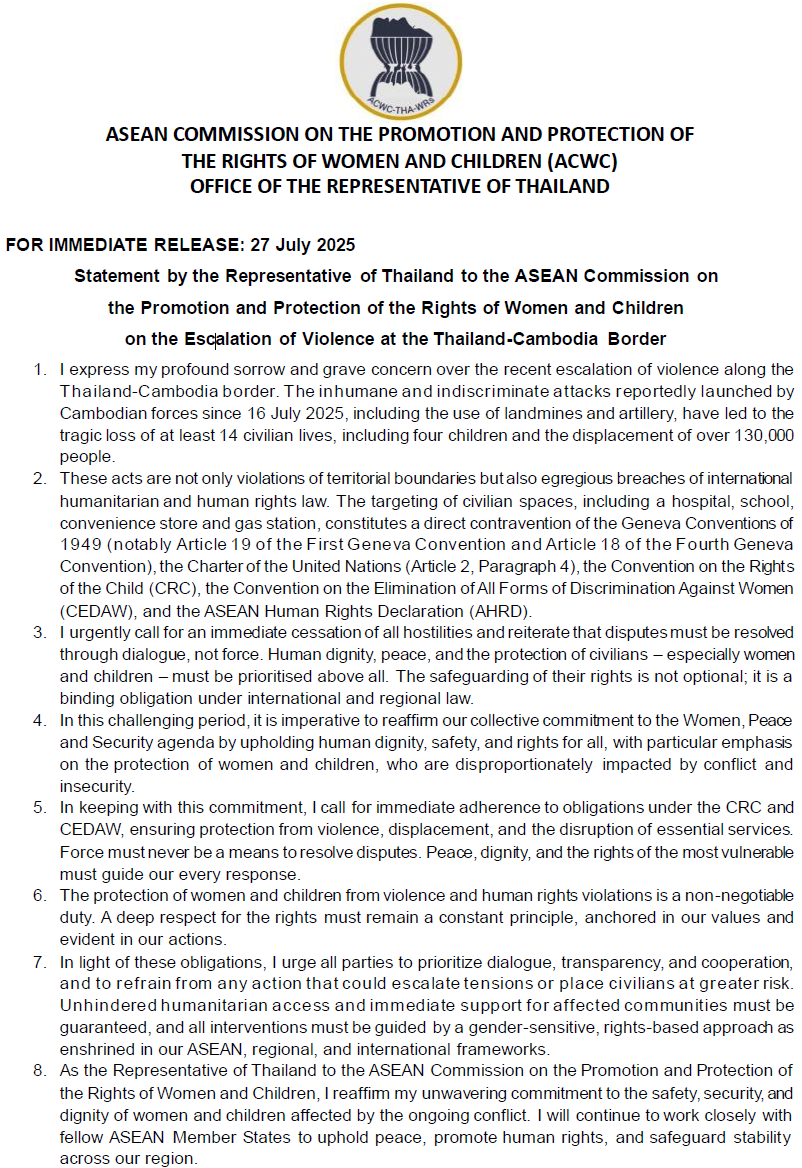
Statement by the Representative of Thailand to the ASEAN Commission on the Promotion and Protection of the Rights of Women and Children on the Escalation of Violence at the Thailand-Cambodia Border

27 July 2025