Our right to free and fair elections

27 March 2025

Universal Declaration of Human Rights – Article 21 (3)

The will of the people shall be the basis of the authority of government; this will shall be expressed in periodic and genuine elections which shall be by universal and equal suffrage and shall be held by secret vote or by equivalent free voting procedures.

General comment adopted by the Human Rights Committee under article 40, paragraph 4, of the International Covenant on Civil and Political Rights.

21. Although the Covenant does not impose any particular electoral system, any system operating in a State party must be compatible with the rights protected by article 25 and must guarantee and give effect to the free expression of the will of the electors. The principle of one person, one vote must apply, and within the framework of each State’s electoral system, the vote of one elector should be equal to the vote of another. The drawing of electoral boundaries and the method of allocating votes should not distort the distribution of voters or discriminate against any group and should not exclude or restrict unreasonably the right of citizens to choose their representatives freely.


[Joint statement] End Lorry Rides, Save Workers’ Lives – Ban them Immediately.

25 July 2023

On the early morning of 18 July 2023, three lorries piled up in an accident on Kranji Expressway. 26 migrant workers who had been riding in them were taken to three different hospitals after sustaining injuries. The very next day, a car collided with a lorry on the KPE. 11 people were taken to the hospital, including 10 migrant workers from the lorry.    

Meanwhile, a mere two weeks ago in Parliament, the Singapore government chose again to reject an adjournment motion by MP Louis Ng to ban the ferrying of workers on lorries. Senior Minister of Transport Amy Khor said the government agreed that it “would be ideal” not to transport workers in lorries, but then went on to repeat the same tired excuses, like how there were “not enough drivers with the necessary license” and “not enough private buses”, as if this were not issues that could have been resolved years ago.

The feeble steps that the government has taken so far – which they claim increases safety on lorries – are grossly inadequate, and a mere distraction from what is plainly the right thing to do – ban ferrying workers on goods lorries. The simple fact remains that good lorries were never designed for human transport – they are not safety tested for human transport, and they violate the dignity of workers, who are exposed to heat stress and heavy rains on the road, always anxious if they will reach their destination safely.

The government’s inaction is further inexcusable given the wide range of transport alternatives that so many other countries rely on to transport workers in similar industries, including high tech-bus scheduling and shuttle services that allow companies to share buses, mini-buses, goods-cum-passenger vehicles, and more.

In 2020, the minimum amount of foreign worker levy the government collected in the industries that ferry workers in lorries would have been at least 1.1. billion dollars. The government can use some of this levy money to support smaller companies that may face start-up challenges with transitioning away from lorries and towards safer transport options.

But when, instead of confronting the issue with the gravity and urgency it requires, the government engages in handwringing and theatrics about “trade-offs” and the “acute pain” to industry that would be caused by banning lorries, we have no choice but to conclude that they simply do not care about workers’ lives, or the real, acute pain that injured workers and grieving families thousands of miles away experience every year because of our unconscionable choices.

Over the years, more and more voices have called for an end to transporting workers in lorries, including rights groups, health and safety experts, MPs, and migrant workers themselves. In a Straits Times article in 2021, NTUC assistant secretary general Melvin Yong  stated that “there is a perfectly viable alternative to transport our migrant workers – in buses, equipped with seat belts”. A people’s petition in 2020 to ban lorries garnered over 40,000 signatories in a single week. It is abundantly clear what the people want – it weighs heavily on ordinary Singaporeans’ conscience that we put workers at risk every day, while we travel safely in buses, taxis, cars and the MRT. Does it not weigh on the government’s?

Between 2011 and 2020 alone, 58 workers on-board lorries died in road traffic accidents, and 4765 were injured.     

How many more workers will be injured while the government continues to have “difficult conversations”? How many more years must we mourn these completely preventable deaths? What will it take before the dignity and the basic right to safe transportation is restored to our migrant brothers?   

If our Ministers would not put their children in the backs of lorries, then they have no business putting other people’s children – our migrant brothers – in the backs of lorries.

Migrant workers’ lives matter. And they certainly matter more than their bosses’ profits.

We, the undersigned, call on the government to:

a) immediately ban the ferrying of migrant workers on lorries;

b) set up an MOT initiative to support companies that may face challenges with transitioning towards safer modes of transport

#HumansNotCargo


MARUAH’s statement on the Singapore Government’s intention to repeal Section 377A of the Penal Code

21 August 2022

We welcome Singapore’s repeal of Section 377A of the Penal Code as announced by Prime Minister Lee Hsien Loong at the National Day Rally 2022.

We appreciate that the Singapore Government has recognised that societal attitudes towards gay people have changed over time.

Section 377A came into force in 1938 after being adapted from a 19th century Indian penal code. This was aimed at targeting rampant male prostitution during the British colonial rule which was many years ago. India repealed that law in 2018. It is clear that the environment has changed since the 1930s and the legislation must change to keep up with the times.

Section 377A has been seen as a symbol of discrimination and stigma against LGBT people here in Singapore. Such discrimination undermines the human rights principles in the Universal Declaration of Human Rights. Article 1 of the UDHR opens with ‘all human beings are born free and equal in dignity and rights.’

While Singapore has taken the first step towards protecting the human rights of LGBT people by repealing Section 377A, this is just the start of a long journey towards strengthening human rights protection for LGBT. We hope that the Singapore Government will go from strength to strength in this respect from hereon.

This is a step in Making Equality Meaningful.

Issued by MARUAH Singapore

21 August 2022


About MARUAH Singapore

We are a Singapore human rights NGO.

MARUAH means Dignity in Malay, Singapore’s national language. Human rights are all about maintaining, restoring and reclaiming one’s dignity at the individual, regional and international level.

We seek to:

  • promote and raise awareness, knowledge and understanding of human rights and human rights and related issues at the national, regional and international levels, in Singapore, ASEAN and elsewhere
  • provide a civil society perspective on human rights and related issues at the national, regional, and international levels
  • advocate for and work towards the respect for and upholding of human rights in accordance with international and other norms
  • foster national, regional, and international co-ordination and development of all activities in relation to human rights and related issues facilitate the education, participation and
  • engagement of persons, groups and organisations in Singapore with respect to human rights and related issues.

MARUAH is also the Singapore focal point for the Working Group for an ASEAN Human Rights Mechanism. The Working Group has national representatives from all of the founding Member States of ASEAN, namely Indonesia, Malaysia, the Philippines, Singapore, and Thailand.

The Working Group is an NGO officially recognised in the ASEAN Charter as a stakeholder in ASEAN.

maruahsg@gmail.com

www.maruah.org


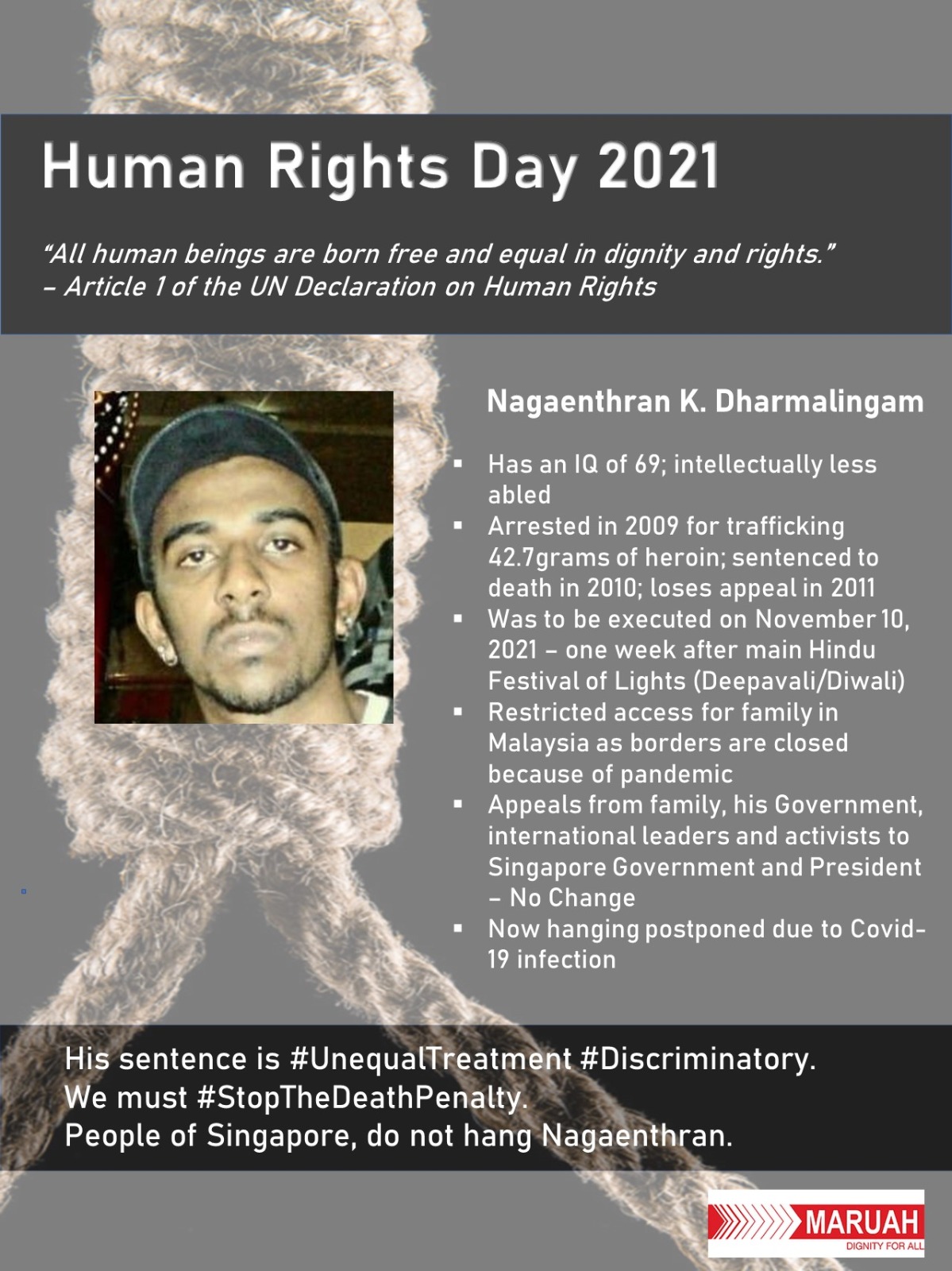
Human Rights Day 2021 – “All human beings are born free and equal in dignity and rights”

10 December 2021

[CNBC] Nobel Peace Prize goes to journalists Maria Ressa, Dmitry Muratov for work on freedom of expression

10 October 2021

https://www.cnbc.com/2021/10/08/2021-nobel-peace-prize-goes-to-maria-ressa-dmitry-muratov.html

PUBLISHED FRI, OCT 8 2021 5:05 AM EDT | UPDATED FRI, OCT 8 2021 10:46 AM EDT

Chloe Taylor

  • Maria Ressa is founder, CEO and executive editor of Rappler, an online news outlet covering the policies and actions of President Rodrigo Duterte’s regime in the Philippines.
  • Dmitry Muratov is editor-in-chief of Novaya Gazeta, a Russian newspaper that publishes critical coverage of the Kremlin.

The 2021 Nobel Peace Prize has been awarded to journalists Maria Ressa and Dmitry Muratov for their efforts to safeguard freedom of expression.

The Nobel committee praised Ressa and Muratov for “their courageous fight for freedom of expression in the Philippines and Russia.”

“They are representatives of all journalists who stand up for this ideal in a world in which democracy and freedom of the press face increasingly adverse conditions,” it said in a press release following the announcement Friday.

Ressa is founder, CEO and executive editor of Rappler, an online news outlet covering the policies and actions of President Rodrigo Duterte’s regime in the Philippines.

The Nobel committee said she “uses freedom of expression to expose abuse of power, use of violence and growing authoritarianism in her native country, the Philippines.”

Muratov is editor-in-chief of Novaya Gazeta, a Russian newspaper that publishes critical coverage of the Kremlin. Novaya Gazeta, co-founded by Muratov in 1993, is renowned for in-depth exposes of power abuses, human rights abuses and corruption under the Russian regime.

Both Ressa and Muratov have faced attempts by their respective governments to silence their publications.

Ressa and Rappler

In November 2018, Filipino authorities accused Ressa and Rappler of tax evasion, claiming the government had enough evidence to indict her.

Authorities had claimed that year that foreign investment into Rappler amounted to prohibited foreign control of a media company, an accusation denied by the organization. In 2019, the Philippines’ Court of Appeals rejected Rappler’s appeal against the claims.

Rappler was banned from covering official presidential events in 2018, with a presidential spokesperson saying Duterte had “lost trust” in the publication.

Rappler continues to operate, with Ressa telling the Committee to Protect Journalists in 2018 that the government’s action against her website was “a politicized decision aimed at stifling critical coverage.” 

Muratov and Novaya Gazeta

Meanwhile, Novaya Gazeta was praised by the Nobel committee on Friday for its coverage of a range of topics, including police violence, unlawful arrests, electoral fraud and “troll factories,” as well as the use of Russian military forces both within and outside Russia. It added that six of its journalists have been murdered for carrying out their work, and the publication has been met with harassment, threats and violence.

“Despite the killings and threats, editor-in-chief Muratov has refused to abandon the newspaper’s independent policy,” the Nobel committee said. “He has consistently defended the right of journalists to write anything they want about whatever they want, as long as they comply with the professional and ethical standards of journalism.”

Kremlin response

In response, Kremlin spokesman Dmitry Peskov told reporters on Friday that the Russian government congratulated Muratov for winning the Nobel prize.

“He persistently works in accordance with his own ideals, he is devoted to them, he is talented, he is brave,” he said, according to Reuters.

The Nobel committee said that the peace prize was awarded to Ressa and Muratov to reflect the importance of freedom of expression and information.

“Free, independent and fact-based journalism serves to protect against abuse of power, lies and war propaganda,” it said. “These rights are crucial prerequisites for democracy and protect against war and conflict. The award of the Nobel Peace Prize to Maria Ressa and Dmitry Muratov is intended to underscore the importance of protecting and defending these fundamental rights.”

The Nobel Peace Prize, which includes 10 million Swedish krona ($1.14 million), will be awarded to Ressa and Muratov at a ceremony in Oslo, Norway, on Dec. 10.

There were 329 nominees for the 2021 Nobel Peace Prize, 234 of which were individuals and 95 were organizations.

Neither the names of the nominators or the nominees are disclosed until 50 years after the prize is awarded. Only those who meet strict criteria — such as members of the International Court of Justice or Nobel Peace Prize laureates — are permitted to submit nominations for the Nobel Peace Prize.

The 2021 prize had the third-highest number of nominees ever.


[TODAY] Beware of collateral damage of Fica

30 September 2021

Published SEPTEMBER 29, 2021

Earlier this month, the Government tabled a Bill to enact the Foreign Interference (Countermeasures) Act (Fica).

The legislation, if passed, will provide the Government with the powers to act against foreign interference that comes in the forms of hostile information campaigns and local proxies by foreign entities.

The Bill is underscored by the recognition that foreign interference takes place in both online and offline settings.

The swathe of provisions proposed will provide the Government, specifically the Minister for Home Affairs, with different mechanisms to prevent, detect and disrupt actions by foreign actors who interfere with domestic politics through influence operations.

The directives will be issued to social media companies, electronic services such as instant messaging apps and Internet access providers, and individuals who own or manage websites and blogs.

Given the rise of influence operations — also known as cyber-enabled foreign interference — globally, this Bill does not come as a surprise.

However, while Fica upgrades the Government’s arsenal to counter foreign interference in a digitalised age, it should not do so at the expense of people’s trust in the Government and diminish Singapore’s position as a global hub.

FIGHTING AN EVOLVING THREAT

Tabled two years after the passing of the Protection from Online Falsehoods and Manipulation Act (Pofma), some might wonder what took Singapore so long to legislate against influence operations, given the prevalence of the problem in other countries.

In the past few years, countries such as Australia, Canada and the United States have introduced or passed bills to curtail foreign interference in elections and infrastructures.

The rapidly evolving nature of influence operations — in terms of the who, how and why — renders existing laws such as Pofma and the Political Donations Act toothless in countering hostile foreign actors.

There is a tendency for people to think of foreign powers as the main perpetrators of foreign influence.

The trend is evident from actions that have been taken by social media companies like Facebook, Twitter and Google (YouTube) to eradicate inauthentic behaviour originating from Russia, Iran, China and Turkey in the past few years.

However, hostile actors are not limited to foreign governments.

Facebook recently shared that most of the covert influence operations in Asia-Pacific are domestic. Research conducted by the Australian Strategic Policy Institute uncovered “apolitical disinformation entrepreneurs” as masterminds.

The toolbox used by perpetrators of influence operations has also expanded.

While the “basic” and more crude forms of tactics, such as bots and fake accounts, are still being used, more covert techniques such as buzz accounts and pop culture fan communities are emerging.

Furthermore, hostile actors are often very adept at mixing and matching tactics, combining them to achieve devastating consequences.

PROTECTING PUBLIC TRUST AND GLOBAL HUB STATUS

To detect, disrupt and stop hostile information campaigns, the Bill includes a wide range of directives.

These include directing social media platforms to disclose information even before the content is published, requiring a person or an Internet intermediary to stop communicating hostile information campaign contents, and requiring services and platforms to restrict the dissemination of such additional content.

Internet service providers can also be ordered to block access to content.

Since the first reading of the Fica Bill, concerns have been raised by different quarters pertaining to the overly broad and expansive definitions of foreign interference and what constitutes political activities.

A petition against Fica which calls for more public consultation via a multi-party parliamentary Select Committee has also been launched.

A provision that merits special discussion is the Technical Assistance Direction that will allow the Government to act on an anticipatory basis.

Research on rumours and conspiracy theories found that the inoculation strategy — exposing individuals to fallacies to prepare them — has been shown to heighten people’s vigilance and scepticism towards false information.

While this directive will help the Government prevent the slow drip effect of influence operations and make a pre-emptive strike as soon as it is aware of suspicious activities, there could be concerns about its opacity and potential overreach.

According to the Bill, a “Technical Assistance Direction can be issued if the Minister suspects that there are preparations or plans to undertake an online communication activity in Singapore by or on behalf of a foreign principal, and the Minister is of the opinion that it is in the public interest to issue the direction”.

The ongoing tussle between the Indian government and WhatsApp over a new law that requires the platform to identify the “first originator of information” when the authorities demand it highlights the potential pushback.

While the Indian government emphasises that the law will only be used to unmask people credibly accused of wrongdoing, WhatsApp has said that the law would require it to break encryption for message receivers as well as message originators.

This will potentially breach privacy protections on the platform.

Fica should specify the situations and the purposes that warrant the issuance of such a direction, or other directions for the matter.

This will help put the public’s mind at ease and promote cooperation from tech platforms.

At the international level, the Government needs to consider the potential effects Fica might have on Singapore as an international hub as well as criticisms about the lack of clarity on what “collaboration” entails.

Part of the wonder of cyberspace is its transboundary nature which makes collaborations on an unprecedented scale possible.

It has spurred the growth of the digital economy, sparked entrepreneurship, advanced academic collaboration and scholarship, and strengthened political alliances.

For example, the free-flowing exchange of ideas and resources form the backbone of the global climate movement.

The movement sparked off the people’s climate march, industry-wide climate activism efforts in different countries as well as grassroots campaigns.

While one cannot establish causation, the sharp gain in the momentum of transnational collaboration could have contributed to the energised global action on climate change.

Therefore, the definition of foreign interference and its measurements would have to be sharp and clear so as not to diminish Singapore’s position as a node in the global network of collaboration and creation.

Since the first reading of the Fica Bill, legal practitioners, activists and academics have raised concerns and offered suggestions on how to refine the Bill.

The Government should take heed and consider how it can strengthen the proposed Act so that it can keep foreign interference at bay while safeguarding people’s trust in it and Singapore’s hub status.

ABOUT THE AUTHOR:

Dr Carol Soon is a senior research fellow at the Institute of Policy Studies where she heads the Society and Culture department.

Read more at https://www.todayonline.com/commentary/beware-collateral-damage-fica


[TODAY] Draft foreign interference law: Workers’ Party proposes changes to prevent abuse and enhance oversight over powers

30 September 2021

Published SEPTEMBER 29, 2021

  • A draft law to protect Singapore from foreign interference gives the Government power to deal with such acts
  • The Workers’ Party said it believes in countering foreign threats, but disagrees on the Bill’s wording 
  • The party’s parliamentarians filed a notice to amend the Bill
  • One proposed change is to exempt activities where foreign individuals or publications comment on Singapore politics in an “open, transparent and attributable way”

Read more at https://www.todayonline.com/singapore/workers-party-disagrees-proposed-foreign-interference-law-files-changes-prevent-abuse-and-enhance-oversight-powers