[Repost] Myanmar Six Months After The Coup: ’We Only Have Ourselves’

2 August 2021

https://www.reportingasean.net/myanmar-six-months-after-the-coup-we-only-have-ourselves/

YANGON/BANGKOK | 29 Jul 2021

You pause before picking up a call from an unknown phone number. You’re ready to change plans in a second, if explosions occur in your area or soldiers show up. When going out, you may delete the Facebook app from your phone, lest you get stopped by soldiers wanting to check your posts. If you have COVID-19 symptoms, you look for an antigen test kit before trying to get an RT-PCR test or go to hospital.

These are among the survival skills that many people in Myanmar are using these days, six months after the February military coup. Hypervigilance has become routine.

Anxiety is never too far away as they make their way through layer upon layer of crises – the political crisis sparked by the military’s ouster of the elected government on Feb 1, the economy’s breakdown amid rising poverty, and a third COVID-19 wave surging in the wake of a collapsed system for delivering public services.

“I always feel insecure wherever I go,” said one resident of Yangon, the commercial capital of this country of over 57 million people. “I dare not bring my phone because I’m scared when I hear that security forces are checking mobile phones, and they also take money. So I never take much money if I go out.”

“I’m also insecure at home because they (soldiers) can check any time and they take whatever they want,” she added.

“There are lots of things to care about when you go outside, not only the COVID third wave but also explosions, people in uniform,” agreed one artist. “Our daily lives are different compared to before, due to COVID and the coup – double trouble – in terms of work security, safety, unemployment.”

Locals say the price of some goods and medicines, food items have risen by 20 to 40%. Worries abound about the latest harvest and future ones, because farmers (80% are small farmers) depend on credit from the state and fertiliser prices have shot up by 50%. Fuel prices are reported to have nearly doubled since February.

Power outages are worrisome amid a pandemic that sees daily new cases at 4,000-5,000 and over 300 deaths daily. Cases are under-reported as testing is severely limited, and infectivity is very high: 37% of COVID-19 tests were positive, as of Jul 22. Only Mexico’s 38.1% is higher in the One World in Data global tracker.

Cash is a precious commodity, one that can be received after shelling out 6-10% commission fees to brokers and mobile apps. “Wasting our money in these horrible times” is how the owner of a small business puts it. Access to cash has become better in some cases, but long queues are common and limits on cash withdrawals remain.

Even as the pandemic rages – and has affected its ranks – Myanmar’s military has continued to arrest anti-coup protesters, those who have stayed with the civil disobedience movement that started right after the coup.

“Now I’m afraid of going outside and I dare not pick up calls from unknown people,” said one schoolteacher who continues to stay away from her work with the government. “I’m also afraid to answer calls because some officers in our department threaten and force (us) to go back to work. And I’m always afraid of the informers and spies of the military.”

For many, there is too much of the military’s presence in their lives, but too little, or none, of public governance in this catastrophe unfolding in their midst.“It is estimated that up to 90% of national government activity has ceased,” the UN World Food Programme (WFP) said in its June report on the economic fallout and food insecurity in Myanmar since the coup.

As they have learned to do under past periods of military rule, Myanmar’s people are turning to one another, forming networks of their own, to survive.

Communities have been arranging donation drives for those who have lost relatives to the pandemic or are taking care of the sick, and others who are in self-isolation. Volunteers are still driving patients to hospitals, which have run out of beds. Online groups help track supplies of medical oxygen amid the ongoing scarcity. Many share what income they make with the jobless.

DISASTER OF EPIC PROPORTIONS

But still tougher times lie ahead in what Myanmar historian Thant Myint-U calls an “economic and humanitarian disaster of epic proportions”. The economy is expected to contract by 18% in 2021, said the World Bank’s ‘Myanmar Economic Monitor’ in late July. At nearly double the 10% contraction projected in March, it is Southeast Asia’s largest such plunge. 

“As the third wave of COVID-19 outbreak struck and strict containment measures were reimposed, an even worse scenario could unfold, with poverty levels in 2022 rising to well over twice as high as they were in 2019 (22.4% in 2018/19), wiping out gains of over a decade of poverty reduction progress,” the World Bank said.

The same report said one million jobs could be lost in 2021 out of a labour force of some 25 million – and this figure excludes workers in the huge informal economy. Already, the International Labour Organization says, 3.1 million full-time equivalent jobs have been lost due to COVID-19 and containment measures.

Migrant workers and those overseas are finding it harder, and often more expensive, to send money into Myanmar, through informal channels. More than 10 million people cite remittances as an income source, says the WFP, and 40% of remittances come from abroad.

Half of households have reported cutting consumption, including food, the World Bank said. Up to 3.4 million more people are at risk of food insecurity, on top of the 2.8 million who were not getting enough food before the coup, the WFP said in its June situation report

Many pin hopes on the National Unity Government that was formed on Apr 16. With 16 ministers apart from a prime minister, the government-in-exile reports on meetings with foreign diplomats and parliamentarians, sends officials to speak at webinars. But it is struggling to gain international recognition and faces challenges around having its decisions actually carried out inside the country.

As COVID-19 took a turn for the worse in June, its health ministry opened a telemedicine channel on Facebook and formed a national committee with the health organizations of several ethnic groups, but a mechanism for a pandemic response is unclear.

“I would like to appeal to all the people of Myanmar to continue the fight bravely with the spirit of victory in mind,” said Mahn Wann Khaing Thann, NUG prime minister. “When we succeed, our government will repay and work for the establishment of a Federal Democratic Union that all people aspire to.”

THE PRESENT MOMENT

But it is the here and now that people live in – and like the COVID-19 pandemic, an end to the crisis is not within sight.

“We only have ourselves,” said a Yangon resident. “We have to take care, as much as we can, of food, medicine, oxygen, and other basic needs. The authorities can’t do anything. Unfortunately, it’s like we are waiting for the day we die.”

“I can’t sleep well at night,” confided another local. “Most of my family members are jobless right now. Even though I save money, not spending spend much money, I’m afraid that one day, I won’t be able to make it.”

(*This feature is part of the ‘Lens Southeast Asia’ series of Reporting ASEAN, supported by the Sasakawa Peace Foundation.)

(END/Reporting ASEAN/Edited by J Son)


[Repost] Latest update on Myanmar by ANFREL

27 July 2021

[Repost] ANFREL Monthly Brief on Countries Under Restrictive Management – Series #3

6 July 2021

Bangladesh, Cambodia, Myanmar & Hong Kong

June 2021

Introduction
ANFREL started publishing the monthly brief on the countries under a restrictive environment in April 2021 to provide an insight into the human rights and democracy situation in these countries. As usual, they will cover issues related to elections and civil and political rights in Bangladesh, Cambodia, Myanmar and Hong Kong.

To read the full brief, please click here.


[MARUAH] International Criminal Court Review Process in 2021 – Assessing and implementing the experts’ recommendations

13 May 2021

The ICC Review Mechanism

In early 2021 States Parties appointed Ambassador Paul Van Den Ijssel (Netherlands), based in The Hague, and Ambassador Michael Kanu (Sierra Leone), based in New York, as the State party representatives heading the ICC Review Mechanism.  States parties also appointed three regional country focal points: Bangladesh, Chile, and Poland.

The Mechanism is mandated to:

  • Submit a proposal for the categorization of the IER recommendations by 30 April, to the ASP Bureau.
  • Submit a proposed action plan to the Bureau by 30 June. The proposed action plan should:

–   Allocate the IER recommendations to the relevant court organs and ASP thematic focal points, facilitations, and working groups for their considerations. The Mechanism is expected to deal with the rest of the recommendations;

–   Prioritize the IER recommendations; and

–   Set deadlines for the consideration of the IER recommendations.

  • Regularly brief States Parties on its progress and submit a report on the review process to the ASP ahead of the 20th session of the Assembly of States Parties.

Proposal for the categorization of the IER recommendations

On 29 April 2021, the ICC Review Mechanism submitted its “Proposal for the categorization of the IER recommendations and remaining review issues” to the ASP Bureau, together with an Introductory note.

The Review Mechanism also published the Comments on categorization submitted by:


Background

A review of the ICC’s performance for a strengthened Court and Rome Statute System

In 2018 the Rome Statute celebrated its 20th anniversary. States Parties, Court officials, civil society and other key stakeholders reflected then on the achievements and the challenges of the ICC and the Rome Statute system. The ICC’s own shortcomings had become evident: limited success of the Prosecution in the courtroom, with a low conviction rate, taking into account the number of cases investigated; limited impact in the countries concerned; lack of an adequate level of cooperation; among others.That triggered discussions on steps to strengthen the Courtand the Rome Statute system.

In 2019, this led to the launch of a review of the functioning of the court’s and the Rome Statute system.

For more information, please visit https://www.coalitionfortheicc.org/review-icc-and-rome-statute-system.


38th Session of the Universal Periodic Review – Review of Singapore [Wed 12 May 3 – 6.30pm (SG time)]

9 May 2021

The Review of Singapore will be broadcast live at http://webtv.un.org/.

Please click here to add a reminder to watch the review live on UN Web TV.


What is the Universal Periodic Review?

The Universal Periodic Review (UPR) is a unique process which involves a review of the human rights records of all UN Member States. The UPR is a State-driven process, under the auspices of the Human Rights Council, which provides the opportunity for each State to declare what actions they have taken to improve the human rights situations in their countries and to fulfil their human rights obligations. 

As one of the main features of the Council, the UPR is designed to ensure equal treatment for every country when their human rights situations are assessed. The ultimate aim of this mechanism is to improve the human rights situation in all countries and address human rights violations wherever they occur. Currently, no other universal mechanism of this kind exists.

Please click here for more information on the UPR.


[Repost] 2021 First Quarter News Updates from RWG

6 May 2021

Statement in Solidarity for the Restoration of Democracy and Justice in Myanmar

20 April 2021

MARUAH wishes to congratulate ASEAN for organising an ASEAN Special Summit Meeting on the 24th of April 2021 to discuss Myanmar and find a collective path to restore peace, non-violence, and democracy in the country. We state that this Special Summit is crucially important to the people in Myanmar and for ASEAN as a regional body of 10 member states. We also appreciate Foreign Minister Vivian Balakrishnan for the discussions he had with ASEAN member states of Brunei, Indonesia[1] and Malaysia which have also been working towards this special Summit. We note that call made by ASEAN’s foreign ministers for a halt to the escalating violence and dialogue to end the crisis.[2]

But we need to underscore the importance of having a legitimate representation from Myanmar at the Special Summit meeting, as it is also part of ASEAN’s responsibility to the people in Myanmar and in ASEAN. We are of the view that this dialogue effort to negotiate for an agreement towards non-violence, peace and democracy would be derailed if Myanmar’s junta leader, General Min Aung Hlaing, is the sole representative for Myanmar. We note with concern the announcement made by Thailand that General Min Aung Hlaing is set to attend the ASEAN Special Summit meeting.[3]

The Tatmadaw’s leader, General Min Aung Hlaing, is the key person, responsible for the: coup; denunciation of last year’s legitimate elections where the National League for Democracy (NLD) had won decisively and fairly; ongoing violent assaults on people, continued air raids targeting ethnic groups and the severe restrictions and censorship imposed on the people. The net result is one that shows Myanmar’s people fleeing to other countries, an internal humanitarian crisis, of more than 700 civilians, including 50 children,[4] having been killed by Myanmar’s security forces since February 1st and the possibility of a civil war as 10 of Myanmar’s ethnic armed groups [5]have recently thrown their support behind the movement for democracy, peace and free and fair elections.

Hence, we state that recognising Gen Min Aung Hlaing as Myanmar’s political leader to be the sole representative at the Special Summit, would be a travesty to the rule of law, the principles spelt out in the ASEAN Charter and a gross injustice, a betrayal, to the people in Myanmar, many of whom are willing to die for their country.

We ask instead that the Special Summit asks for representatives from: the National Unity Government (NUG) that has been formed;[6] the Committee Representing Pyidaungsu Hluttaw (CRPH) which is a body formed of elected lawmakers from Myanmar’s ousted civilian government; and the tatmawdaw. This way it also anchors ASEAN as the neutral mediator focused on key political players being at the dialogues. It is also an opportunity for ASEAN to establish itself as the regional body that endorses peace, harmony and democracy in the region as also endorsed in the preamble of the 1976 Treaty of the Amity And Cooperation in Southeast Asia.[7]

In summary, we urge that this ASEAN Special Summit does:

  • include representatives from Myanmar’s National Unity Government (NUG) and Committee Representing Pyidaungsu Hluttaw (CRPH)
  • explicitly state that General Min Aung Hlaing is attending as a representative of the Tatmadaw, not as leader of Myanmar
  • make a clear stand that ASEAN is functioning by the Responsibility to Protect principles and its principles for peace, democracy, and rule of law.

Statement issued by MARUAH Secretariat
20th April 2021


[1] https://www.straitstimes.com/asia/se-asia/vivian-balakrishnan-meets-indonesian-counterpart-retno-marsudi-in-jakarta

[2] https://www.rfa.org/english/news/myanmar/asean-coup-03022021134500.html

[3] https://www.straitstimes.com/asia/se-asia/myanmars-junta-leader-confirmed-to-attend-asean-meeting-thai-foreign-minister

[4] https://www.straitstimes.com/asia/se-asia/myanmar-activists-vow-week-of-protests-during-new-year-holidays

[5] https://www.straitstimes.com/asia/se-asia/myanmar-rebel-groups-back-anti-coup-protests-condemn-junta-crackdown

[6] https://www.irrawaddy.com/news/burma/whos-myanmars-national-unity-government.html

[7] “CONVINCED that the settlement of differences or disputes between their countries should be regulated by rational, effective and sufficiently flexible procedures, avoiding negative attitudes which might endanger or hinder cooperation; BELIEVING in the need for cooperation with all peace-loving nations, both within and outside Southeast Asia, in the furtherance of world peace, stability and harmony;”. https://asean.org/treaty-amity-cooperation-southeast-asia-indonesia-24-february-1976/


[Repost] ANFREL’s Monthly Brief on Countries under Restrictive Environment

13 April 2021

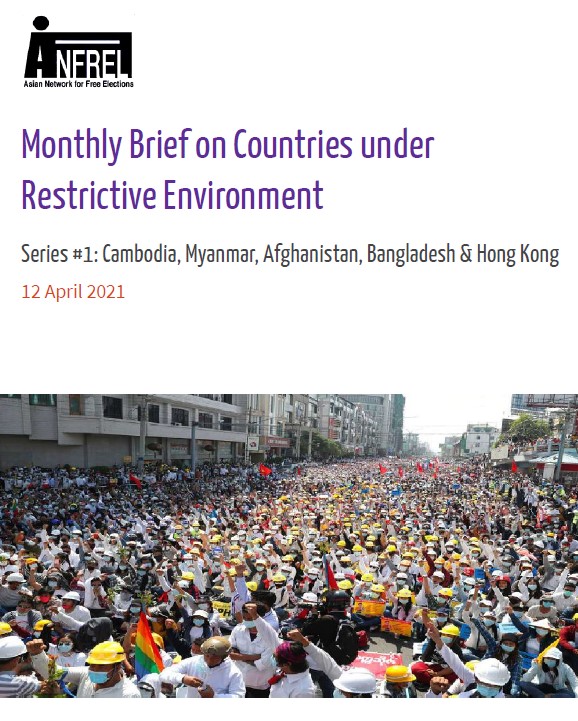
ANFREL will start publishing this brief to provide an insight into the human rights and democracy situation in the countries facing democratic regression. In this series, they have covered Cambodia, Myanmar, Afghanistan, Bangladesh and Hong Kong. Please click on the image below to access the full brief.


In Solidarity for the Restoration of Democracy in Myanmar: A Call to ASEAN

8 April 2021

8th April 2021

By: Tan Yi Han*

Seven year old Khin Myo Chit was sitting on her father’s lap in her home when soldiers killed her. Thinzar Hein was a nursing student who was treating injured protestors at protest sites when she was shot in the head by soldiers. Sixteen year old Kyaw Min Latt was cycling with two others when soldiers in a passing vehicle shot him. 

More than 500 civilians have been killed since the Myanmar military, the Tatmadaw, seized power on 1 February 2021. The highest toll – 141 lost their lives in one day of 27 March. The escalating violence represents not only a humanitarian crisis but threatens regional peace, stability and prosperity. 

ASEAN cannot afford to turn a blind eye to this tragedy. The leaders of ASEAN must act decisively to help Myanmar return peacefully to a democratically-elected civilian government. 

ASEAN has taken encouraging first steps. A statement conveyed by ASEAN Chair, Brunei, summarising the meeting of ASEAN foreign ministers, urged for a “peaceful solution” to the crisis. Also deserving of applause are individual statements issued by Malaysia, Indonesia, the Philippines and Singapore urging Myanmar’s military rulers to free Suu Kyi and other political leaders who have been arrested. 

Thailand has called for ASEAN to adopt a “collective stand” on Myanmar. That could happen via the high-level ASEAN meeting of Southeast-Asian leaders proposed by Indonesian President Joko Widodo. It is encouraging that Singapore actively supports such a proposal. as stated by the Dr Vivian Balakrishnan, Minister of Foreign Affairs, 

The Myanmar general election on 8 November 2020, won decisively by the National League for Democracy (NLD), had been praised by election monitors for being a peaceful process and that it was free of major irregularities. The Tatmadaw has a right to raise concerns on the election.  In fact the Union Solidarity Development Party  had filed their complaints in court, making it unnecessary an illegal to resort to violence. The coup and subsequent killings call into question the Tatmadaw’s claim to be defending the Constitution and the will of the people. 

The anti-coup movement continues to grow despite the brutal crackdown, suggesting that the coup is widely condemned by the people of Myanmar. Meanwhile, 10 of Myanmar’s ethnic armed groups have thrown their support behind the anti-coup movement. All signs point to a protracted conflict and further escalation of violence.

The peaceful transition to democracy in 2015 had led to a friendly environment for economic investments, including from fellow ASEAN countries. In fact, Singapore has been the largest investor in the country, with US$24.1 billion in approved foreign capital. The coup is therefore not only disastrous for the country’s economic recovery, but also for the entire region’s economy.

Many from ethnic groups and villagers are fleeing the violence, becoming refugees. What is often forgotten is the pandemic and that Covid-19 is still rife. The Chinese city of Ruili near the Myanmar border has already seen an outbreak of Covid.

The gestures made by ASEAN and some of the countries in ASEAN cannot remain as just the spoken word. In fact, there has been success when ASEAN’s engagement effort, among other efforts, helped to pave the way towards Myanmar’s political reforms under Prime Minister (and later President) Thein Sein, leading eventually, to a peaceful transition of power to a democratically-elected civilian-led government in 2015. 

ASEAN must endeavour to use its unique position and relationship with Myanmar to positively influence the Tatmadaw and mediate between the key political stakeholders: the Tatmadaw, Aung San Suu Kyi and the Committee Representing Pyidaungsu Hluttaw, and representatives from the ethnic minorities. 

For negotiations to be successful, however, all parties must see it as the best way forward. That means that ASEAN must make a clear stand that while the Tatmadaw is a key stakeholder in Myanmar, it does not represent the people nor the government of Myanmar. Only decisions collectively agreed by Myanmar’s key political stakeholders should be recognised. 

ASEAN is the best hope for the people of Myanmar. I urge the leaders of ASEAN to:

  • Hold as soon as possible a high-level ASEAN meeting of Southeast-Asian leaders to discuss the Myanmar crisis and adopt a collective stand towards addressing the conflict.
  • Facilitate dialogue between Myanmar’s key political stakeholders;
  • Make a clear stand the Tatmadaw does not represent the people or government of Myanmar, and only collective decisions via peaceful negotiations will be recognised.

ASEAN can do it again. It needs to. ASEAN must.

Further References:

https://www.e-ir.info/2012/02/08/asean-and-the-principle-of-non-interference/

https://www.channelnewsasia.com/news/commentary/myanmar-coup-asean-non-interference-vivian-bakakrisnan-singapore-14263056

https://opinion.inquirer.net/138046/asean-must-help-myanmars-return-to-democracy

*Opinion Writer for MARUAH

*Edited & Approved by MARUAH


Joint Declaration of the Southeast Asian People-to-People Region Hall on the Crisis in Myanmar

8 April 2021

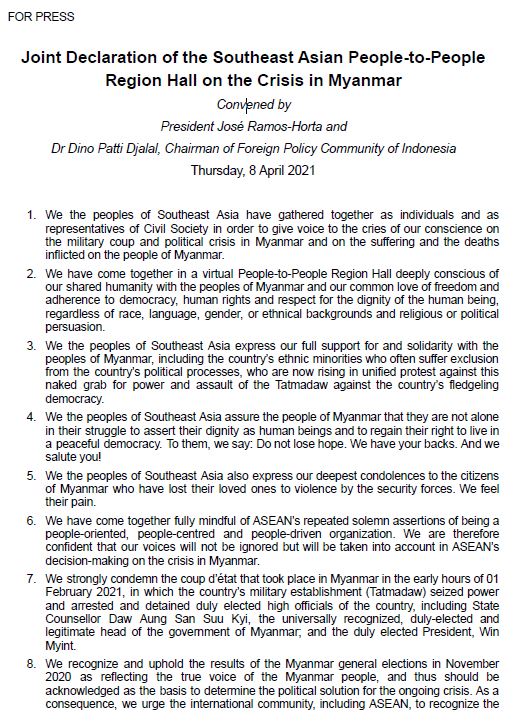
Please click on the screen shot above for the full statement.