On the 11-year anniversary of the enforced disappearance of Lao civil society leader Sombath Somphone, we, the undersigned civil society organizations and individuals, strongly condemn the Lao government’s continued failure to provide necessary information as to his fate and whereabouts and reiterate our calls to the authorities to deliver truth, justice and reparations to his family.
International concerns over Sombath’s case, expressed by international civil society, United Nations (UN) human rights experts, and UN member states on last year’s anniversary of Sombath’s enforced disappearance, have been ignored by the Lao government.
On 25 September 2023, in a submission to the UN Human Rights Committee as part of its follow-up review of Laos under the International Covenant on Civil and Political Rights, the Lao government repeated previous misleading statements and miserably failed to provide any additional information on the steps it said it had taken to find Sombath. The government claimed it “never stopped trying to find the truth” about Sombath’s fate “in order to bring the offender(s) to justice.” In reality, the Lao authorities have continued to disregard Sombath’s wife, Shui Meng Ng, and have not provided her with any updates on her husband’s case since 2017. The government then made the extraordinary assertion that its Task Force’s investigation had been “carried out on the basis of transparency, impartiality and accountability, including the use of modern investigative techniques consistent with international standards by the capable inquiry officials.” It concluded that the case of Sombath needed “more time for investigation” and added that the Task Force was “still active in the investigation” and had “not yet closed the case.”
These government statements are unequivocally false in suggesting any degree of transparency. Existing evidence is clear that the Lao government has been engaged in a continuous cover-up of the facts of Sombath’s case since he was forcibly disappeared in 2012, including providing misleading information about its actions to his family, the Lao public, and the international community, as stated above.
We deplore the unmistakable pattern of inaction, negligence, and obfuscation that various Lao authorities have repeatedly engaged in for more than a decade and we continue to resolutely stand in solidarity with Sombath’s family and all other victims of enforced disappearances in Laos.
We reiterate our calls on the Lao authorities to take real and effective measures to establish the fate or whereabouts of Sombath and all other victims of enforced disappearances in the country, identify the perpetrators of such serious crimes, and provide victims with an effective remedy and full reparations. We also urge the government to immediately ratify without reservations the International Convention for the Protection of all Persons from Enforced Disappearance, which it signed in 2008, and to fully implement it into national law, policies and practices.
As upcoming chair for the Association of Southeast Asian Nations (ASEAN), Laos will be placed in a strategic position to lead the regional efforts to strengthen, promote, and protect human rights. However, its continued failure to act on Sombath’s enforced disappearance sends a message of inadequacy to head the regional bloc and to fulfill ASEAN’s purpose under Article 1(7) of the ASEAN Charter, which is to strengthen democracy, enhance good governance, and the rule of law and to promote and protect human rights and fundamental freedoms.
We will continue to seek justice and accountability for Sombath. Until the truth is found and justice is delivered to his family, we will not stop demanding answers from the Lao government to the same question we have been asking for the past 11 years: “Where is Sombath?”
Background
Sombath Somphone, a pioneer in community-based development and youth empowerment, was last seen at a police checkpoint on a busy street of Vientiane on the evening of 15 December 2012. Footage from a traffic CCTV camera showed that police stopped Sombath’s vehicle at the checkpoint and that, within minutes, unknown individuals forced him into another vehicle and drove him away in the presence of police officers. CCTV footage also showed an unknown individual arriving and driving Sombath’s vehicle away from the city center. In December 2015, Sombath’s family obtained new CCTV footage from the same area and made it public. The video shows Sombath’s car being driven back towards the city by an unknown individual.
On the early morning of 18 July 2023, three lorries piled up in an accident on Kranji Expressway. 26 migrant workers who had been riding in them were taken to three different hospitals after sustaining injuries. The very next day, a car collided with a lorry on the KPE. 11 people were taken to the hospital, including 10 migrant workers from the lorry.
Meanwhile, a mere two weeks ago in Parliament, the Singapore government chose again to reject an adjournment motion by MP Louis Ng to ban the ferrying of workers on lorries. Senior Minister of Transport Amy Khor said the government agreed that it “would be ideal” not to transport workers in lorries, but then went on to repeat the same tired excuses, like how there were “not enough drivers with the necessary license” and “not enough private buses”, as if this were not issues that could have been resolved years ago.
The feeble steps that the government has taken so far – which they claim increases safety on lorries – are grossly inadequate, and a mere distraction from what is plainly the right thing to do – ban ferrying workers on goods lorries. The simple fact remains that good lorries were never designed for human transport – they are not safety tested for human transport, and they violate the dignity of workers, who are exposed to heat stress and heavy rains on the road, always anxious if they will reach their destination safely.
The government’s inaction is further inexcusable given the wide range of transport alternatives that so many other countries rely on to transport workers in similar industries, including high tech-bus scheduling and shuttle services that allow companies to share buses, mini-buses, goods-cum-passenger vehicles, and more.
In 2020, the minimum amount of foreign worker levy the government collected in the industries that ferry workers in lorries would have been at least 1.1. billion dollars. The government can use some of this levy money to support smaller companies that may face start-up challenges with transitioning away from lorries and towards safer transport options.
But when, instead of confronting the issue with the gravity and urgency it requires, the government engages in handwringing and theatrics about “trade-offs” and the “acute pain” to industry that would be caused by banning lorries, we have no choice but to conclude that they simply do not care about workers’ lives, or the real, acute pain that injured workers and grieving families thousands of miles away experience every year because of our unconscionable choices.
Over the years, more and more voices have called for an end to transporting workers in lorries, including rights groups, health and safety experts, MPs, and migrant workers themselves. In a Straits Times article in 2021, NTUC assistant secretary general Melvin Yong stated that “there is a perfectly viable alternative to transport our migrant workers – in buses, equipped with seat belts”. A people’s petition in 2020 to ban lorries garnered over 40,000 signatories in a single week. It is abundantly clear what the people want – it weighs heavily on ordinary Singaporeans’ conscience that we put workers at risk every day, while we travel safely in buses, taxis, cars and the MRT. Does it not weigh on the government’s?
Between 2011 and 2020 alone, 58 workers on-board lorries died in road traffic accidents, and 4765 were injured.
How many more workers will be injured while the government continues to have “difficult conversations”? How many more years must we mourn these completely preventable deaths? What will it take before the dignity and the basic right to safe transportation is restored to our migrant brothers?
If our Ministers would not put their children in the backs of lorries, then they have no business putting other people’s children – our migrant brothers – in the backs of lorries.
Migrant workers’ lives matter. And they certainly matter more than their bosses’ profits.
We, the undersigned, call on the government to: a) immediately ban the ferrying of migrant workers on lorries;
b) set up an MOT initiative to support companies that may face challenges with transitioning towards safer modes of transport
Re: ASEAN’s response to the military coup in Myanmar
As civil society organizations from the ASEAN region, we write to you urging you to use your unique position to influence the situation in Myanmar by taking immediate measures to ensure that the military respects people’s right to peaceful protests and to freedom of expression, that democracy is upheld, and the will of the people respected.
Following the Myanmar military’s illegal seizure of power on 1 February, Commander-in-Chief Senior General Min Aung Hlaing assumed all legislative, executive, and judicial powers under the newly-established State Administrative Council.
A non-violent pro-democracy movement has since grown nationwide, and the Myanmar authorities have responded by cracking down on fundamental freedoms. Hundreds of senior officials from the National League for Democracy (NLD), pro-democracy activists and human rights defenders have been arrested; mobile phone and Internet communications have been heavily restricted; highly repressive legislation, including a draft Cyber Security Bill and revisions to the Penal Code have been adopted; and restrictions on gatherings imposed.
The Myanmar security forces have also increasingly responded with force against peaceful protesters, using live munitions, water cannons and deploying armored vehicles in cities. Given the abuses committed in the past by the Myanmar military under the command of Senior General Min Aung Hlaing, including international crimes against the Rohingya and in other ethnic minority areas, we are seriously concerned about a potentially violent response from the authorities.
We would like to recall to your excellencies the principles of the ASEAN Charter, which includes adhering to the principles of democracy, the rule of law and good governance, as well as the respect for and protection of human rights and fundamental freedoms. We also recall the recent UN Security Council statement supporting and encouraging regional organizations, in particular ASEAN, to address the situation in Myanmar.
We welcome the ASEAN Chairman’s statement on the situation in Myanmar, later echoed by the representatives of Indonesia, Malaysia, Singapore, and Thailand to the ASEAN Intergovernmental Commission on Human Rights (AICHR). In addition, we are encouraged by the calls made by the leaders of Indonesia and Malaysia in seeking a special meeting of ASEAN’s foreign ministers to discuss the situation.
However, we urge you to go further by immediately using all diplomatic leverage at your disposal to ensure that the Myanmar military refrains from using violence and imposing further restrictions on freedom of expression and peaceful assembly, as well as to establish a comprehensive response that secures long-term democratic and human rights gains.
Recent developments in Myanmar are disastrous for its people, as well as the region as a whole. They create the potential for thousands of people to flee violence and persecution, as well as a volatile regional environment.
We firmly believe that it is not only crucial, but also in ASEAN’s best interests, to take a strong stance on these urgent and worrying developments. Failure to do so risks further damaging ASEAN’s reputation as an effective regional body that can meaningfully contribute to a strong and viable community of nations.
We draw strength from ASEAN’s productive engagements with Myanmar’s military in the past, most notably in response to the Cyclone Nargis crisis of 2008. We urge ASEAN to recognize that it can be equally helpful to the people of Myanmar today as it was then.
This is the perfect opportunity for ASEAN to demonstrate its political leverage and push for positive developments.
With this in mind, we urge ASEAN to:
Immediately hold an urgent special meeting to call on the Myanmar military to adhere to the principles of the ASEAN Charter, including the principles of democracy, the rule of law, good governance, and respect for the protection of human rights and fundamental freedoms by:
Immediately and unconditionally releasing all those currently arbitrarily detained;
Refraining from using violence against protesters and respecting people’s right to privacy and information, freedom of expression, association and peaceful assembly;
Allowing parliament to resume, and elected MPs to fulfil their mandate without impediment;
Immediately restoring full access to the Internet and all forms of communications; and
Immediately allowing all humanitarian aid and health support to resume unimpeded.
Collaborate with the UN Security Council and UN Human Rights Council to immediately send a delegation to the country to monitor the situation and help negotiate a democratic and human rights-based solution.
Use your position in UN fora, in particular at the UN Security Council and Human Rights Council, to support enhanced monitoring and reporting of the unfolding human rights crisis in Myanmar.
Impose targeted financial sanctions on the military as an institution, including its businesses and its associates in a manner that respects human rights and gives due consideration to any negative socio-economic impact on the ordinary civilian population, as recommended by the UN Fact-Finding Mission on Myanmar;
Impose an embargo on the transfer or sale of military arms and equipment to Myanmar; and
Use all diplomatic leverage and establish a comprehensive response to ensure long-term democratic and human rights change in the country, including by ensuring that:
The Myanmar armed forces end all violations of international humanitarian and human rights law in ethnic minority and ceasefire areas, and that all civilians are protected;
Myanmar guarantees the safe, voluntary and dignified return of displaced communities, including the Rohingya, by lifting all arbitrary and discriminatory restrictions on their access to citizenship, freedom of movement, and access to healthcare, education and livelihood opportunities;
Myanmar fully cooperates with the IIMM and complies with the provisional measures ordered by the ICJ; and
Institutional and constitutional changes are adopted that would bring the military under civilian control and ensure accountability for human rights violations.
Signatories:
Alliance for Conflict Transformation
ALTSEAN-Burma
Arakan CSO network
ASEAN Parliamentarians for Human Rights
ASEAN SOGIE Caucus
ASEAN Youth Forum
Asia Justice and Rights
Asian Forum for Human Rights and Development (FORUM-ASIA)
Association of Human Rights Defenders and Promoters
Athan
Backpack Health Workers Team
BALAOD Mindanaw
Burma Medical Association
Burmese Women’s Union
Child Rights Coalition Asia
Chin Human Rights Organization
Commission for the Disappeared and Victims of Violence (KontraS)
Cross Cultural Foundation
Democracy, Peace and Women Organization
Equality Myanmar
Freedom and Labor Action Group
Generation Wave
Genuine People’s Servants
Global Partnership for the Prevention of Armed Conflict
Human Rights Educators Network
Human Rights Foundation of Monland
Indonesia Legal Aid Foundation (YLBHI)
Initiatives for International Dialogue
Kachin Women’s Association Thailand
Karen Affairs Committee
Karen Environmental and Social Action Network
Karen Grassroots Women Network
Karen Human Rights Group
Karen Peace Support Network
Karen Refugee Committee
Karen Rivers Watch
Karen Student Network Group
Karen Teacher Working Group
Karen Women’s Organization
Karenni Human Rights Group
Karenni National Women’s Organization
Karenni Refugee Committee
Keng Tung Youth
Let’s Help Each Other
Maramagri Youth Network
MARUAH
Myanmar Civil Society Core Group on ASEAN
Myanmar People Alliance
Network for Human Rights Documentation – Burma
Olive Organization
Pa-O Women’s Union
Pa-O Youth Organization
Peace Institute
People’s Empowerment Foundation
Philippine Alliance of Human Rights Advocates
Progressive Voice
Pusat KOMAS
Shan MATA
SHAPE-SEA
Society for the Promotion of Human Rights (PROHAM)
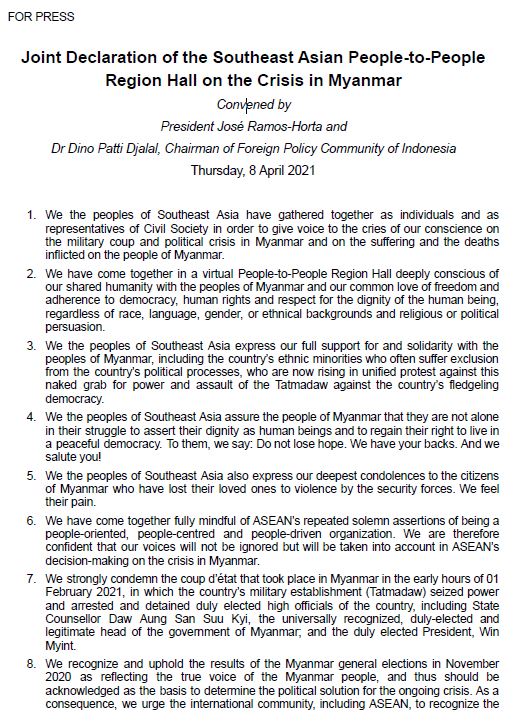
On 1 February, the armed forces of Myanmar (Tatmadaw), ostensibly acting on allegations of voter fraud in the general elections of 8 November 2020, detained numerous government officials, including State Counsellor Daw Aung San Suu Kyi, President U Win Myint, and Union Election Commission (UEC) Chair U Hla Thein, as well as pro-democracy activists and politicians from the ruling National League for Democracy (NLD) and other parties.
The Tatmadaw subsequently announced that it would seize power, declare a one-year state of emergency, and install Vice-President and retired general U Myint Swe as acting president. It was also announced that new elections would be held after the state of emergency under a new election commission, which was later appointed on the night of 2 February.
The undersigned election or human rights monitoring organizations condemn the military coup in Myanmar and call for the immediate release of all detained politicians, government officials, and activists. The Tatmadaw must restore power to the civilian-led government, and seek redress of election-related complaints through the due process of law established under the 2008 Constitution.
Indeed, Myanmar’s Constitution and election laws provide a mechanism to resolve disputes in the form of election tribunals. The military-backed Union Solidarity and Development Party (USDP), which has repeatedly made claims of vote rigging and irregularities in the recent general elections, has like any other stakeholder the legal right to formally contest election results. It certainly has done so, filing 174 complaints out of the 287 received by the UEC.
Election observers were looking forward to seeing all election-related complaints and potential evidence presented and addressed in tribunal proceedings. According to our information, the UEC was about to proceed with the appointment of election tribunals when the military intervened. Election dispute resolution is an integral part of any electoral process, which rests on the fundamental premise that all sides act in good faith.
Therefore, the Tatmadaw must back down from its coup attempt and instead engage in a peaceful and transparent election dispute resolution process. The road to a fully realized democracy is long and arduous, but it is important that all stakeholders commit to upholding and protecting democratic norms. A repeat of what transpired after the 1990 general elections would mark a stark return to authoritarianism and will not be accepted by the people of Myanmar and the international community.
Signatories:
Asian Network for Free Elections (ANFREL)
Association for Elections and Democracy (PERLUDEM), Indonesia
Cambodian Human Rights Action Coalition (CHRAC)
Cambodian Human Rights and Development Association (ADHOC)
Cambodian Institute for Democracy (CID)
Cambodian League for the Promotion and Defense of Human Rights (LICADHO)
Center for Alliance of Labor and Human Rights (CENTRAL), Cambodia
Centre for Monitoring Election Violence (CMEV), Sri Lanka
Centre for Policy Alternatives (CPA), Sri Lanka
Citizen Congress Watch (CCW), Taiwan
Civil Network OPORA, Ukraine
Coalition for Clean and Fair Elections (Bersih 2.0), Malaysia
Coalition of Cambodian Farmers Community (CCFC)
Committee for Free and Fair Elections in Cambodia (COMFREL)
East and Horn of Africa Election Observers Network (E-HORN)
Elections Observation Group (ELOG), Kenya
ENGAGE, Malaysia
Free and Fair Election Forum (FEFA), Afghanistan
Free and Fair Election Network (FAFEN), Pakistan
General Election Observation Committee (GEOC)/Nepal Law Society
Global Network of Domestic Election Monitors (GNDEM)
Hong Kong Election Observation Project (HKEOP)
Independent Democracy of Informal Economy Association (IDEA), Cambodia
Independent Election Monitoring Committee (KIPP), Indonesia
Jaringan Pendidikan Pemilih untuk Rakyat (JPPR), Indonesia
Legal Network for Truthful Elections (LENTE), Philippines
MARUAH (Working Group for ASEAN Human Rights Mechanism, Singapore)
Movement for Free & Fair Elections (MDDE), Sri Lanka
National Citizens’ Movement for Free Elections (NAMFREL), Philippines
National Election Observation Committee (NEOC), Nepal
National Election Watch Sierra Leone (NEWSL)
Neutral & Impartial Committee for Free & Fair Elections in Cambodia (NICFEC)
Open Forum for Democracy Foundation (P-NET), Thailand
People Center for Development and Peace (PDP-Center), Cambodia
People’s Action for Free and Fair Elections (PAFFREL), Sri Lanka
Pusat KOMAS, Malaysia
Suara Rakyat Malaysia (SUARAM)
Thai Action Committee for Democracy in Burma (TACDB)
Tindak Malaysia
Transparency International Cambodia
Transparency Maldives
Transparent Election Foundation of Afghanistan (TEFA)
We Watch, Thailand
West Africa Election Observers Network (WAEON)
Women for Social Progress (WSP), Mongolia
Youth Resource Development Program (YRDP), Cambodia
Chairperson of the National Reconciliation and Peace Centre
Republic of the Union of Myanmar
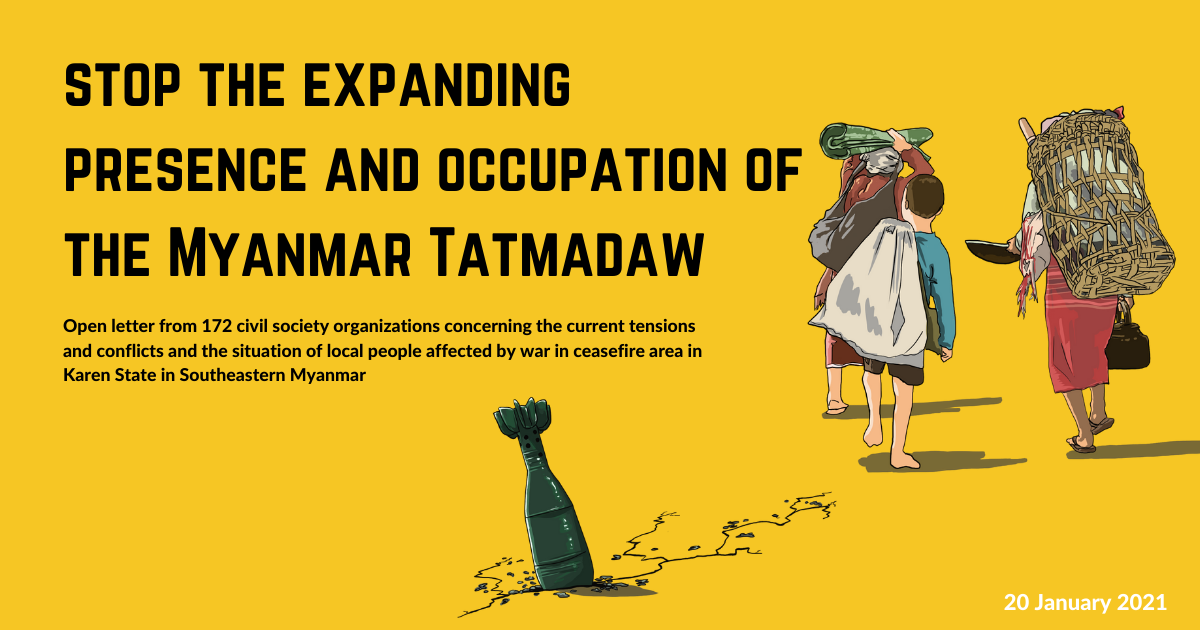
20 January 2021
Subject: Open letter from civil society organizations concerning the current tensions and conflicts and the situation of local people affected by war in ceasefire area in Karen State in Southeastern Myanmar
Dear President U Win Myint, and State Counsellor and Chairperson of the National Reconciliation and Peace Centre Daw Aung San Suu Kyi,
In relation to the above mentioned matter, we, the undersigned (172) civil society organizations and networks, are gravely concerned and would like to sincerely request you to immediately take action and resolve the tensions and conflicts between the Myanmar Tatmadaw (Myanmar military) and the Karen National Liberation Army (KNLA) under the control of the Karen National Union (KNU). The increasing armed engagements between the two armed actors have displaced almost 4,000 people who have been forced to flee their homes and taking shelter in adjacent areas in Hpapun, Thaton and Nyaunglaypin Districts during this challenging time of the COVID-19 pandemic.
In December 2020, we learned that the Myanmar Tatmadaw ignored the provisions contained within the Nationwide Ceasefire Agreement (NCA) and began to expand the presence of its troops in Hpapun District and other areas designated under the KNU’s control, creating tension between the Myanmar Tatmadaw and the KNU, resulting in armed clashes breaking out between the Mae Wei based Myanmar Tatmadaw troops and a battalion of KNLA troops (under KNU control), since 1 December. Over 3,000 civilians have had to flee to avoid the fighting in Hpapun District as the Myanmar Tatmadaw troops shelled in areas where villagers were working for their livelihoods, including inside and outside villages. In addition, on 12 January 2021, the Infantry Battalion 404 of the Myanmar Tatmadaw shelled Mae Cho Village Tract in Hpapun District killing a 35-year-old village chief. Furthermore, on 15 January, an 11-year-old boy was seriously injured as the Light Infantry Battalion 339 of the Myanmar Tatmadaw intentionally continued its artillery shelling of Mae Wei Village in Hpapun District. The boy is now receiving medical treatment. We call on the government to bring justice for those who have suffered casualties and to ensure that such incidents do not take place again.
At present, we have learned that the tensions between the two groups are rising, leading to deterioration of trust. We believe that an end to tensions and fighting between the two sides is difficult, particularly if the Myanmar Tatmadaw continues its military movements in KNU designated areas in contravention of the NCA.
In addition, 790 villagers from four villages in Nyaunglaypin District have had to flee to avoid the ongoing fighting between the KNU troops and the Myanmar Tatmadaw since 28 December 2020, as the Myanmar Tatmadaw entered into KNU designated territories. On 19 January, a 41-year-old man was injured by the artillery shelling of the Light Infantry Battalion 603 of the Myanmar Tatmadaw in Pae Kaw Hkee Village in Kyaukkyi Township. We have learned that villagers are especially concerned that this will lead to the expansion of armed clashes in the region as the Myanmar Tatmadaw have reinforced their troops in KNU controlled areas in Hpapun and Nyaunglaypin Districts since December 2020. We are particularly concerned of the continued displacement of ethnic people at a time when the country is striving for national reconciliation and long-lasting peace in the pursuit of a genuine federal democratic country.
Upon observing the catalyst for such conflict and tensions between the NCA signatories – an ethnic armed organization, the KNU, and the Myanmar Tatmadaw – we have found that the Myanmar Tatmadaw broke the NCA as they have taken positions and expanded deployment, giving different excuses, including in the name of development projects. Therefore, we call on the government, elected by the people, to look towards national reconciliation and genuine sustainable peace, and to immediately implement the calls made by more than 10,000 villagers from 12 villages in Luthaw Township who protested on 30 December 2020, to stop the Myanmar Tatmadaw from invading the KNU controlled territories and expanding its forces in contravention of the NCA’s agreements, among other calls.
In our country, civil war has been raging for more than 70 years and it is still far from the genuine peace that our people aspire to today. Furthermore, we believe that the Myanmar Tatmadaw’s use of state funds to continue using military force across Myanmar, particularly in ethnic areas is inappropriate and leads us further astray from peace.
In the time of conflict, women and children are the most vulnerable to human rights violations, including sexual violence, and their rights to education and healthcare can be impacted. As Myanmar is a signatory to the Convention on the Elimination of all Forms of Discrimination Against Women (CEDAW) and the Convention on the Rights of the Child (CRC), Myanmar is obligated to protect the rights of women and children in line with these conventions.
Finally, it is our belief that the armed conflicts in ethnic areas in Myanmar and its root causes are political in nature and must be solved by political means. To solve this political issue via political means, we, the undersigned civil society organizations, would like to respectfully call on the President and State Counsellor to develop political opportunities and means of solution, as well as to withdraw and stop the expanding deployment and occupation of the Myanmar Tatmadaw in ethnic areas.
We, the undersigned organisations, strongly condemn the killing of elections monitor and democracy advocate Mohammad Yousuf Rasheed in Afghanistan and urge the authorities to bring those responsible to justice.
On the morning of 23 December 2020, Rasheed, executive director of the Free and Fair Election Forum of Afghanistan (FEFA), was shot by unknown gunmen in Kabul when he was traveling to his office. He later died from injuries in the hospital.
The killing and ongoing threats of violence aim at creating fear and intimidation among those promoting peace and democracy in Afghanistan. In recent months, targeted killings and threatening of prominent figures, including civil society activists, journalists and politicians have been increasing disturbingly. The United Nations Assistance Mission in Afghanistan (UNAMA) recorded 934 civilian casualties caused by targeted killings from January to September 2020, a 39 per cent increase compared to the same period last year.
We condemn this heinous crime and stand by the people of Afghanistan in support of their aspirations for sustainable peace and democracy. It is essential for the Government of Afghanistan to conduct fair and impartial investigations into these cases and end the impunity of those responsible for the attacks.
Endorsed by,
Asia Democracy Network (ADN)
Asian Network for Free Elections (ANFREL)
Center for Monitoring and Research (CeMI)
Centre for Monitoring Election Violence (CMEV), Sri Lanka
Centre for Policy Alternatives (CPA), Sri Lanka
Citizen Congress Watch (CCW), Taiwan
Civil Network OPORA, Ukraine
Coalition for Clean and Fair Elections (Bersih 2.0), Malaysia
Committee for Free and Fair Election (COMFREL), Cambodia
European Network of Election Monitoring Organizations (ENEMO)
Free and Fair Election Network (FAFEN), Pakistan
Global Network of Domestic Election Monitors (GNDEM)
Jaringan Pendidikan Pemilih Untuk Rakyat (JPPR), Indonesia
Komite Independen Pemantau Pemilu (KIPP), Indonesia
MARUAH, Singapore
National Democratic Institute (NDI)
National Election Observation Committee (NEOC), Nepal
Nepal Law Society, Nepal
Neutral & Impartial Committee for Free & Fair Elections in Cambodia (NICFEC), Cambodia
Odhikar, Bangladesh
People Network for Elections in Thailand (P-NET), Thailand
People’s Alliance for Credible Elections (PACE), Myanmar
People’s Action for Free and Fair Elections (PAFFREL), Sri Lanka
Perkumpulan untuk Pemilu dan Demokrasi (PERLUDEM), Indonesia
Transparency Maldives (TI Maldives), Maldives
Transparent Elections Foundation of Afghanistan (TEFA), Afghanistan


 Posted by jamestan2019




















 MARUAH Singapore
You must be logged in to post a comment.