[Statement] Ongoing Human Rights Crisis in Venezuela and the Capture of Venezuelan President Nicolás Maduro

5 January 2026

MARUAH is deeply disconcerted by the organised military attack on 3 January 2026 by the United States of America (“America”, or the “US”) on Venezuela. We are also deeply concerned over the American capture of Nicolás Maduro, the sitting president of Venezuela, to stand trial in America. These actions in all likelihood constitute violations of international law, including the UN Charter as well as America’s own Constitution as shown in expressed concerns within Congress. We are disturbed by the expressed intentions of America to run Venezuela and to control its oil resources. 

As a human rights organisation we condemn the approach, intentions and actions taken by the US as these are violations which can also dangerously disrupt national, regional and international peace and security, jeopardise commitments to the rules-based international order and most importantly endanger civil population. This attack has killed and injured a number of Venezuelans.

We call upon the international community to consider this attack as a human rights violation and to show support to the people in this aftermath by prioritizing protection of human dignity, restoration of democratic rights and provision of humanitarian support. The Venezuelan people have already, for years, endured much suffering from widespread violence, repression and severe economic hardship.

We hope that changes to Venezuela’s political situation will lead to an end of human rights abuses and ensure protection for the people. We urge the international community to work together in addressing the urgent needs of Venezuelans that “everyone has the right to life, liberty and security of person” (Article 3 of the Universal Declaration of Human Rights (“UDHR”)) and to ensure that everyone, in due course, “has the right to take part in the government of his country, directly or through freely chosen representatives” (Article 21 of the UDHR).

We hope that Venezuelan President Maduro, like any individual, will be tried fairly and impartially by an independent and impartial tribunal. The recent events, without due process or international consensus, can dangerously set a wrong precedent on how political leaders are to be held accountable. We reiterate that “everyone is entitled in full equality to a fair and public hearing by an independent and impartial tribunal, in the determination of his rights and obligations and of any criminal charge against him” (Article 10 of the UDHR).

MARUAH stands in solidarity with the people of Venezuela.


What principles should be considered to guide the boundary delimitation process?

1 April 2025

In a 2007 paper published by Dr. Lisa Handley, “Challenging the Norms and Standards of Election Administration: Boundary Delimitation”, she explained how certain fundamental principles should be considered when setting international election standards to guide the delimitation process.

  • Impartiality: The boundary authority should be a nonpartisan, independent, and professional body;
  • Equality: The populations of constituencies should be as equal as possible to
    provide voters with equality of voting strength;
  • Representativeness: Constituencies should be drawn taking into account
    cohesive communities, defined by such factors as administrative boundaries,
    geographic features, and communities of interest;
  • Non-discrimination: The delimitation process should be devoid of electoral
    boundary manipulation that discriminates against voters on account of race, color,
    language, religion, or related status; and
  • Transparency: The delimitation process should as transparent and accessible to
    the public as possible.

Dr. Handley concluded that “there is no single best model for delimiting constituency boundaries. The wide variety of delimitation practices, many of them quite successful, attest to this. However, it is important to establish standards to which the delimitation process might aspire, if current practices do not already meet them. These standards will need to be flexible to be relevant to both mature and transitional democracies, but underlying all of them should be the fundamental principles of impartiality, equality, representativeness, nondiscrimination, and transparency.

Meeting standards that include an impartial boundary authority (guided by principles like equal voting strength, representativeness, and non-discrimination) as well as a process that is as transparent as possible offers credibility and legitimacy to a process that can have decided political consequences. The table below provides a summary of the principles that should guide the delimitation process and some examples of best practices that meet these standards.


[UN News] Myanmar: ‘Meaningful action’ needed to stop the slaughter’ 

6 February 2022

1 February 2022

https://news.un.org/en/story/2022/02/1110992

“Now is not the time for more rhetoric, it is time for meaningful action”, said Tom Andrews, Special Rapporteur on the situation of human rights in Myanmar.

“The international community must take strong, meaningful steps to cut the junta’s access to weapons, funds and legitimacy”.

People ‘deserve better’
The UN expert reiterated the urgent need for the Security Council to impose an arms embargo on the Myanmar military and significantly increase financial pressure on the junta.

“The fact that one year has elapsed with no Security Council Resolution imposing a comprehensive arms embargo – as arms continue to flow to the junta and kill innocent people – is unacceptable”, he stated.

“The people of Myanmar deserve better from the United Nations”.

Criminal enterprise’

The Special Rapporteur said that he would soon release a report identifying the weapons in the junta’s arsenal and where they came from.

Mr. Andrews pointed out that the military junta is functioning as “a criminal enterprise”, committing murder, torture, abductions and forced displacement – while stealing revenue and seizing assets of the people of Myanmar.

“What is worse, they appear to be getting away with it. Their attacks continue unabated. The suffering of the Myanmar people is steadily increasing”, he continued.

Recent months have seen an even further escalation of violence, and a campaign of terror now widespread across the country.

“I have received more reports of mass killings, attacks on hospitals and humanitarian targets, and the bombing and burning of villages”, he added.

Unwavering commitment
“I am amazed at the resilience of the Myanmar people. In the face of aerial assaults, and mass arrest and torture, they continue to strike, to protest, to speak out and to defend themselves. They need and deserve stronger support from the international community”, he said. “The best and worst of humanity is unfolding in Myanmar”.

Special Rapporteurs are appointed by the Geneva-based UN Human Rights Council to examine and report back on a country situation. The positions are honorary and they are not paid for their work.

New UN humanitarian response plan
Meanwhile, Jens Laerke, Deputy Spokesperson for the UN humanitarian office, OCHA, noted that the newly published 2022 Humanitarian Response Plan (HRP) for Myanmar requests a record $826 million to assist 6.2 million people in need.

The 2022 plan represents double the amount requested last year, reflecting a growing crisis that has plunged an estimated 14.4 million people into humanitarian need.

Since the military coup, conflict and insecurity has continued, displacing more than 400,000 people to camps, displacement sites and with host communities. Many others have crossed into Thailand and India or sought refuge in the jungle, lacking adequate food, shelter, sanitation and medical care.

Sick and hungry
The economic and political turmoil of 2021, combined with the devastating impact of COVID-19, have driven half the population into poverty, with many unable to feed their families.

Over 13 million people are moderately or severely food insecure and malnutrition is expected to worsen among children, unless parental support is increased.

“Our ability to save lives and reduce suffering on this scale will depend on increased funding, improved access and removal of bottlenecks such as visa delays and banking restrictions”, said Mr. Laerke.

“Humanitarian agencies must be allowed access to displacement sites to conduct needs assessments and deliver lifesaving aid including food, water and health care”, he added.


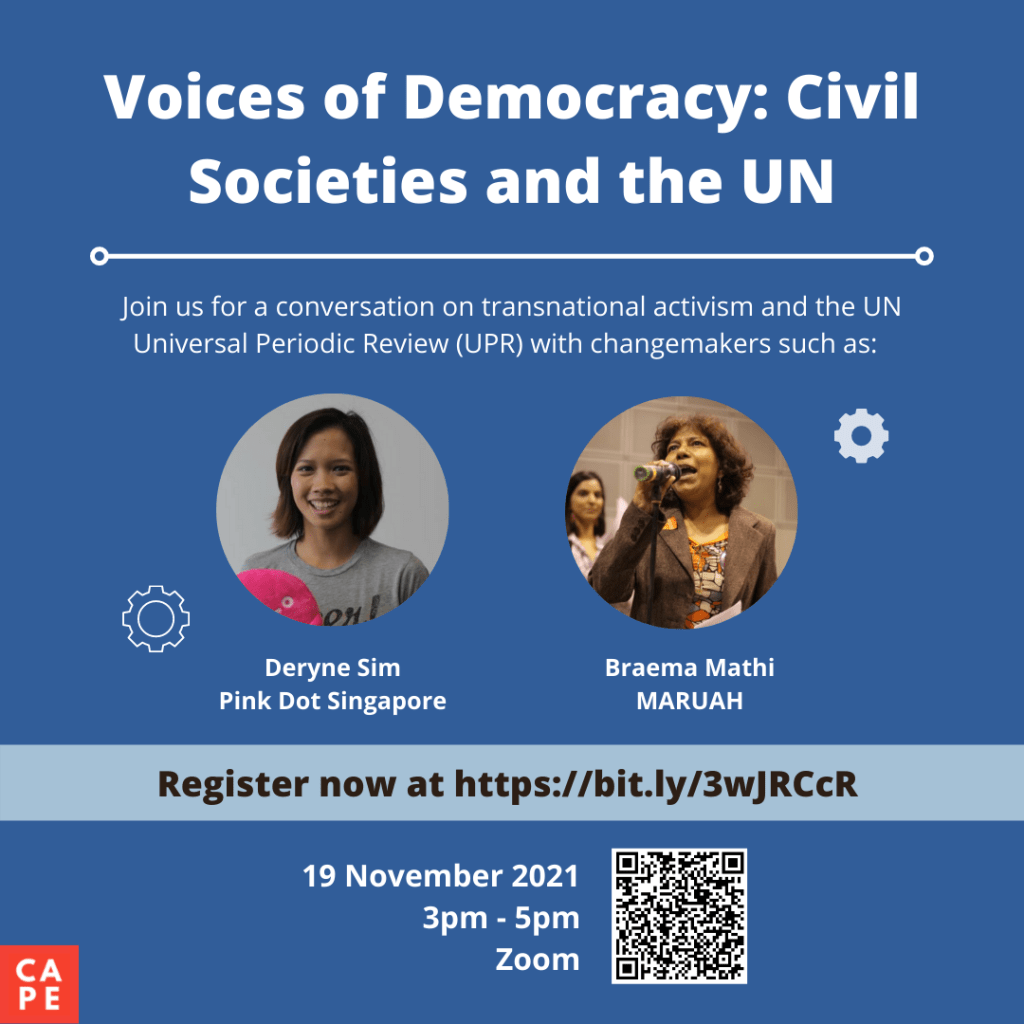
[Webinar] Voices of Democracy: Civil Societies and the UN

18 November 2021

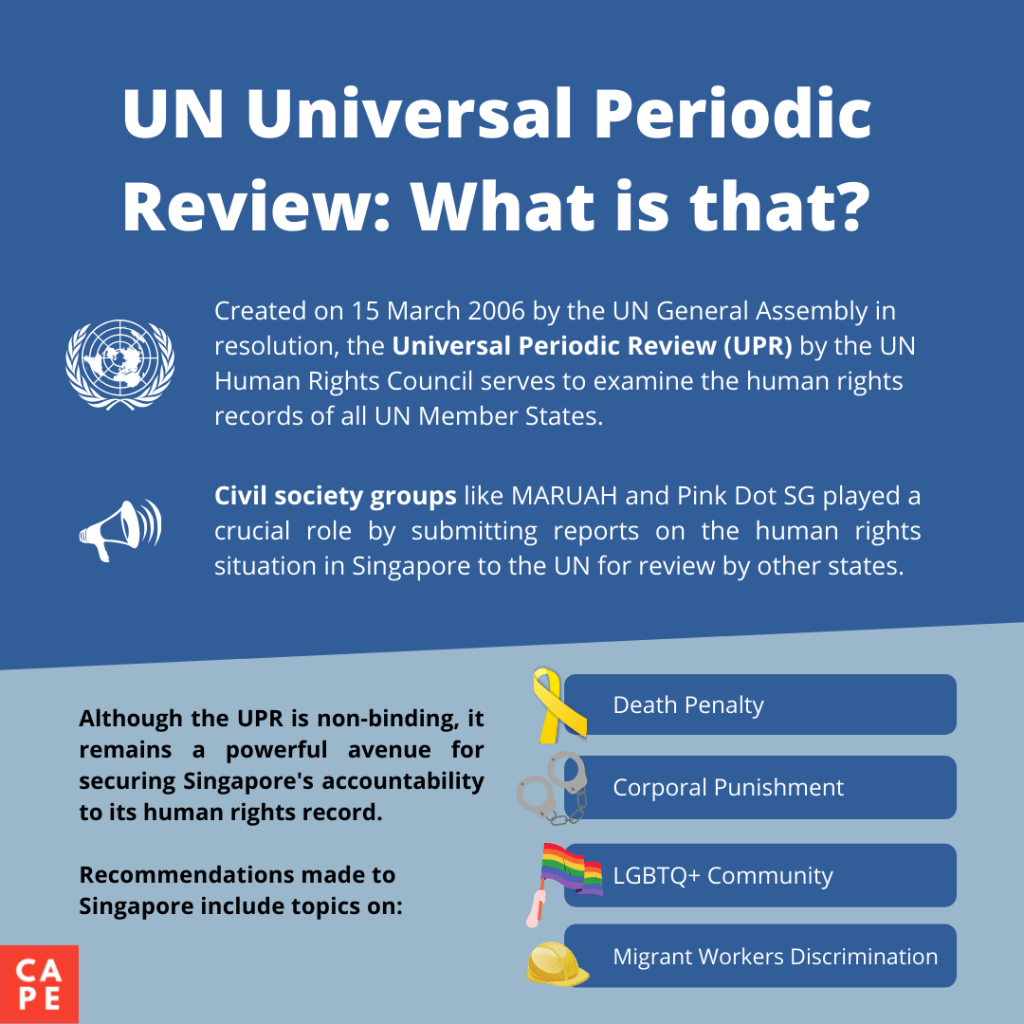
Ever wondered what the UPR was? Every few years, the Universal Periodic Review (UPR) by the United Nations Human Rights Council sets about examining the human rights records of all UN Member States. Join changemakers from Pink Dot and MARUAH for an online panel discussion about the role of the UPR in Singaporean advocacy, policymaking and discourse this Friday, Nov 19, from 3pm-5pm! Proudly organised by the Yale-NUS/NUS Community for Advocacy and Political Education (CAPE)


Sign up at bit.ly/UPRCAPE or scan the QR code