[Malay Mail] Malaysia’s abolishment of death penalty not done deal yet until Parliament passes law, Human Rights Watch rep says

12 June 2022

By John Bunyan

Friday, 10 Jun 2022 4:35 PM MYT – https://www.malaymail.com/news/malaysia/2022/06/10/malaysias-abolishment-of-death-penalty-not-done-deal-yet-until-parliament-passes-law-human-rights-watch-says/11669

KUALA LUMPUR, June 10 — A Human Rights Watch (HRW) representative Phil Robertson has insisted today that any abolishment of the mandatory death penalty in Malaysia needs to be accompanied by a legislative amendment in the Parliament before the pledge can be put into effect.

The deputy director of the human rights watchdog’s Asia division said Malaysians must instead to take a wait-and-see approach as Putrajaya has historically only delivered little of its promises despite promising so much on human rights.

“Malaysia’s public pronouncement that it will do away with the mandatory death penalty is an important step forward, especially when one considers how trends on capital punishment are headed in precisely the opposite direction in neighbouring countries like Singapore, Myanmar, and Vietnam.

“But before everyone starts cheering, we need to see Malaysia pass the actual legislative amendments to put this pledge into effect because we have been down this road before, with successive Malaysian governments promising much on human rights but ultimately delivering very little,” he said in a statement.

Earlier, Malaysia’s de facto law minister Datuk Seri Wan Junaidi Tuanku Jaafar announced that the government has agreed to abolish the mandatory death penalty and substitute sentences at the discretion of the court.

Wan Junaidi also confirmed that the Cabinet has agreed that further scrutiny and study be carried out on the proposed substitute sentence for 11 offences carrying the mandatory death penalty, one offence under section 39B of the Dangerous Drugs Act 1952 [Act 234] 2 and 22 other offences which carry the death penalty but at the discretion of the court.

This further study will be carried out in collaboration with the Attorney General’s Chambers (AGC) Legal Affairs Division, the Prime Minister’s Department and other interested ministries and departments.

Robertson described the latest announcement on the death penalty by the Malaysian government as merely to show the international community that the country is progressing forward.

“The Malaysian government loves to float trial balloons about human rights initiatives because it knows the international community has a short attention span and will take this as a sign of Malaysia progressing forward.

“But the reality is often more complicated, so we’ve learned to be wary. Hopefully, Malaysia will do the right thing by immediately implementing this pledge to do away with the mandatory death penalty,” he said.

Malaysia has had a moratorium on all executions since 2018 while awaiting recommendations from the committee.

In August 2019, the Pakatan Harapan (PH) administration formed the Special Committee to Review Alternative Punishments to the Mandatory Death Penalty to examine alternatives to the mandatory death sentence.

However, the PH government collapsed in February 2020 before the Bill for the abolition of the death penalty could be tabled in the March meeting of Parliament that year.


[APHR] Southeast Asian MPs alarmed by planned executions of four Myanmar political prisoners

12 June 2022

JAKARTA, 6 June 2022 – Parliamentarians from Southeast Asia are alarmed by the announcement by the Myanmar junta that it will carry out the death sentences handed down to four political prisoners, including prominent former member of Parliament, Ko Phyo Zeya Thaw, and well-known pro-democracy activist, Kyaw Min Yu, better known as “Ko Jimmy”, both convicted on charges of terrorism.

These death sentences would be the first known judicial executions in the country since 1988, according to Amnesty International, which considers Myanmar as “Abolitionist in Practice”, as it retains the death penalty in law, but has not applied it for decades. Ever since the coup in February last year that ousted the democratically elected government, Myanmar has seen a drastic surge in the number of people sentenced to death with at least 86 people, including minors who were under 18 at the time.

“ASEAN and the international community must use every means at their disposal to prevent these executions from taking place. If they are carried out they will be nothing less than cold blooded political assassination. These executions would further contribute to prevent the already remote possibility of a sustainable political dialogue, as prescribed over one year ago in the Five-Point Consensus agreed by ASEAN member states and Min Aung Hlaing’s junta, which has not made any effort whatsoever in that direction,” said Charles Santiago, Member of Parliament from Malaysia, and APHR Chairperson. 

The Myanmar military has killed at least 1,887 protesters since the coup, but it is attempting to give a veneer of legality to the execution of the four men. Yet it is abundantly clear that, as in dozens of sentences handed by military tribunals, there was no respect for fair trial rights.

ASEAN Parliamentarians for Human Rights (APHR) unreservedly supports the recent United Nations Secretary General’s statement reminding Myanmar’s military that the death sentences are a blatant violation of the right to life, liberty and security of person, as per Article 3 of the Universal Declaration of Human Rights. We also join him in emphasizing that the Declaration also enshrines the principles of equality before the law, the presumption of innocence, the right to a fair and public hearing by an independent and impartial tribunal, and all of the guarantees necessary for a person’s defense.

“This announcement should be viewed in the context of the increasingly brazen atrocities being committed by the Myanmar military in order to consolidate its power in the face of widespread popular resistance. The junta is killing, torturing and arbitrarily arresting Myanmar people with an impunity that owes a great deal to the failure of the international community to hold it accountable for its crimes,” said Santiago.

APHR calls on each and every member state of ASEAN, as well as its Dialogue Partners, to urgently demand an unconditional and immediate stay of execution and release of the four detainees by the self-declared State Administration Council. They must individually and collectively make a stand before it is too late, not only for these four, but for all those currently arbitrarily detained who should be immediately and unconditionally released.

Click here to read this statement on APHR’s website.

For more information please contact info@aseanmp.org.


[APHR] Southeast Asian MPs call Indonesia to give a voice to the Global South at the G20

11 June 2022

JAKARTA, 9 June 2022 – Parliamentarians from Southeast Asia have called Indonesia, the only G20 member in Southeast Asia and its President this year, to “give voice to the aspirations of the Global South” and bring to the table issues that particularly affect the region, but also the world in general, at the group’s Summit which will be held in November this year in Jakarta.

In a position paper published today, ASEAN Parliamentarians for Human Rights (APHR) has urged Indonesia to advocate at the Summit for stronger and more creative global responses to the devastation caused by conflicts like that of Myanmar, a substantial increase in global financial support for a sustainable energy transition, and to find ways to reduce the impact of the world’s digital transformation on human rights and democracy.

We, Parliamentarians from Southeast Asia, are urging the Indonesian Government to use its preeminent position to promote at the G20 a form of collective and inclusive collaboration among nations to address challenges that, having a specific resonance to our region, affect humanity as a whole,” said APHR in the Position Paper.

APHR suggests that new creative ways are necessary to prevent the human and economic costs of crises such as those devastating Myanmar, Ukraine, Yemen or Syria. As international organizations like the UN, or regional groups like ASEAN, have often failed to prevent atrocities, Indonesia should propose a new Working Group at the G20 to discuss responses from the largest economies in the world to those crises.

On the climate change front, it has become evident that current pledges from states to reduce carbon emissions will not be sufficient to slow climate change, and the necessity to transition to renewable sources of energy is more urgent than ever. APHR urges Indonesia to lead the G20 to agree to accelerate the phasing out from coal and fossil fuels, but it must also substantially increase global financial support for such a transition.

Lastly, and in face of the challenges posed by the spread online of disinformation campaigns, divisiveness and hate-speech, APHR urges the G20 to discuss and identify measures that can be adopted to regulate the digital marketplace along democratic lines, put an end to invasive use of people’s personal data, and hold online platforms accountable for their harmful business models.

Click here to read the position paper.

Click here to read this press release on APHR’s website.

For more information please contact info@aseanmp.org.


[Featured] Braema as an alumnus of the Diplomacy Training Program

22 February 2022

Braema Mathiaparanam

Photo of Braema Mathi


Role: 
Secretary* of MARUAH

Active in Country: Singapore

DTP Trainer and Alumna: 2006 Migrant Workers Program – Malaysia as a participant and 2008 Migrant Workers Program – Philippines as a trainer

Braema Mathiaparanam is a prominent Singaporean human rights activist, a former journalist with Singapore’s most prestigious newspaper The Straits Times and an ex-Nominated Member of Singapore’s Parliament.

Braema began her human rights advocacy work in 1992. She has championed gender rights, LGBTQ rights, civil liberties (especially anti-death penalty campaign), political pluralism, and the rights of the migrant workers in Singapore. Braema participated in two DTP courses – on the rights of migrant workers, and on Business and Human Rights.   

With others she founded Maruah, a human rights NGO, and led the organisation for a number of years and is now its Secretary.* ‘Maruah’ in Malay, Singapore’s native language, means ‘dignity’. The organisation is also the Singapore civil society focal point to the Regional Working Group on ASEAN Human Rights Mechanisms.

Braema reflects that defending human rights in Singapore is complex and challenging, and a difficult path to take. Work on civil and political rights is particularly difficult, given legal restrictions.  

Singapore has ratified some of the core human rights treaties – but neither of the core conventions on Civil and Political Rights or Economic, Social and Cultural Rights. Singapore is host, rather than home, to many migrant workers from elsewhere in Asia, and their treatment is one of the key human rights concerns. Singapore has not ratified the Convention on the Protection of the Rights of All Migrant Workers and their Families (CMW). Many of these migrant workers are women domestic workers and advocates have used the Convention on the Elimination of Discrimination Against Women, which Singapore has ratified, to promote the rights of these domestic workers.

Despite the many challenges, Braema’s motivation remains high. She said if you are aware, often it stays with you. This stems from values built up within the home and reinforced in school.  

“When you grow up with this increased awareness, you see gaps, and you start thinking how to patch up the gaps,” said Braema.

She said one result of her attending the DTP training on defending the rights of migrant workers was to become more focused on including regional CSOs, diplomats, and representatives of the business sector in advocacy campaigns. She reached out to embassies of the countries sending migrant workers to Singapore to develop collaboration for the well-being of their citizens who are Singapore’s migrant workers.

“I contacted embassies such as Philippines, Indonesia, Thailand, and Bangladesh, in the early years of working on migrant workers’ rights. Together we created a mutual-learning environment so that they could share and develop ways to offer more protection to their citizens working in Singapore.”  

They also encouraged embassies to also collaborate in defence of migrants and to learn from each others’ good practices. The embassies of Indonesia and Thailand introduced educational materials, booklets, and set up hotlines for the migrant workers as an outcome of this advocacy, following what they had learnt from Philippines.

Her reflections on DTP’s course on business and human rights is also highly positive. Before participating in the program, she said her knowledge of “business and human rights was very weak.” “I found that DTP program excellent and had effectively presented complex issues.”

“What was really good to learn,” she said, “was learning that European/OECD governments had specific commitments to guide the private sector on business and human rights – and the OECD Guidelines established National Contact Points that could hear complaints.”

As a whole she thinks the DTP training facilitators and the core content experts were excellent in mapping out the basic theories and the advanced knowledge that activists needed to know to spearhead their activism on the ground.

“It was intense upliftment in terms of knowledge from experts, an open discourse where I had many opportunities to ask questions and understand issues better, plus a reading list. All which help you to move fast in a short period.”

Braema thinks that against the backdrop of the renewed global attention on climate change, DTP does have the potential to expand its training work on climate change, business, and human rights. She said corporate social responsibility (CSR), is still the dominant mindset in the corporate sector. “This mindset needs to be pushed out to connect effectively with climate change. Business and human rights, sustainability frameworks, worker’s rights, meeting people’s basic needs to food, water are all taking centrestage now, more than ever before Perhaps DTP could ponder expanding its program into this sector,” Braema suggested.

“I still have all my DTP training files on my shelf. Anytime I’m unsure. I pull out those files to clarify. Or If I need to contacts to participants, I look into those files, to check on the participants’ lists,” said Braema.


*At time of profile in December 2021. Braema stepped down as Secretary in Jan 2022 but remains active in Maruah.


[UN News] Myanmar: ‘Meaningful action’ needed to stop the slaughter’ 

6 February 2022

1 February 2022

https://news.un.org/en/story/2022/02/1110992

“Now is not the time for more rhetoric, it is time for meaningful action”, said Tom Andrews, Special Rapporteur on the situation of human rights in Myanmar.

“The international community must take strong, meaningful steps to cut the junta’s access to weapons, funds and legitimacy”.

People ‘deserve better’
The UN expert reiterated the urgent need for the Security Council to impose an arms embargo on the Myanmar military and significantly increase financial pressure on the junta.

“The fact that one year has elapsed with no Security Council Resolution imposing a comprehensive arms embargo – as arms continue to flow to the junta and kill innocent people – is unacceptable”, he stated.

“The people of Myanmar deserve better from the United Nations”.

Criminal enterprise’

The Special Rapporteur said that he would soon release a report identifying the weapons in the junta’s arsenal and where they came from.

Mr. Andrews pointed out that the military junta is functioning as “a criminal enterprise”, committing murder, torture, abductions and forced displacement – while stealing revenue and seizing assets of the people of Myanmar.

“What is worse, they appear to be getting away with it. Their attacks continue unabated. The suffering of the Myanmar people is steadily increasing”, he continued.

Recent months have seen an even further escalation of violence, and a campaign of terror now widespread across the country.

“I have received more reports of mass killings, attacks on hospitals and humanitarian targets, and the bombing and burning of villages”, he added.

Unwavering commitment
“I am amazed at the resilience of the Myanmar people. In the face of aerial assaults, and mass arrest and torture, they continue to strike, to protest, to speak out and to defend themselves. They need and deserve stronger support from the international community”, he said. “The best and worst of humanity is unfolding in Myanmar”.

Special Rapporteurs are appointed by the Geneva-based UN Human Rights Council to examine and report back on a country situation. The positions are honorary and they are not paid for their work.

New UN humanitarian response plan
Meanwhile, Jens Laerke, Deputy Spokesperson for the UN humanitarian office, OCHA, noted that the newly published 2022 Humanitarian Response Plan (HRP) for Myanmar requests a record $826 million to assist 6.2 million people in need.

The 2022 plan represents double the amount requested last year, reflecting a growing crisis that has plunged an estimated 14.4 million people into humanitarian need.

Since the military coup, conflict and insecurity has continued, displacing more than 400,000 people to camps, displacement sites and with host communities. Many others have crossed into Thailand and India or sought refuge in the jungle, lacking adequate food, shelter, sanitation and medical care.

Sick and hungry
The economic and political turmoil of 2021, combined with the devastating impact of COVID-19, have driven half the population into poverty, with many unable to feed their families.

Over 13 million people are moderately or severely food insecure and malnutrition is expected to worsen among children, unless parental support is increased.

“Our ability to save lives and reduce suffering on this scale will depend on increased funding, improved access and removal of bottlenecks such as visa delays and banking restrictions”, said Mr. Laerke.

“Humanitarian agencies must be allowed access to displacement sites to conduct needs assessments and deliver lifesaving aid including food, water and health care”, he added.


[Amnesty International] Myanmar: World must act now to prevent another year of intolerable ‘death and misery’

6 February 2022

27 January 2022

If the international community continues to drag its feet on the grave human rights violations including lethal violence targeted at protestors that we have seen in Myanmar this past year, many more people will suffer and this human rights crisis could worsen, Amnesty International said today ahead of the one-year anniversary of the 1 February, 2021 coup.

“Enough is enough, the 55 million people of Myanmar cannot afford another year of wavering and sitting on the sidelines by many governments around the world. Concrete action aimed at holding the military accountable and preventing their access to weaponry used to commit widespread human rights abuses must be taken now or the shocking death and misery that have defined life in Myanmar since the coup is likely to persist,” said Ming Yu Hah, Amnesty International’s Deputy Regional Director for Campaigns.

“As the anniversary of the coup draws near, the military has launched indiscriminate air strikes that have killed civilians in the southeast, blocked life-saving aid, and kept up a bloody campaign against activists and journalists, who have been detained and killed in custody. Too many governments continue turning a blind eye to all these atrocities, as they did following the gross violations of human rights against the Rohingya people. As a result, the military has been increasingly brazen, acting with impunity in its efforts to wipe out any resistance to its rule.

“The Myanmar people are desperate and have become disillusioned about help from the international community. But there are clear steps that need to be taken to prevent the Myanmar military from maintaining its dystopian campaign of terror and persecution. The UN Security Council must stop dragging its feet, and instead impose a global arms embargo and targeted sanctions against military leaders, and urgently refer the situation in Myanmar to the International Criminal Court.

“In addition, all local and foreign companies in business partnerships with the military or military-owned businesses need to responsibly disengage, cutting the flow of funds that the military uses to prop up its lethal operations.

“Closer to home, the Association of Southeast Asian Nations (ASEAN) must present a unified front on Myanmar and demand the military to immediately stop the violence against civilians. The ASEAN should also exert pressure on the military to stop blocking humanitarian access and expand on and implement with a clear timeline its five-point consensus adopted last year, which has proved a failure.

“The new year must bring new approaches to Myanmar, placing human rights for the people of Myanmar, accountability, and a zero tolerance to human rights violations and abuses at the forefront.”

Background:

Myanmar’s military seized power in a coup in the early hours of 1 February, 2021. Since then it has killed more than 1,400 people and arrested more than 11,000, with over 8,000 currently in detention, according to the Assistance Association for Political Prisoners. The shocking violence fits into a long history of well-documented crimes under international law against ethnic minorities in the country, including the Kachin, Shan and Rohingya.

The UN Fact-Finding Mission on Myanmar has previously called for Senior General Min Aung Hlaing and other senior officials to be investigated and prosecuted for war crimes, crimes against humanity, and genocide.

The former civilian leader Aung San Suu Kyi has been sentenced to six years on bogus charges and faces more than 100 years if convicted on all the counts against her. Many of her closest allies, including President Win Myint, have also been convicted on similarly trumped-up charges.

Following the violent crackdown on peaceful protesters, some opponents of the military authorities have established the armed People’s Defense Force, which claims to have killed hundreds of soldiers through shootings, bombs and ambushes.

On top of the chaos that has gripped major cities and towns across the country in the aftermath of the coup, economic and food insecurity as well as pandemic-related challenges have caused millions to face hunger. Hundreds of thousands have also been internally displaced while thousands have fled across the border to Thailand.


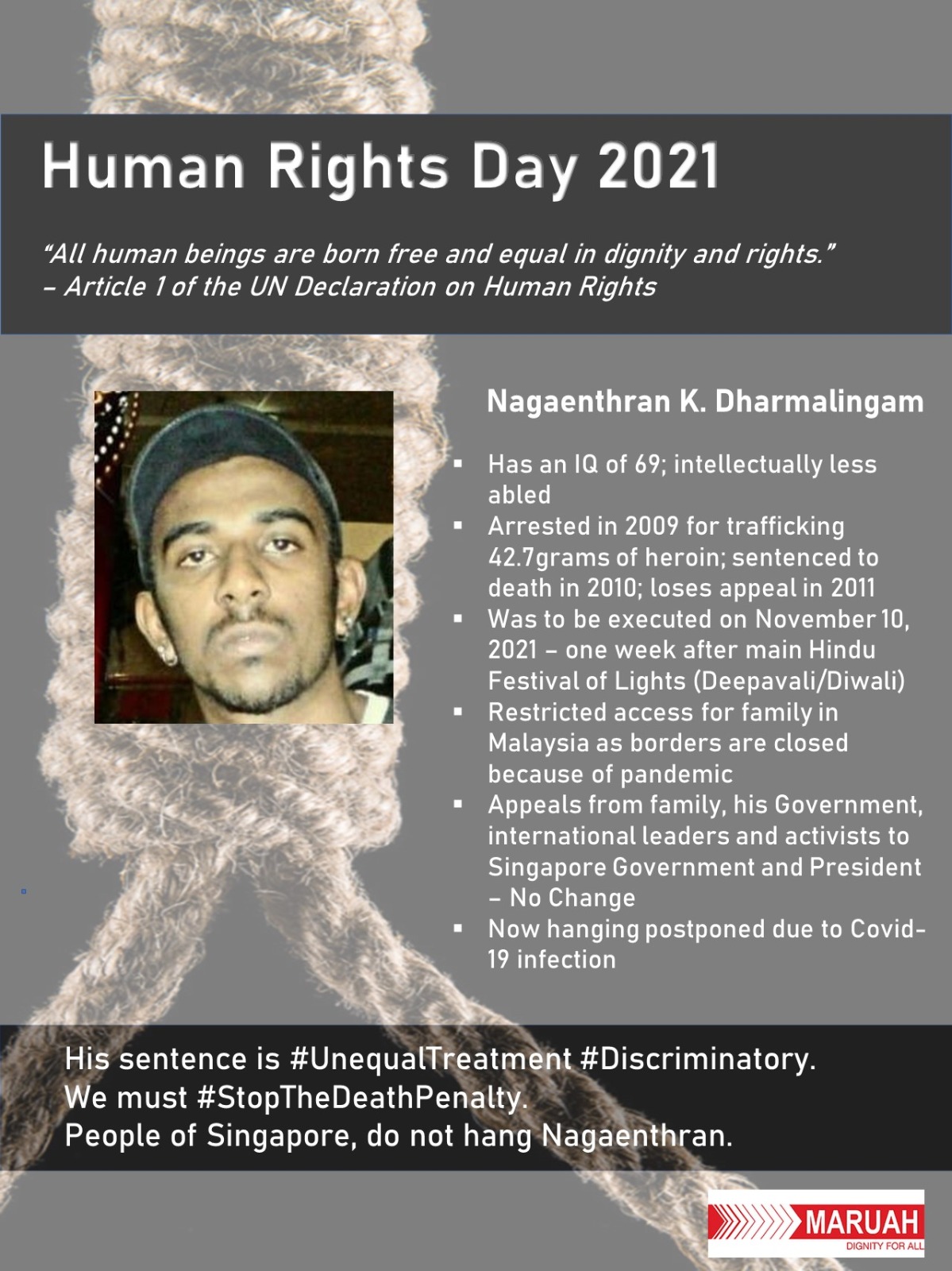
Human Rights Day 2021 – “All human beings are born free and equal in dignity and rights”

10 December 2021

[ANFREL] Asian Electoral Stakeholders Forum 5 – Memorandum (The Way Forward for Elections Beyond the Covid-19 Pandemic)

27 October 2021

Asian Electoral Stakeholders Forum 5 was hosted online this year on 20-21 October 2021. There were four panel discussions on (1) addressing electoral challenges and democratic backsliding in Asia, (2) success stories of holding elections during COVID-19, (3) promoting electoral reforms through cooperation between EMBs and CSOs, and (4) improving electoral integrity using technology and open data.

The memorandum – The Way Forward for Elections Beyond the Covid-19 Pandemic (click to view), was adopted by consensus at the end of the forum. It is hoped that this memo can guide election stakeholders, such as election management bodies, civil society organisations and observer groups, to strive to improve electoral processes in their respective countries in pursuit of genuine democracy.

The panel speakers’ presentation slides can be found in this Google Drive folder.

Recordings of the forum can be found on ANFREL’s Facebook page (Day 1 | Day 2).

Thank you.


[APHR] Quotes and Open Letter on Myanmar’s presence at the ASEAN Summit

14 October 2021

Please see below quotes from Charles Santiago, Malaysian MP and Chair of ASEAN Parliamentarians for Human Rights (APHR). 

“ASEAN’s credibility depends on its ability to act decisively. Denying the illegal Myanmar junta a place at the ASEAN Leaders Summit is a small step towards reclaiming the bloc’s desired centrality as a key regional player that can bring peace and stability.”

“Myanmar’s junta has shown utter contempt for ASEAN and its own people. Since it agreed to the Five-Point Consensus there have been more than 3,530 attacks either on civilians by the military or armed clashes that failed to protect civilians – that’s an 840% increase from the same period in 2020. Min Aung Hlaing and his gang of thugs are making fools of our governments.”

Open Letter to ASEAN Leaders


To: ASEAN Leaders

CC: ASEAN Dialogue Partners

13 October 2021

Re: Myanmar’s presence at the ASEAN Summit

Your Excellencies,  

We, the undersigned organisations, write to you to urge you not to extend an invitation to Myanmar’s military junta to the upcoming ASEAN Summit on 25 to 28 October because of the military’s blatant disregard for the Five Point Consensus agreed at the ASEAN Leaders’ Meeting and continuing refusal to cooperate with ASEAN towards its implementation.

We welcome the remarks made by the Foreign Ministers of Indonesia and Malaysia who questioned whether the junta should be invited to the Summit and urge the other Member States to come to the same conclusion. 

ASEAN’s credibility depends on its ability to act decisively and bring an end to the Myanmar military junta’s relentless violence against the people of Myanmar. A lack of decisiveness and consequences for the military’s total contempt for the ASEAN’s leaders’ agreement risks undermining the bloc’s legitimacy as a key regional player that can bring peace and stability.

On 24 April 2021, the leaders of nine Member States and the Myanmar junta, represented by Senior General Min Aung Hlaing, agreed on a consensus that included the “immediate cessation of violence”, constructive dialogue among all parties, the appointment of an ASEAN special envoy on Myanmar, humanitarian assistance to be delivered to the country, and for the Special Envoy and delegation to visit Myanmar to “meet with all parties concerned”. 

Myanmar’s junta has failed to respect this consensus on every single count.

Since the Myanmar junta agreed to immediately cease the violence on 25th April till the end of September there have been 3,534 attacks either on civilians by the military or armed clashes that failed to protect civilians – that’s an 840% increase from the same period in 2020 (376). Thousands have been forced to flee their homes in search of safety. Violent acts amounting to crimes against humanity have been documented. It is clear that junta leader Min Aung Hlaing will not stop in his attempts to crush the democratic opposition to his rule.

The military junta has also continually opposed any form of dialogue. Zaw Min Tun, the military’s spokesman, recently said that dialogue between the ASEAN Special Envoy and the State Counsellor Aung San Suu Kyi, the National Unity Government and People’s Defence Forces could not take place because they have been declared by the junta as “illegal organizations”. The junta’s stalling tactics also contributed to the delay in announcing Brunei’s Foreign Affairs Minister II Erywan Yusof as ASEAN’s special envoy to Myanmar.

While we note aid commitments made to the AHA Centre and delivered through the Myanmar Red Cross, it is important to recall that the Myanmar military’s own actions are creating the current humanitarian crisis engulfing the country. According to the United Nations (UN), three million people require assistance. That number has tripled over the last eight months. In addition to that, there are now 20 million people living below the poverty line – nearly half the population. Yet, the military junta is weaponizing humanitarian aid; blocking the distribution of supplies, placing travel restrictions on humanitarian workers, hoarding and destroying aid, and attacking civilians, health and humanitarian aid workers. 

It is clear that Myanmar’s military has displayed a flagrant lack of respect for ASEAN, and in fact since the coup, it appears to have used the bloc to try to gain legitimacy while at the same time increasing its brutal reprisals against the people.

The UN Secretary-General Antonio Guterres has also warned that the opportunity to prevent the Myanmar junta from entrenching its rule could be narrowing. He has called for unified regional and international action to prevent the crisis from becoming a large-scale conflict and multi-faceted “catastrophe” in Southeast Asia and beyond.

It is time for ASEAN to act decisively. This starts by denying the Myanmar junta the legitimacy it craves, and which has been rejected constantly by the people of Myanmar. The junta has refused to cooperate with regional and international neighbors, failed to stand by the commitments it has made, and exposed to the world not only its barbaric brutality but also an inability to deal with the deepening social and economic disaster currently taking place in the country, which includes the dereliction of public health services amid the global pandemic. 

Reiterating the remarks of Malaysia and Indonesia’s foreign ministers, a firm united response by the other Member States is required. The Myanmar junta’s actions must not be accepted as “business as usual.” They are endangering the stability, prosperity, peace and health of the region.

We therefore call on ASEAN leaders to deny the head of the Myanmar military junta a seat at the table and display to him that his callous disregard for the people, and his regional neighbors, does not come free of consequences. 

Sincerely, 

Signatories:

  1. A Lin Thitsar
  2. A Lin Yaung Pan Daing
  3. A Naga Alin
  4. Action Committee for Democracy Development
  5. All Arakan Students’ and Youths’ Congress
  6. ALTSEAN Burma
  7. ASEAN Parliamentarians for Human Rights (APHR)
  8. Assistance Association for Political Prisoners
  9. Association of Human Rights Defenders and Promoters
  10. Athan – Freedom of Expression Activist Organization
  11. Backpack Health Workers Team
  12. Burma Medical Association
  13. Burmese Women’s Union
  14. CIVICUS: World Alliance for Citizen Participation
  15. Democracy for Ethnic Minorities Organization
  16. Democracy, Peace and Women’s Organization – DPW
  17. Equality Myanmar
  18. FORUM-ASIA
  19. Freedom and Labor Action Group
  20. Future Light Center
  21. Future Thanlwin
  22. Generation Wave
  23. Human Rights Foundation of Monland
  24. Kachin Women’s Association Thailand
  25. Karen Environmental and Social Action Network (KESAN)
  26. Karen Human Rights Group
  27. Karen Peace Support Network
  28. Karen River Watch (KRW)
  29. Karen Women’s Organization
  30. Karenni Civil Society Network
  31. Karenni Human Rights Group
  32. Karenni National Women’s Organization
  33. Keng Tung Youth
  34. Let’s Help Each Other
  35. Metta Campaign Mandalay
  36. Myanmar Peace Bikers
  37. Myanmar People Alliance (Shan State)
  38. Network for Advocacy Action Tanintharyi Women Network
  39. Network for Human Rights Documentation – Burma (ND-Burma)
  40. Olive Organization
  41. Progressive Voice
  42. Save and Care Organization for Ethnic Women at Border Areas
  43. Save the Salween Network (SSN)
  44. Shan MATA
  45. Southern Youth Development Organization
  46. Spring Revolution Interfaith Network
  47. Synergy – Social Harmony Organization
  48. Tanintharyi MATA
  49. Thint Myat Lo Thu Myar
  50. Union of Karenni State Youth
  51. Women Advocacy Coalition – Myanmar
  52. Women’s League of Burma
    1. Burmese Women’s Union (BWU)
    2. Kachin Women’s Association-Thailand (KWAT)
    3. Karen Women’s Organization (KWO)
    4. Karenni National Women’s Organization (KNWO)
    5. Kayan Women’s Organization (KyWO)
    6. Kuki Women’s Human Rights Organization (KWHRO)
    7. Lahu Women’s Organization (LWO)
    8. Pa-O Women’s Union (PWU)
    9. Shan Women’s Action Network (SWAN)
    10. Ta’ang Women’s Organization (TWO)
    11. Tavoy Women’s Union (TWU)
    12. Women for Justice (WJ)

Click here to read on APHR’s website
Click here to download the pdf file

For more information, please contact info@aseanmp.org


[ICJ] Singapore: Withdraw Foreign Interference (Countermeasures) Bill 

14 October 2021

OCTOBER 13, 2021https://www.icj.org/singapore-withdraw-foreign-interference-countermeasures-bill/

Today, ICJ and nine others organizations called on the Government of Singapore to withdraw the Foreign Interference (Countermeasures) Bill (‘FICA’). FICA’s provisions contravene international legal and human rights principles – including the rights to freedom of expression, association, participation in public affairs, and privacy – and will further curtail civic space, both online and offline.

On October 4, 2021, the Parliament of Singapore passed FICA, three weeks after it was tabled on September 13 by the Ministry of Home Affairs purportedly to “prevent, detect and disrupt foreign interference in (…) domestic politics”. This was despite serious concerns that the law could undermine civic freedoms – raised by members of the publiccivil societylegal fraternityindependent mediapolitical oppositionacademia and industry in Singapore. The bill went through both its second and third readings in one parliament sitting and FICA was passed without significant amendments to address key concerns.

While the protection of national security may be a legitimate aim, FICA contravenes the rule of law and the principles of legality, necessity and proportionality under international human rights law. Overbroad and ambiguous provisions draw within its scope a wide range of conduct, activities and communications “directed towards a political end in Singapore”. As a result, almost any form of expression and association relating to politics, social justice or other matters of public interest in Singapore may be ensnarled within the ambit of the legislation – making it difficult, in turn, for the average individual to reasonably predict with precision what conduct may fall foul of the law. Vague provisions also allow for unfettered executive discretion in interpretation and implementation of the law. Unlimited executive discretion – together with severe penalties under the law – can result in executive overreach into what it deems permissible as civic discussion and public debate. FICA also provides no mechanism for independent judicial oversight or provision of remedy where human rights violations occur as a result of the enforcement of its provisions. The law thus fails to provide for the least intrusive mechanisms to achieve its stated aim of protecting national security while greatly enhancing the risk of executive abuse.

FICA empowers the Minister for Home Affairs to order the removal or disabling of online content – undermining the right to freedom of expression. The Minister is, for example, empowered to order publication of mandatory messages drafted by the authorities, ban apps from being downloadable in Singapore, and order disclosure of private communications and information, when the Minister “suspects or believes” that someone is undertaking or planning to undertake online communications activity “on behalf of a foreign principal”, and that it is in the “public interest” to act. The law makes it a criminal offence to undertake “clandestine” electronic communications on behalf of a foreign principal under certain circumstances, including when that activity “diminishes or is likely to diminish public confidence in (…) the Government or a public authority” or “is likely to be directed towards a political end in Singapore”. Activity “directed towards a public end” includes conduct influencing or seeking to influence government decisions or public opinion on matters of “public controversy” or “political debate” in Singapore. The government can also designate individuals as “politically significant persons” after which they can be required to follow strict limits on sources of funding and disclose all links with foreigners or foreign entities.

FICA’s provisions can also facilitate violations of the rights to freedom of association and participation in public affairs. “Conduct” committed in connection with a “foreign principal” and “directed towards a political end in Singapore” is criminalized where this involves “covert” communication or “deception” – which is defined as including any “deliberate” use of “encrypted communication platforms”. The expansive and vaguely worded definition of activities “directed towards a political end” can cover a broad range of activities – including social justice advocacy, artistic commentary, academic research, social enterprise or journalistic reporting – carried out by, among others, members of civil society, academia, media, the arts and industry. Meanwhile, the overbroad configuration of connection with a “foreign principal” as “arrangements” with any “foreigner” or “non-Singapore registered entity” that can be “written or unwritten” brings within the law’s remit nearly all forms of cross-border collaboration or engagement. Use of “encrypted platforms” as a reflection of “covert” communications also allows for criminal intent to be inferred from a wide range of modes of communications via modern electronic devices and platforms – including through encrypted messaging and email services; and the use of online platforms through secure connection services, such as virtual private networks (VPNs).

FICA will disproportionately impact members of civil society, independent journalists, academics, researchers, artists, writers and other individuals who express opinions, share information and collaborate to advocate on socio-political issues and matters of public interest. As their work can involve critical opinions and is often underpinned and supported by cross-border collaboration, research and funding, they are exposed to increased scrutiny and sanctions under FICA. The issues on which they work will also come under increased State oversight and control. Executive oversight and control can, in turn, infringe not only their rights to freedom of expression and association but the rights of other individuals in Singapore who rely on their work to participate in public affairs, which includes conduct of citizens to “exert influence through public debate and dialogue with their representatives or through their capacity to organize”.

Severe penalties under FICA are disproportionate. In addition, many of those penalties may be imposed without adequate independent oversight or remedy in case of human rights violations, which can result in a chilling effect on civic space and discussion. Directions can be issued by the authorities to censor, restrict or block access to online content, accounts, services, apps or locations deemed to violate the law. The law also allows for the authorities to designate “politically significant” individuals and entities and order them to “disclose foreign affiliations” and “arrangements” or to end “reportable arrangements”. However, there is a lack of independent oversight over these restrictions and designations. These directions may only be appealed to a Reviewing Tribunal appointed by the President on advice of the Cabinet, and decisions made by this Tribunal cannot be appealed to the High Court except for non-compliance with procedural requirements. Further, individuals can face criminal sanctions under the law for “clandestine foreign interference by electronic communications activity” and non-compliance with directions, which may result in steep fines and imprisonment terms. These criminal offences are arrestable and non-bailable.

These penalties and restrictions not only risk undermining the right to privacy, but increase the risk of individuals self-censoring and deliberately deciding not to participate in or engage with cross-border networks to avoid potentially falling foul of the law. Their negative impacts can be particularly severe on independent online platforms, which can be banned from receiving funding or other financial support from foreign individuals or entities, and on journalists, political commentators, civil society members and community researchers who often nurture public opinion and debate through information, opinions and advocacy shared online.

In light of these significant concerns, we request that the Government of Singapore withdraw FICA. The law risks imminently and substantially narrowing already limited civic space in the country – particularly where this space is significantly restricted through abuse of other existing laws such as defamation and contempt of court provisions; the Protection Against Online Falsehoods and Manipulation Act (POFMA), the Public Order Act and the Administration of Justice (Protection) Act. The imminent enactment and future enforcement of FICA will significantly undermine the Government of Singapore’s obligations under international law to protect, promote and fulfil human rights – instead allowing for the State to expand curtailment of civic freedoms to the detriment of its people.

Signatories

Access Now

Amnesty International

ARTICLE 19

ASEAN Parliamentarians for Human Rights

Asian Forum for Human Rights and Development (FORUM-ASIA)

CIVICUS: World Alliance for Citizen Participation

Digital Defenders Partnership

Human Rights Watch

International Commission of Jurists

Lawyers’ Rights Watch Canada

Download

Full statement with a summary legal analysis, click here.

Contact

Osama Motiwala, ICJ Asia-Pacific Communications Officer, t: +66-62-702-6369 e: osama.motiwala(a)icj.org