GE2020: Our Youth, Our Future (registration closed)

14 August 2020

Please follow the ‘live-stream’ of the webinar on MARUAH’s Facebook at https://www.facebook.com/MARUAHsg/ from 10.00am onwards on 5 September 2020.

Should there be any technical issues with Facebook, please view the webinar on MARUAH’s YouTube Channel at https://www.youtube.com/user/MARUAHSG/, we hope to upload the video by 2.00pm on 5 September 2020.

The webinar will be led by Discussant Prof Kenneth Paul Tan (https://lkyspp.nus.edu.sg/our-people/faculty/kenneth-paul-tan) and Moderator Ms Braema Mathi (https://sg.linkedin.com/in/braema-mathi-88b95216).

Our panellists are –
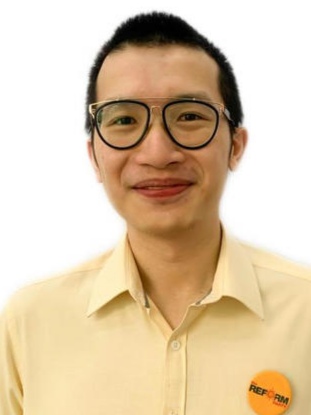
Mr Charles Yeo, Advocate and Solicitor

Reform Party’s candidate in GE2020

Charles is a practising lawyer and political activist in Singapore and also serves as the Chairman of the Reform Party. During the webinar, he will be speaking on how the law has a chilling effect on civil society generally and how a culture of intimidation and fear is used to create a system of self-censorship

Mr Nicholas Tang, Law Engineer

Red Dot United’s candidate in GE2020

Nicholas is keenly interested in political and social issues and shares the concerns, experience and challenges of young Singaporeans as they deal with an increasingly daunting and globalised world. He is determined to understand the problems faced by his peers; to help improve the lives of future generations and strongly feels that participation in civil discourse is the duty of every citizen.

Ms Vigneswari Diana Ramachandran, Teacher

People’s Voice Party’s candidate in GE2020

Vigneswari currently serves as the teacher of Citikids Edventure at Bukit Panjang, responsible for children aged 6 years old preparing teaching aids, lesson materials, observations, summary reports,  work samples and children’s progress also linking home school partnership projects between the school and parents. She has 12 years of teaching experience in the preschool education industry and in other sectors such as in retail. She is also the member of People’s Voice Party. 

During the webinar, she will be addressing the educational system in Singapore and the issues faced in the preschool sector from teachers’, operators’, and students’ perspective. 

Mr Terence Soon Jun Wei, Aviation Professional

Head of Youth Wing

Progress Singapore Party’s candidate in GE2020

Terence currently heads the youth wing in the Progress Singapore Party (PSP), also known as the PSP Youth Catalyst. He was a candidate in the recent GE 2020, contesting under the PSP’s banner in Tanjong Pagar GRC.

Terence is an aviation professional; formerly running a business dealing with the brokerage of private aircraft, before joining Singapore Airlines in 2015 where he is currently a Pilot operating the Boeing 777 jets.

Terence will be discussing about the youth effect on GE 2020’s results, and what youth in Singapore can, and must, do in the years ahead in order to effect the change that they want to see in our society. Terence strongly believes that youths are not only the leaders of tomorrow, but they can be the leaders of today.

Ms Min Cheong, Writer and Marketing Communications Strategist

Singapore Democratic Party’s candidate in GE2020

Min is a seasoned writer and marketing communications strategist who has worked for multinational corporations, start-ups, and non-profit organisations across industries spanning consumer technology, telecommunications, lifestyle, and education. 

She joined the SDP in 2011 as a volunteer in the policy studies unit, and was a counting agent for the party in both the 2011 and 2015 General Elections before becoming more active in her contributions. She is now a member of the Young Democrats, Women Democrats, and Communications teams.

Min is an advocate of open public discourse, and is also passionate about what she calls Workforce Wellness – an overarching approach to reforming how we live and work – covering issues ranging from socio-economic sustainability, job creation and innovation, career empowerment, organisational culture, and personal wellbeing.

She believes in harnessing information, innovation and technology as tools people can use to empower themselves, share ideas and better the world; and supports enlightened, compassionate, and respectful leadership focused on value-creation above profit-generation.


All are welcome to attend the webinar, should the Zoom attendance limit be reached, please follow the live streaming on MARUAH’s Facebook at https://www.facebook.com/MARUAHsg/


[Repost] Statement of love & support for all members of our LGBT+ community in Singapore

13 August 2020

https://heckinunicorn.com/pages/statement-love-support-lgbt-members-community-in-singapore

We stand in solidarity with everyone in Singapore’s lesbian, gay, bisexual, transgender, gender-diverse, intersex, non-binary & queer (LGBT+) community.

We extend our love to those who are questioning, exploring, or even struggling with your gender identity, sexual orientation, and/or attractions. We feel your loneliness, and we hear you.

We reach out especially to those among us who have survived attempts to change us through conversion practices. We feel your shame and your pain. We see you for who you are, in your beloved wholeness.

We believe that faith and religion may be comforting resources, but we also acknowledge the evidence that shows the harm and trauma that conversion practices can cause us.

We are here to offer you a safe and affirming space to be yourself.  We feel your strength and your resilience, and we extend our compassion.

Above all, we are here to let you know that you are not alone.

You are not alone. We’re here.

Statement prepared by Heckin’ Unicorn & Oogachaga.

For a full list of community organisations in Singapore which jointly supported this statement, please visit https://heckinunicorn.com/pages/statement-love-support-lgbt-members-community-in-singapore


[Espacio Público] Organizations in the region demand the Venezuelan Government’s compliance with their human rights obligations amid the humanitarian and sanitary emergency in the country

5 August 2020

4 August 2020

Human rights organizations that sign on to  this statement condemn the escalation in reprisals and persecution of the Venezuelan people for the exercise of their fundamental human rights. An unprecedented  Venezuelan humanitarian emergency has been severely aggravated by the sanitary crisis generated by the  COVID-19 virus. The signatory organizations urge  the Venezuelan Government to respect and guarantee the exercise of human rights without discrimination.

A joint declaration of United Nations experts and Special Rapporteurs published on the 29th of June details the current  living conditions of the Venezuelan people. According to the “Living Conditions Survey” of 2019/2020, 79.3% of Venezuelan homes cannot afford basic food supplies, 96% of Venezuelan families are classified as poor and 79% can be classified as living in extreme poverty. In addition,  21% of children under the age of 5 are at grave risk of malnutrition. During the COVID-19 pandemic unemployment rates have increased by 6.9%. and 43% of Venezuelan families have been unable to work and have registered losses in their income.

Another UN joint declaration, published on the 28th of June gives a thorough account of the repressive context during the first third of the year, in which at least 51 attacks against human rights defenders and organizations have been documented. The illegitimate «National Constituent Assembly» is also trying to pass a law that would prohibit and limit international funding of civil society organizations, which would increase the operational limitations of organizations to submit documentation or update their status before administrative institutions.

There has also been an increase in surveillance, hacking and the blocking of web pages of human rights organizations. The use of sophisticated methods, such as the creation of fake reports that lead to  web providers’ closing their web pages and blocking access to their information  has also increased.

The UN High Commissioner for Human Rights released a report on July 3rd,  2020 indicating that between March and June of 2020 there has been an arbitrary use of the “State of Alarm” in Venezuela. The military, security forces and the judicial power have carried out arbitrary detentions, brief forced disappearances, and initiated judicial processes against activists, journalists, health personnel and human rights defenders. The report reveals a pattern of human rights violations  against  people who have supposedly participated in “destabilization actions against the government”.

The Inter-American Commission on Human Rights (IACHR) released a press release on July 15,expressing concern regarding the continuing hostility and a discourse of criminalization  against human rights activists in the context generated by the pandemic. “The IACHR reiterated its call to the Venezuelan State to adopt measures to combat stigmatization campaigns targeted at  those who defend human rights in the country as it had signaled before in its Press Release No. 40/19.”

The undermining of civic space and democracy in Venezuela is evident in systematic violations of human rights, generally committed within the framework of security operations, including the repression of protests and media coverage, or political persecution against the dissemination of opinions and/or the work of human rights defenders seeking to confront the authorities’ abuses during the pandemic. The response of the Venezuelan government continues to be focused on the repression and censorship of its citizens, which, in addition to affecting civic space, compounds the effects on other human rights, including citizens’ economic, social and environmental rights.

Most of the cases that have been documented by Venezuelan organizations report the use of the “internal enemy” thesis. The concentration of all powers in the Executive branch is used to punish the “opposition” or people perceived as such, which in turn creates an inhibitory  effect that silences all possible opinions or protests against the current crisis.

These violations are bound to be exacerbated due to the absence of judicial independence and impartiality. As the UN High Commissioner   indicated in her July 15th report on access to justice: “The information at hand suggests that the Judges of the TSJ (Supreme Court) have control of the judgments issued by lower courts throughout the country, especially in the criminal jurisdiction. The lack of job stability for criminal prosecutors also affects their impartiality. Almost all of them are provisional and may be removed at the discretion of the the Attorney General. The Attorney General was elected by the Constitutive National Assembly” using a process that does not respect constitutional requirements.”

The human rights organizations that sign on to this statement urge the Venezuelan  government to respect and guarantee the exercise of fundamental rights of Venezuelan citizens, which are of even greater importance during the pandemic. In addition, the Venezuelan government should facilitate dialogue with and democratic participation of civil society for the sake of generating structural and human rights-friendly solutions to this crisis. In this sense, we request the following:

1. Compliance with  the recommendations included  in the reports of the UN High Commissioner for  Human Rights  and the Inter-American Commission and Court of Human Rights’  reports, hearings and precautionary measures. .

2. Cooperation with and  application of the recommendations given by the Treaty Bodies and Special Procedures of the United Nations.

3. The reestablishment of the rule of law and democracy through t Venezuela’s constitutional channels to overcome the crisis in a peaceful way.

References

https://spcommreports.ohchr.org/TMResultsBase/DownLoadPublicCommunicationFile?gId=25229

https://spcommreports.ohchr.org/TMResultsBase/DownLoadPublicCommunicationFile?gId=25212

https://www.civilisac.org/civilis/wp-content/uploads/Informe-sobre-Patrones-de-Violaci%C3%B3n-de-DDHH-Completo-01.pdf

http://www.oas.org/es/cidh/prensa/comunicados/2020/165.asp

https://www.ohchr.org/EN/HRBodies/HRC/RegularSessions/Session44/Documents/A_HRC_44_54_UnofficialSpanishTranslation.pdf

Signatory organisations:

Associação Brasileira de Jornalismo Investigativo (Abraji) – Brasil

Alerta Venezuela 

CIVICUS – Global

Derechos Digitales – América Latina

Kazakhstan International Bureau for Human rights and the Rule of Law – Kazakhstan

MARUAH – Singapore

Partnership for Integrated Protection (PPI) – Congo

Robert F. Kennedy Human Rights – EEUU

R3D: Red en Defensa de los Derechos Digitales – México

ROLBG Human Rights – Gabon

Usuarios Digitales – Ecuador

Venezuela Inteligente – Venezuela 

Alianza Regional por la Libre Expresión e Información – América Latina

Members:

Asociación Nacional de la Prensa de Bolivia – Bolivia

Observatorio Cubano de Derechos Humanos – Cuba

Fundación Violeta B de Chamorro – Nicaragua

Instituto de Derecho y Economía Ambiental – Paraguay

Fundación Ciudadanía y Desarrollo – Ecuador

Fundación Salvadoreña por el Desarrollo Económico y Social – El Salvador

Transparencia por Colombia – Colombia

Fundación Democracia sin Fronteras (FDsF) – Honduras

Centro de Archivos y Acceso a la Información Pública (CAinfo) – Uruguay

ARTICLE 19 – Brasil

Fundar – México

Acción Ciudadana (AC) – Guatemala

Comité por la Libre Expresión (C-Libre) – Honduras

Participación Ciudadana – República Dominicana

Transparencia Venezuela


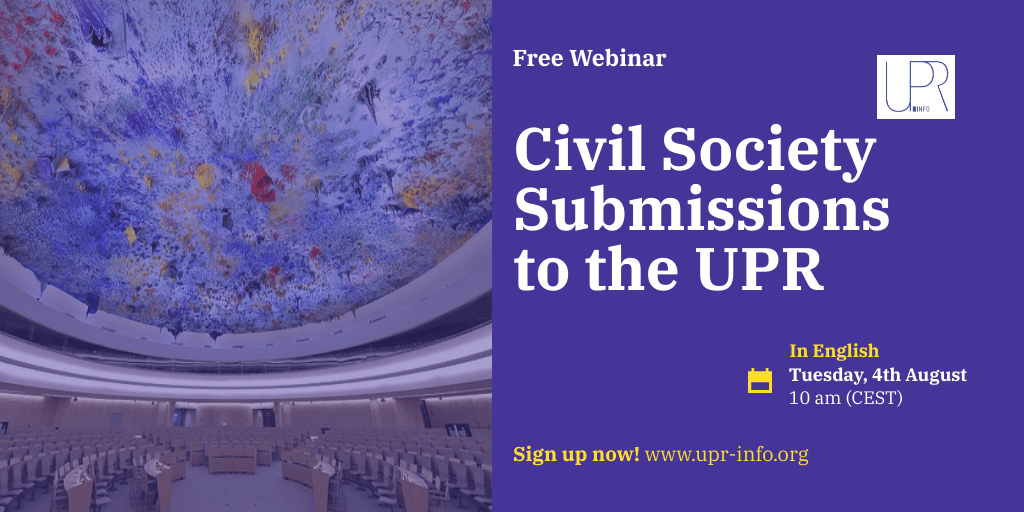
[Repost] UPR Info: Free Webinar on Civil Society Submissions to the Universal Periodic Review

30 July 2020

* New timing: English session to be held on Tuesday, 4th August 2020 at 9:00 am CET / 3.00pm (SG time)

This webinar will equip human rights advocates with the tools and information necessary to engage with the UPR, a unique mechanism of the United Nations Human Rights Council aimed at improving the human rights situation in UN Member States. To participate in the event, please register here. 

Civil society is encouraged to submit their own assessment of the human rights record of the States under Review to the Office of the High Commissioner of Human Rights (OHCHR) around 6–8 months before the review itself. The OHCHR will compile all of the civil society reports received into a single summary report. If your organization submits a well-documented and structured report, your key priorities will most likely be included in OHCHR summary report.

All human rights advocates are welcome to participate. 

In light of the deadline for the submission of the Stakeholders reports for the States that will be reviewed at the 38th session (15th October 2020), we particularly encourage the attendance of civil society organizations, human rights defenders and NHRIs from Namibia, Niger, Mozambique, Estonia, Paraguay, Belgium, Denmark, Palau, Somalia, Seychelles, Solomon Islands, Latvia, Sierra Leone and Singapore.

Kindly note that the webinar will take place in English, French and Spanish according to the following schedule:

English:  Tuesday, 4th August 2020 at 9:00 am CET / 3.00pm (SG time)
French:  Thursday, 6th August 2020 at 11:00 am CET
Spanish:  Wednesday, 19th August 2020 at 14:00 pm CET

Don’t forget to share our flyer with your CSO network! 

For further information, visit our website or contact us at:  stakeholders@upr-info.org

We look forward to welcoming you to the event.

With best wishes,

UPR Info Team


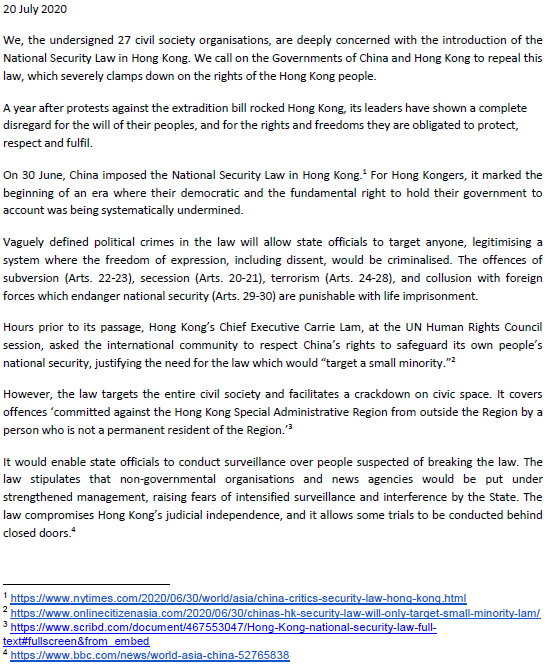
[Joint Statement] China and Hong Kong: Repeal the National Security Law, respect rights and freedoms in Hong Kong

22 July 2020

[Repost from ANFREL] Hong Kong: Stop Intimidation and Threats Ahead of Legislative Council Elections

22 July 2020

The Asian Network for Free Elections (ANFREL) is alarmed by the quickly deteriorating election environment in the run-up to the Hong Kong Legislative Council elections scheduled for 6 September 2020.

The new National Security Law that came into effect on 30 June has exacerbated a climate of fear in Hong Kong’s electoral democracy. The law’s ambiguities in criminalizing secession, subversion, terrorism, and collusion with foreign forces with sentences going up to life imprisonment has given the authorities sweeping powers to clamp down on civil liberties and human rights[1].

Several pro-democracy groups advocating for greater autonomy and self-determination, such as the Hong Kong National Front, Studentlocalism and opposition party Demosistō[2], have since chosen to either disband or relocate abroad over fears of political imprisonment. Activist and former lawmaker Nathan Law has also fled Hong Kong[3] and subsequently withdrawn from the pro-democracy camp’s primaries. Other opposition members are facing an uncertain future ahead as the Beijing-imposed law has empowered authorities to disqualify candidates from running in the election[4].

The authorities have used the new legislation to threaten the organizers of the 11 and 12 July primaries designed to select pro-democracy candidates to the 6 September legislative elections. Secretary for Constitutional and Mainland Affairs Erick Tsang claimed the participation in the primaries may violate the National Security Law[5], while Chief Executive Carrie Lam declared that the coordinated effort by democrats to win a majority in the legislature to oppose government policy “may fall into the category of subverting the state power”, an offense under the new law[6].

On the day before the primaries, district councilors and a pro-democracy shop faced intimidation attempts to warn them not to use their premises as polling stations[7]. The Hong Kong police also raided the office of the primaries’ co-organizer Public Opinion Research Institute (PORI), accusing the organization of “dishonest use of a computer”[8].

Despite overt intimidation, the two-day primaries saw a high voter turnout, with over 600,000 Hong Kongers casting ballots in the process. It is commendable that the people of Hong Kong are showing their resilience and determination to resist democratic regression.

The instillation of fear using the National Security Law did not stop after the primaries. Both Hong Kong Liaison Office[9] and Hong Kong and Macau Affairs Office[10] have issued strong-worded statements to accuse the primaries of violating the National Security Law. The Electoral Affairs Commission also claimed the primaries are not part of the electoral procedures and reminded the public to take heed of the National Security Law when organizing and participating in election-related activities[11].

The National Security Law is the latest development in a year-long crackdown on protesters, activists, and opposition forces in the territory. In November 2019, authorities conducted a two-week siege on the campus of Hong Kong Polytechnic University[12], culminating in over 1,100 arrests in a single day[13]. On 18 April 2020, police arrested 15 prominent activists[14], including publishing tycoon Jimmy Lai and founder of the Democratic Party Martin Lee, in what was perceived as a hardening of the authorities’ position towards the pan-democracy camp.

ANFREL condemns the sustained intimidation and threats towards the city’s democracy advocates, citizens, and civil society by the authorities of Hong Kong and Beijing. Avenues for debate and constructive dialogue have been steadily restricted, ensuring that the environment prior to the Legislative Council elections can be considered neither free nor fair.

We call for an immediate repeal of the National Security Law, which violates the spirit of the 1984 Sino-British Joint Declaration and Hong Kong’s Basic Law and stand in solidarity with Hong Kongers in their pursuit for democracy, attachment to fundamental freedoms, and demands for free and fair elections. We call on the government of China to honor its international commitments and stop encroaching on Hong Kong’s autonomy, rights, and tradition of democratic governance.

[1] https://www.hrw.org/news/2020/06/09/hong-kong-rights-under-attack-anniversary
[2] https://www.taiwannews.com.tw/en/news/3956221
[3] https://hongkongfp.com/2020/07/02/breaking-democracy-activist-nathan-law-says-he-has-fled-hong-kong/
[4] https://www.scmp.com/news/hong-kong/politics/article/3091433/national-security-law-facing-disqualification-or-worse-hong
[5] https://www.theguardian.com/world/2020/jul/14/hong-kong-primaries-china-declares-pro-democracy-polls-illegal
[6] https://hongkongfp.com/2020/07/13/democrats-plan-to-win-legislative-majority-to-oppose-govt-policy-may-be-illegal-under-security-law-says-hong-kongs-lam/
[7] https://hongkongfp.com/2020/07/11/hong-kong-primaries-pro-democracy-shop-scraps-polling-station-plan-as-govt-warns-district-councillors/
[8] https://www.rfa.org/english/news/china/raid-07102020105020.html
[9] http://www.locpg.gov.cn/jsdt/2020-07/13/c_1210700891.htm
[10] https://www.hmo.gov.cn/xwzx/xwfb/xwfb_child/202007/t20200714_22007.html
[11] https://www.info.gov.hk/gia/general/202007/14/P2020071400889.htm
[12] https://www.nytimes.com/2019/11/29/world/asia/hong-kong-protests-polytechnic.html
[13] https://asia.nikkei.com/Spotlight/Hong-Kong-protests/Hong-Kong-arrests-mount-to-1-100-as-campus-siege-continues
[14] https://www.scmp.com/news/hong-kong/politics/article/3080529/least-12-hong-kong-opposition-veterans-arrested-police-over

Download the full statement here: Hong Kong: Stop Intimidation and Threats Ahead of Legislative Council Elections


MARUAH’s Notice to Political Parties for Singapore’s Future

8 July 2020

Congratulations on this lead up to Polling Day on July 10th. Wishing each candidate and all political parties the absolute best.

As Singapore citizens we will be making our way to the polling station if we can, practice ‘stay safe’ habits and vote for the political parties and the candidates that we think will best represent our interest and with whom we can work to build up our country as a peaceful, prosperous and equal society to live in, where we can enjoy happiness, have fair and equal access to justice for all persons and practice non-discrimination as our moral code.

So, as a human rights organization, MARUAH is reminding all political parties and candidates that they need to fulfil State obligations to promote, protect and fulfil a citizen’s rights. We also reassure that an individual’s right does not mean it is to the exclusion of community-mindedness or a mutualism, as this is already a given in the Universal Declaration of Human Rights (Article 29). We also state as Singapore becomes more diverse and we live in an interconnected world that the core values of human rights – indivisible, inalienable, interdependent and universal – are not compromised as legislation, policies and programmes are prepared and set for the future. These core principles are also part of the Sustainable Development Goals in its 2030 vision, in its frameworks and in international agreements. As such we make the following calls on what we would like to have over the next five years, till the next General Elections. We ask:

  • that we achieve a higher level of accountability through a Transparency Act that we hope will be enacted before the next General Elections
  • that the Freedom of Information Act be enacted so that data, public documents, and historical materials can be shared with the public and where needed, can be held as archives
  • that the Freedom of Expression be legislated as the digitized world is the norm and we already have the counterbalancing force via legislation – Protection of Online Falsehoods and Manipulation Act (POFMA) – and the authoritative powers as given to each Minister 
  • that an Anti-Discrimination Act be enacted as soon as possible
  • that all political parties and especially those with representatives in Parliament take on a participatory approach with civil society freely and not selectively, setting the ground rules for fair-minded conversation aimed at the betterment of people, protecting their rights and developing a stronger democracy
  • that the budget for Defence be reduced from its current proportion of the national budget and that there is an increased focus on peace  building, reparative and remedial work  in the region and internationally through our diplomacy, making it Singapore’s mainstay reputation
  • that we ratify international peace treaties such as the Convention on the Prevention and Punishment of the Crime of Genocide (1951)
  • that we also ratify the International Convention on the Protection of the Rights of All Migrant Workers and Members of Their Families (1990)
  • that we make determined plans to ratify the core human rights instruments of the International Covenant on the Civil and Political Rights (1966), the International Covenant on the Economic, Social and Cultural Rights (1966)
  • that we become signatories to the Core International Labour Organisation’s Agreements that are still pending
  • that we build up, to achieve an excellent track record, on the Paris Agreement (2016) and so become a leading force in the region as a Climate Change promoter and advocate, to protect and preserve the environment
  • that we continue to be a key leader in ASEAN in bridge-building but support the human rights agenda of ASEAN in that they need to be fulfilled
  • that we develop an economic climate that builds up on a national developmentist approach of self-sufficiency, a greater reliance on regional supply chains for goods, raw materials and human resources and process Singapore’s shift from just market-driven capitalism to sustainability and self-sufficiency in the creation of new industries and job opportunties
  • that policies be centred on ensuring that all basic needs of an individual are met adequately and well, so that no one is left behind or be placed, divided into various recipient clusters to receive social protection of social insurance, social assistance and universal transfers, which ought to be well-planned and implemented on a sustainable scale leading to empowerment, confidence and independent living of individuals and communities
  • that land prices are not pegged to market prices for public housing and for small scale enterprises so that costs are not beyond a middle-income individual with an unbroken career path
  • that we set the National Minimum Wage that takes into account the living costs in Singapore 
  • that health care pricing be reviewed with inputs from experts and by studying the schemes held by other countries so that people in Singapore can access healthcare with affordable healthcare insurance schemes
  • that we measure success by determined factors of well-being, happiness of the people and of having participatory and democratic processes
  • that as citizens there will be greater monitoring of politicians and political parties due to digitisation of information as well as rising awareness in politics

Majulah Singapura!

MARUAH Secretariat


MARUAH – GE2020

8 July 2020


MARUAH – GE2020 series (6 of 6)

8 July 2020

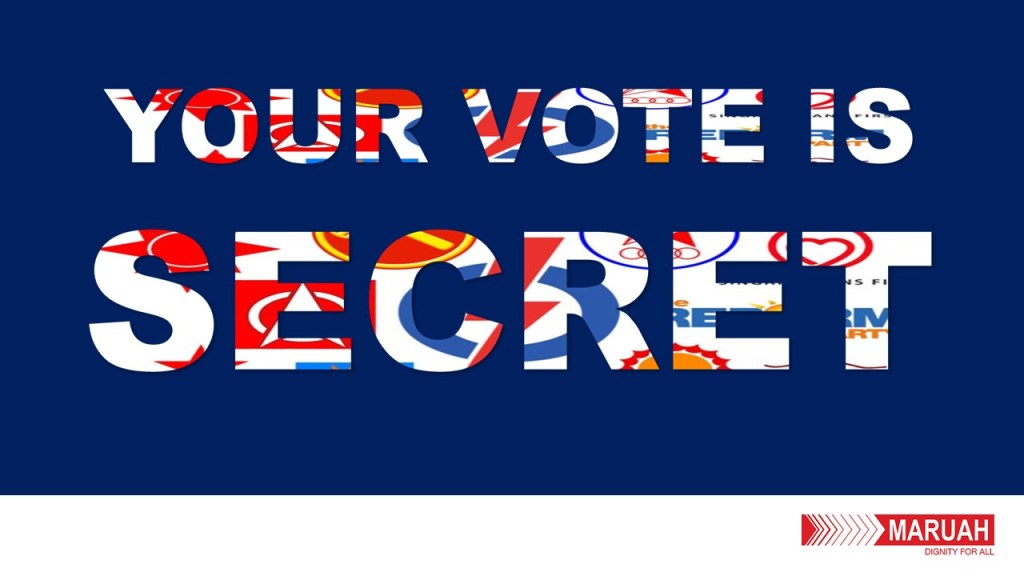
Article 21(3) of the Universal Declaration of Human Rights

The will of the people shall be the basis of the authority of government; this will shall be expressed in periodic and genuine elections which shall be by universal and equal suffrage and shall be held by secret vote or by equivalent free voting procedures.

At MARUAH, we believe in everyone’s right to a free and fair election.


MARUAH – GE2020 series (5 of 6)

7 July 2020

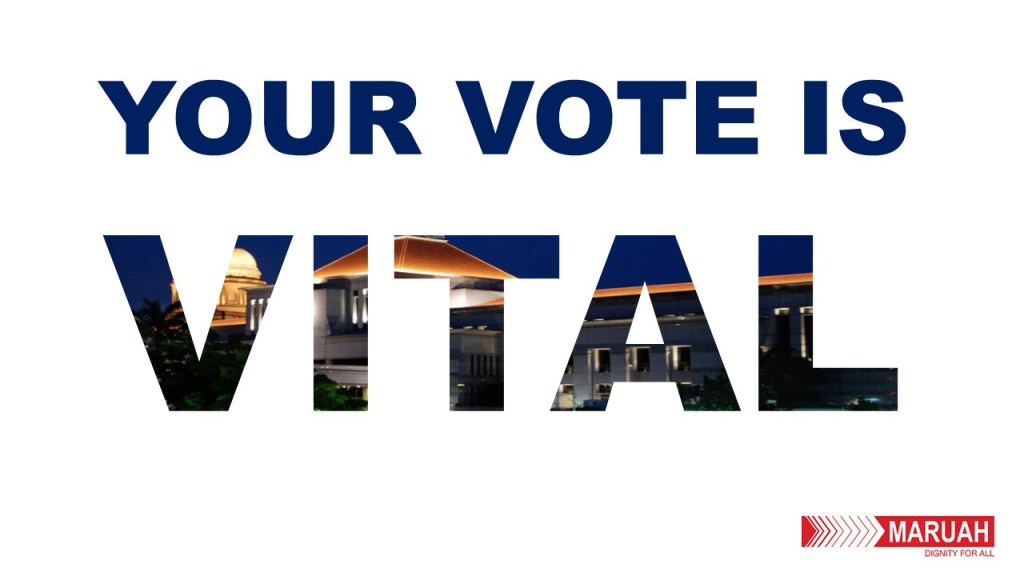
Article 21(3) of the Universal Declaration of Human Rights

The will of the people shall be the basis of the authority of government; this will shall be expressed in periodic and genuine elections which shall be by universal and equal suffrage and shall be held by secret vote or by equivalent free voting procedures.

At MARUAH, we believe in everyone’s right to a free and fair election.