
[Update] Recording of the online forum is now available! Please click on link below to watch this on YouTube.
[Update] Recording of the online forum is now available! Please click on link below to watch this on YouTube.
 Leave a Comment » |
  Uncategorized | Tagged: ASEAN, covid-19, human rigts, migrant workers, webinar |
  Permalink
 Posted by jamestan2019
We are pleased to share a publication published by the Penang Institute. The “Human Rights Derogations in Southeast Asian Countries during the Covid-19 Pandemic” was written by Braema Mathiaparanam (Visiting Senior Research Fellow, History and Regional Studies Programme).
The full publication can be found at: https://penanginstitute.org/wp-content/uploads/2020/09/Human-Rights-Derogations-in-Southeast-Asian-Countries-during-the-Covid-19-Pandemic.pdf
EXECUTIVE SUMMARY
Leave a Comment » | Uncategorized | Tagged: ASEAN, covid-19, human rights, pandemic, south east asia | Permalink
Posted by jamestan2019
MARUAH hosted the GE2020 Post election webinar entitled “Our Youth, Our Future” this morning (5 September).
We would like to thank all our speakers, Discussant Prof Kenneth Paul Tan and Moderator Ms Braema Mathi for taking time to share their thoughts and contributing to a lively discussion. We also would like to thank all Zoom participants and viewers who watched the webinar via the Facebook livestream.
The video from the webinar has been uploaded to MARUAH YouTube channel at https://youtu.be/glRSVAvrdqE, please feel free to share this with all your contacts.
If you would like to join MARUAH as a volunteer, please fill in this form – https://bit.ly/3jLdqx6.
Thank you and we look forward to having you at our next online discussion.
MARUAH Secretariat
Leave a Comment » | Uncategorized | Tagged: future, ge2020, human rights, SGElection, sgelections, singapore, webinar, youth, zoom | Permalink
Posted by jamestan2019
Prosecute for offences of killing and causing injury, not merely non-compliance of occupational safety and health requirements
We, the 49 undersigned groups, organizations and trade unions demand that Inquests (Inquiries into death) be conducted for all deaths at workplace, to ensure that justice be done, and ensure that those responsible for the death of workers are also charged and tried for killing crimes. Mere fines for non-compliance of occupational safety and health legal requirements, and no prosecution and penalizing those responsible for crimes of causing death and/or injury of workers is simply inadequate and unjust.
INQUESTS (Inquiries into the death), carried out by an Independent Coroner, in open court, to determine not simply the cause of death, but more importantly whether anyone is criminally liable for the death.
Criminal liability will determine also whether employers, owners, contractors and/or their officers ought to be prosecuted for murder, homicide or causing death by negligence, which are all criminal offences under the Malaysian Penal Code. If the risk of death is known, and there is a failure to do what is needed to keep workers safe, which resulted in the death of a worker, then it could be a murder or homicide.
Criminal liability for those responsible for worker’s deaths at workplaces
On 8 August, Zaid Berahim, 33, died in a factory in Bayan Lepas, Penang (Bernama, 8/8/2020).In mid-March 2020, Malaysians Azarul Ashraf Nor Akmal Zorkalnain, Che Huzaydy Che Harun, Norfazly Mad Nor, Faidhi Akmal Fadzil and Hadi Syafiq Jamil were reported killed in an accident at a refinery owned by PRefChem, a joint venture between Petronas and Saudi Aramco.(Star, 17/3/2020).
At least 61 workers died at the workplace from January to March 2020, according to Department of Occupational Safety and Health (DOSH) data of reported cases. In 2017, DOSH has recorded 711 deaths at the workplace (Malay Mail, 9/7/2018), but no one seems to have been charged for murder or homicide, let alone causing death by negligence for any of these many deaths.
The current practice seems to be simply fining guilty employers or others for non-compliance of workplace requirements and/or obligations to ensure workplace safety. Sadly, offences carry the same sentences, irrespective whether a worker died or was injured, in many workplace legislations including the Occupational Safety and Health Act 1994(OSHA). Reasonably, when injury or death is caused by law breakers, there must be a higher deterrent sentence.
Worker’s lives matter, and all these deaths must be comprehensively investigated beyond merely looking at permit/licensing laws and/or occupational safety and health legal obligation compliance, but also whether any person may criminally liable for the crimes of causing death and/or injury.
Death of worker at workplace may be murder or homicide
Malaysian law, as it is now, states if there is ‘…knowledge that he is likely by such act[or omission] to cause death…’, a person commits the offence of culpable homicide.(Section 299 Penal Code)
It would be the more serious crime of murder ‘if the person committing the act knows that it is so imminently dangerous that it must in all probability cause death, or such bodily injury as is likely to cause death, and commits such act without any excuse for incurring the risk of causing death, or such injury as aforesaid.’(Section 300(d) of the Penal Code). The fact that one did not know that someone will be killed by their actions/omissions is irrelevant under this particular definition of murder.
Temerloh Fatal Accident Case could be Murder – A predictable and preventable death?
In Temerloh, in early March 2020, Md Shoriful, 43, and Julhas Rahman, 27, died by reason of being buried alive in a trench while working at a housing development construction site. This could be classified as murder.
The Malaysian Construction Industry Development Board (CIDB)’s Construction Industry Standard CIS 25:2018, as an example, categorizes this kind of work as HIGH risk, with the risk of death by being buried alive. As such, it is a known ‘imminently dangerous’ work, which can cause death, and any contractor or corporation involved in construction work ought to know this.
To prevent such high risk death, there are clear legal obligations. For trenches/pits, for example, CIDB requires proper shoring, where the shoring design must also be approved by a Professional Engineer (PE) and periodically inspected. The dug-out soil is also required to be placed a certain distance away from the edge of the pit/trench, beyond the ‘zone of influence’. Reasonably, machinery that cause vibration that could cause stacked up soil beside a trench/pit falling back burying alive workers, should not be operating nearby when workers are working in such deep trenches.
Media reports about the Temerloh incident, amongst others, said ‘Both victims and the third worker are believed to have been inside a six metre-deep pit, while two machines were excavating earth on the ground above the pit. “Heaps of soil which had collected at the edge of the pit then began falling during the excavation works, burying the two workers,” said Temerloh district police chief Assistant Commissioner Mohd Yusri Othman.’(New Straits Times, 6/3/2020)
From just these known facts itself, the legal requirements for it to be classified as a murder or homicide case, would have been fulfilled. However, there has been no subsequent news whatsoever whether the police are even conducting a murder investigation.
Inquest prevents ‘cover ups’ and failings – Muhammad Adib’s case
Even if the law enforcement authorities fail to act, an INQUEST finding certainly can prevent possible ‘cover-ups’, corrupt practices and other failings. It will ensure investigations and possibly prosecutions of those criminally liable for the deaths.
An inquest was carried out in the case of the death of a fireman who died in Malaysia in November 2018, while carrying out his work. ‘The death of fireman Muhammad Adib Mohd Kassim was a result of a criminal act by more than two people, an inquest ruled nine months after his death.’(New Straits Times, 27/9/2019).
This inquest finding did result in further police investigations, and recently the Malaysian police disclosed even further plans of setting up a review team to probe into all aspects regarding the death.(Malay Mail, 10/7/2020). There is still much public pressure for the prosecution of those who are criminally liable for Adib’s death.
Inquest overcomes inadequacies of law and practice
An inquest by an independent Coroner, is a recognized right in Malaysia for all deaths, and it should NOT only be done for victims who die by reason of stabbing, shooting and/or beatings, but for all persons that die including workers killed at workplaces.
The Coroner, being a judicial officer usually a Magistrate, is a person independent from the various law enforcement agencies, can and will do a determination that will overcome failings and/or mistakes, of responsible for law enforcers.
In workplace deaths, which is usually covered by many different laws and different agencies, where most agencies may act simply in accordance to the particular law that they are responsible for. An Inquest will be able to look at every aspects including law and legal obligations, including also the Penal Code, in their determination of criminal liability.
We reiterate that persons responsible for workplace deaths can be charged and tried for murder or homicide, simply by reason of failure to do the needful, to reduce risk or prevent deaths, when their failings caused death.
INQUEST for all Deaths is provided by Law
Malaysian Criminal Procedure Code (CPC) clearly provides that a magistrate shall hold an INQUEST (inquiry into death) for all deaths, whereby during such inquest, the Coroner (usually a Magistrate or Judge) shall determine as to when, where, how and after what manner the deceased came by his death and also whether any person is criminally concerned in the cause of the death.(Section 333 and 337 CPC).
An INQUEST is open to the public, and, as such, any interested party (and/or their lawyers), including trade unions, can be involved in the inquest, with the capacity of even calling and examining witnesses, and tendering additional evidence to assist an independent Coroner make a determination into the cause of death, which includes also whether any person (including corporations and their officers) could be criminally liable for the death – murder, culpable homicide or causing death by negligence.
Inquest for workplace deaths must consider all relevant laws and facts
For Inquests of deaths at workplaces, the Coroner needs to consider all relevant employer, owner and controller of worksites legal obligations. In Malaysia, there are clear obligations, amongst others, requirements about permits/license, qualification of workers and even standard of materials/equipment used. A failure to get a relevant permit, for example, for the storage of dangerous substance, can result in failure of relevant enforcement agencies inspecting and ensuring due compliance.
In 2018, we saw a case where the employer or factory owner did not having the permit to store hazardous material, which resulted in ammonia poisoning that killed 2 workers died and injured 18 others(Sun Daily, 13/8/2018). This case could be classified as murder or homicide.
The Coroner must consider whether it is a known risk, and whether the employer, owner and contractor did all that was required by law to prevent deaths, especially from predictable and preventable risks. A failure may result in being criminally liable for murder, homicide or even at the very least the crime of causing death by negligence.
For a construction site fatal accident, the relevant agencies that ought to be assisting the Coroner during an Inquest may include also the Department of Occupational Safety and Health (DOSH), Construction Industry Development Board (CIDB), the Local Government, all approving authorities and other relevant agencies.
Protecting Workers Lives Must Be a Government Priority
Malaysian laws, policies are in serious need of reforms, with the object of ensuring safe working environment, and preventing worker deaths and injuries.
Under the Occupational Safety and Health Act 1994, there is still no clear legal obligations to even keep workers safe from Covid-19 or other occupational diseases. There is still no specific workplace regulations, made in accordance with this law that is the primary legislation dealing with workplace safety and health, which imposes clear legal obligations on employer or workplace owners to keep workers safe from even Covid-19, where a breach will be an offence with clear penalties. Only regulations by the Ministry of Health of general application currently exist.
Malaysia also still do not have offence of industrial manslaughter, which deals with workplace deaths. For example, in Queensland, Australia, industrial manslaughter is committed when a person conducting a business or undertaking (PCBU), or a senior officer, to negligently cause the death of a worker, whereby the maximum penalty is 20 years imprisonment for an individual, or $10M for a body corporate.
Therefore, we call
– That public Inquest(Inquiries into death) be conducted for all worker deaths at workplaces by the Coroner;
– That an inquest be forthwith conducted for death of Md Shoriful (43) and Julhas Rahman (27), who died after being buried alive working in a deep trench to determine whether anyone ought to be charged for murder or homicide;
– That the government enact laws that provide for a higher penalty, if by reason of non-compliance of laws, injury or death of workers happens;
– That the government prioritizes worker safety and health, and make the needed legal, policy and practice reforms.
Charles Hector
Apolinar Tolentino
For and on behalf of the following 49 groups and trade unions
ALIRAN
Building and Wood Workers International (BWI) Asia Pacific Region
Clean Clothes Campaign (CCC) South East Asia Coalition
UNI Global Union- Asia and Pacific Regional Organisation (UNI APRO)
WH4C (Workers Hub For Change)
SUARAM
AMMPO-SENTRO- Association of Filipino Nationalist Workers in Malaysia
Bangladesh Group Netherlands
Banglar Manabadhikar Suraksha Mancha (MASUM), India
Cement Industry Employees Union (CIEU)
Center for Alliance of Labor and Human Rights (CENTRAL), Cambodia
Electronic Industry Employees Union Southern Region Peninsular Malaysia(EIEUSRPM)/Kesatuan Sekerja Industri Elektronik Wilayah Selatan, Semenanjung Malaysia (KSIEWSSM)
IMA Research Foundation, Bangladesh
International Black Women for Wages for Housework
Jaringan Solidariti Pekerja (JSP)
Kesatuan Pekerja Atlas Edible Ice Sdn. Bhd.
Labour Behind the Label(LBL), United Kingdom
MADPET (Malaysians Against Death Penalty and Torture)
Malay Forest Officers’ Union (MFOU)
MARUAH, Singapore
Marvi Rural Development Organization (MRDO), Pakistan
Migrant Care
NAMM (Network of Action for Migrants in Malaysia)
National Union of Flight Attendants Malaysia (NUFAM)
National Union of Transport Equipment and Allied Industries Workers (NUTEAIW) West Malaysia
North South Initiative(NSI)
Odhikar, Bangladesh
Parti Sosialis Malaysia (PSM)
Payday Men’s Network, UK
Payday Men’s Network, US
Penang Stop Human Trafficking Campaign
Persatuan Komuniti Prihatin Selangor & KL (PRIHATIN)
Persatuan Sahabat Wanita Selangor (PSWS)
Philippine Alliance of Human Rights Advocates (PAHRA)
PKNS Employees Union
Programme Against Custodial Torture and Impunity (PACTI), India
Sabah Timber Industry Employees Union (STIEU)
Safety and Rights Society (SRS), Bangladesh
SAVE (Social Awareness and Voluntary Education), India
Singapore Anti Death Penalty Campaign
Sosialis Alternatif (SA)
Tamkeen for Legal Aid and Human Rights- Jordan
Tenaganita
Timber Employees’ Union Peninsular Malaysia (TEUPM)
Timber Industry Employees’ Union of Sarawak (TIEUS)
Union of Employees in Construction Industry (UECI)
Union of Forest Department Employees Sarawak (UFES)
Women of Color/Global Women’s Strike
Workers Assistance Center, Inc. Philippines
Leave a Comment » | Uncategorized | Tagged: death, human rights, malaysia, workers | Permalink
Posted by jamestan2019

Please follow the ‘live-stream’ of the webinar on MARUAH’s Facebook at https://www.facebook.com/MARUAHsg/ from 10.00am onwards on 5 September 2020.
Should there be any technical issues with Facebook, please view the webinar on MARUAH’s YouTube Channel at https://www.youtube.com/user/MARUAHSG/, we hope to upload the video by 2.00pm on 5 September 2020.
The webinar will be led by Discussant Prof Kenneth Paul Tan (https://lkyspp.nus.edu.sg/our-people/faculty/kenneth-paul-tan) and Moderator Ms Braema Mathi (https://sg.linkedin.com/in/braema-mathi-88b95216).
Our panellists are –
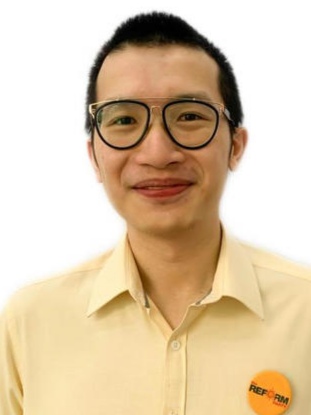
Mr Charles Yeo, Advocate and Solicitor
Reform Party’s candidate in GE2020
Charles is a practising lawyer and political activist in Singapore and also serves as the Chairman of the Reform Party. During the webinar, he will be speaking on how the law has a chilling effect on civil society generally and how a culture of intimidation and fear is used to create a system of self-censorship

Mr Nicholas Tang, Law Engineer
Red Dot United’s candidate in GE2020
Nicholas is keenly interested in political and social issues and shares the concerns, experience and challenges of young Singaporeans as they deal with an increasingly daunting and globalised world. He is determined to understand the problems faced by his peers; to help improve the lives of future generations and strongly feels that participation in civil discourse is the duty of every citizen.

Ms Vigneswari Diana Ramachandran, Teacher
People’s Voice Party’s candidate in GE2020
Vigneswari currently serves as the teacher of Citikids Edventure at Bukit Panjang, responsible for children aged 6 years old preparing teaching aids, lesson materials, observations, summary reports, work samples and children’s progress also linking home school partnership projects between the school and parents. She has 12 years of teaching experience in the preschool education industry and in other sectors such as in retail. She is also the member of People’s Voice Party.
During the webinar, she will be addressing the educational system in Singapore and the issues faced in the preschool sector from teachers’, operators’, and students’ perspective.

Mr Terence Soon Jun Wei, Aviation Professional
Head of Youth Wing
Progress Singapore Party’s candidate in GE2020
Terence currently heads the youth wing in the Progress Singapore Party (PSP), also known as the PSP Youth Catalyst. He was a candidate in the recent GE 2020, contesting under the PSP’s banner in Tanjong Pagar GRC.
Terence is an aviation professional; formerly running a business dealing with the brokerage of private aircraft, before joining Singapore Airlines in 2015 where he is currently a Pilot operating the Boeing 777 jets.
Terence will be discussing about the youth effect on GE 2020’s results, and what youth in Singapore can, and must, do in the years ahead in order to effect the change that they want to see in our society. Terence strongly believes that youths are not only the leaders of tomorrow, but they can be the leaders of today.

Ms Min Cheong, Writer and Marketing Communications Strategist
Singapore Democratic Party’s candidate in GE2020
Min is a seasoned writer and marketing communications strategist who has worked for multinational corporations, start-ups, and non-profit organisations across industries spanning consumer technology, telecommunications, lifestyle, and education.
She joined the SDP in 2011 as a volunteer in the policy studies unit, and was a counting agent for the party in both the 2011 and 2015 General Elections before becoming more active in her contributions. She is now a member of the Young Democrats, Women Democrats, and Communications teams.
Min is an advocate of open public discourse, and is also passionate about what she calls Workforce Wellness – an overarching approach to reforming how we live and work – covering issues ranging from socio-economic sustainability, job creation and innovation, career empowerment, organisational culture, and personal wellbeing.
She believes in harnessing information, innovation and technology as tools people can use to empower themselves, share ideas and better the world; and supports enlightened, compassionate, and respectful leadership focused on value-creation above profit-generation.
All are welcome to attend the webinar, should the Zoom attendance limit be reached, please follow the live streaming on MARUAH’s Facebook at https://www.facebook.com/MARUAHsg/
Leave a Comment » | Uncategorized | Tagged: future, human rights, SGElection, sgelections, sgvotes, webinar, youth, zoom | Permalink
Posted by jamestan2019
https://heckinunicorn.com/pages/statement-love-support-lgbt-members-community-in-singapore
We stand in solidarity with everyone in Singapore’s lesbian, gay, bisexual, transgender, gender-diverse, intersex, non-binary & queer (LGBT+) community.
We extend our love to those who are questioning, exploring, or even struggling with your gender identity, sexual orientation, and/or attractions. We feel your loneliness, and we hear you.
We reach out especially to those among us who have survived attempts to change us through conversion practices. We feel your shame and your pain. We see you for who you are, in your beloved wholeness.
We believe that faith and religion may be comforting resources, but we also acknowledge the evidence that shows the harm and trauma that conversion practices can cause us.
We are here to offer you a safe and affirming space to be yourself. We feel your strength and your resilience, and we extend our compassion.
Above all, we are here to let you know that you are not alone.
You are not alone. We’re here.
Statement prepared by Heckin’ Unicorn & Oogachaga.
For a full list of community organisations in Singapore which jointly supported this statement, please visit https://heckinunicorn.com/pages/statement-love-support-lgbt-members-community-in-singapore
Leave a Comment » | Uncategorized | Tagged: bisexual, faith, gender-diverse, human rights, intersex, lesbian, LGBT, lgbt+, love, non-binary, queer, religion, singapore, transgender | Permalink
Posted by jamestan2019
4 August 2020
Human rights organizations that sign on to this statement condemn the escalation in reprisals and persecution of the Venezuelan people for the exercise of their fundamental human rights. An unprecedented Venezuelan humanitarian emergency has been severely aggravated by the sanitary crisis generated by the COVID-19 virus. The signatory organizations urge the Venezuelan Government to respect and guarantee the exercise of human rights without discrimination.
A joint declaration of United Nations experts and Special Rapporteurs published on the 29th of June details the current living conditions of the Venezuelan people. According to the “Living Conditions Survey” of 2019/2020, 79.3% of Venezuelan homes cannot afford basic food supplies, 96% of Venezuelan families are classified as poor and 79% can be classified as living in extreme poverty. In addition, 21% of children under the age of 5 are at grave risk of malnutrition. During the COVID-19 pandemic unemployment rates have increased by 6.9%. and 43% of Venezuelan families have been unable to work and have registered losses in their income.
Another UN joint declaration, published on the 28th of June gives a thorough account of the repressive context during the first third of the year, in which at least 51 attacks against human rights defenders and organizations have been documented. The illegitimate «National Constituent Assembly» is also trying to pass a law that would prohibit and limit international funding of civil society organizations, which would increase the operational limitations of organizations to submit documentation or update their status before administrative institutions.
There has also been an increase in surveillance, hacking and the blocking of web pages of human rights organizations. The use of sophisticated methods, such as the creation of fake reports that lead to web providers’ closing their web pages and blocking access to their information has also increased.
The UN High Commissioner for Human Rights released a report on July 3rd, 2020 indicating that between March and June of 2020 there has been an arbitrary use of the “State of Alarm” in Venezuela. The military, security forces and the judicial power have carried out arbitrary detentions, brief forced disappearances, and initiated judicial processes against activists, journalists, health personnel and human rights defenders. The report reveals a pattern of human rights violations against people who have supposedly participated in “destabilization actions against the government”.
The Inter-American Commission on Human Rights (IACHR) released a press release on July 15,expressing concern regarding the continuing hostility and a discourse of criminalization against human rights activists in the context generated by the pandemic. “The IACHR reiterated its call to the Venezuelan State to adopt measures to combat stigmatization campaigns targeted at those who defend human rights in the country as it had signaled before in its Press Release No. 40/19.”
The undermining of civic space and democracy in Venezuela is evident in systematic violations of human rights, generally committed within the framework of security operations, including the repression of protests and media coverage, or political persecution against the dissemination of opinions and/or the work of human rights defenders seeking to confront the authorities’ abuses during the pandemic. The response of the Venezuelan government continues to be focused on the repression and censorship of its citizens, which, in addition to affecting civic space, compounds the effects on other human rights, including citizens’ economic, social and environmental rights.
Most of the cases that have been documented by Venezuelan organizations report the use of the “internal enemy” thesis. The concentration of all powers in the Executive branch is used to punish the “opposition” or people perceived as such, which in turn creates an inhibitory effect that silences all possible opinions or protests against the current crisis.
These violations are bound to be exacerbated due to the absence of judicial independence and impartiality. As the UN High Commissioner indicated in her July 15th report on access to justice: “The information at hand suggests that the Judges of the TSJ (Supreme Court) have control of the judgments issued by lower courts throughout the country, especially in the criminal jurisdiction. The lack of job stability for criminal prosecutors also affects their impartiality. Almost all of them are provisional and may be removed at the discretion of the the Attorney General. The Attorney General was elected by the Constitutive National Assembly” using a process that does not respect constitutional requirements.”
The human rights organizations that sign on to this statement urge the Venezuelan government to respect and guarantee the exercise of fundamental rights of Venezuelan citizens, which are of even greater importance during the pandemic. In addition, the Venezuelan government should facilitate dialogue with and democratic participation of civil society for the sake of generating structural and human rights-friendly solutions to this crisis. In this sense, we request the following:
1. Compliance with the recommendations included in the reports of the UN High Commissioner for Human Rights and the Inter-American Commission and Court of Human Rights’ reports, hearings and precautionary measures. .
2. Cooperation with and application of the recommendations given by the Treaty Bodies and Special Procedures of the United Nations.
3. The reestablishment of the rule of law and democracy through t Venezuela’s constitutional channels to overcome the crisis in a peaceful way.
References
https://spcommreports.ohchr.org/TMResultsBase/DownLoadPublicCommunicationFile?gId=25229
https://spcommreports.ohchr.org/TMResultsBase/DownLoadPublicCommunicationFile?gId=25212
http://www.oas.org/es/cidh/prensa/comunicados/2020/165.asp
Signatory organisations:
Associação Brasileira de Jornalismo Investigativo (Abraji) – Brasil
Alerta Venezuela
CIVICUS – Global
Derechos Digitales – América Latina
Kazakhstan International Bureau for Human rights and the Rule of Law – Kazakhstan
MARUAH – Singapore
Partnership for Integrated Protection (PPI) – Congo
Robert F. Kennedy Human Rights – EEUU
R3D: Red en Defensa de los Derechos Digitales – México
ROLBG Human Rights – Gabon
Usuarios Digitales – Ecuador
Venezuela Inteligente – Venezuela
Alianza Regional por la Libre Expresión e Información – América Latina
Members:
Asociación Nacional de la Prensa de Bolivia – Bolivia
Observatorio Cubano de Derechos Humanos – Cuba
Fundación Violeta B de Chamorro – Nicaragua
Instituto de Derecho y Economía Ambiental – Paraguay
Fundación Ciudadanía y Desarrollo – Ecuador
Fundación Salvadoreña por el Desarrollo Económico y Social – El Salvador
Transparencia por Colombia – Colombia
Fundación Democracia sin Fronteras (FDsF) – Honduras
Centro de Archivos y Acceso a la Información Pública (CAinfo) – Uruguay
ARTICLE 19 – Brasil
Fundar – México
Acción Ciudadana (AC) – Guatemala
Comité por la Libre Expresión (C-Libre) – Honduras
Participación Ciudadana – República Dominicana
Transparencia Venezuela
Leave a Comment » | Uncategorized | Tagged: espacio publico, human rights, humanitarian, sanitary emergency, UN, venezuela | Permalink
Posted by jamestan2019
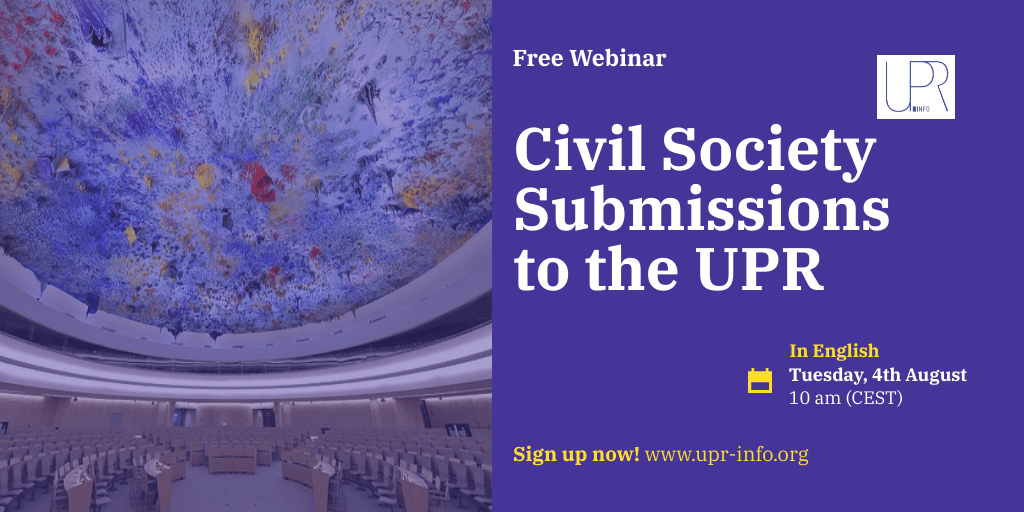
* New timing: English session to be held on Tuesday, 4th August 2020 at 9:00 am CET / 3.00pm (SG time)
This webinar will equip human rights advocates with the tools and information necessary to engage with the UPR, a unique mechanism of the United Nations Human Rights Council aimed at improving the human rights situation in UN Member States. To participate in the event, please register here.
Civil society is encouraged to submit their own assessment of the human rights record of the States under Review to the Office of the High Commissioner of Human Rights (OHCHR) around 6–8 months before the review itself. The OHCHR will compile all of the civil society reports received into a single summary report. If your organization submits a well-documented and structured report, your key priorities will most likely be included in OHCHR summary report.
All human rights advocates are welcome to participate.
In light of the deadline for the submission of the Stakeholders reports for the States that will be reviewed at the 38th session (15th October 2020), we particularly encourage the attendance of civil society organizations, human rights defenders and NHRIs from Namibia, Niger, Mozambique, Estonia, Paraguay, Belgium, Denmark, Palau, Somalia, Seychelles, Solomon Islands, Latvia, Sierra Leone and Singapore.
Kindly note that the webinar will take place in English, French and Spanish according to the following schedule:
English: Tuesday, 4th August 2020 at 9:00 am CET / 3.00pm (SG time)
French: Thursday, 6th August 2020 at 11:00 am CET
Spanish: Wednesday, 19th August 2020 at 14:00 pm CET
Don’t forget to share our flyer with your CSO network!
For further information, visit our website or contact us at: stakeholders@upr-info.org
We look forward to welcoming you to the event.
With best wishes,
UPR Info Team
Leave a Comment » | Uncategorized | Tagged: free, human rights, submissions, UN, UPR, webinar | Permalink
Posted by jamestan2019
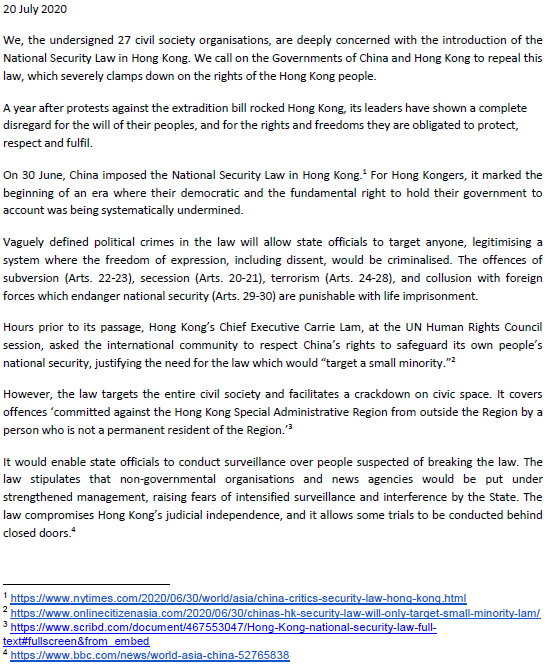


Leave a Comment » | Uncategorized | Tagged: china, freedom, hong kong, joint, national security law, political, statement | Permalink
Posted by jamestan2019
The Asian Network for Free Elections (ANFREL) is alarmed by the quickly deteriorating election environment in the run-up to the Hong Kong Legislative Council elections scheduled for 6 September 2020.
The new National Security Law that came into effect on 30 June has exacerbated a climate of fear in Hong Kong’s electoral democracy. The law’s ambiguities in criminalizing secession, subversion, terrorism, and collusion with foreign forces with sentences going up to life imprisonment has given the authorities sweeping powers to clamp down on civil liberties and human rights[1].
Several pro-democracy groups advocating for greater autonomy and self-determination, such as the Hong Kong National Front, Studentlocalism and opposition party Demosistō[2], have since chosen to either disband or relocate abroad over fears of political imprisonment. Activist and former lawmaker Nathan Law has also fled Hong Kong[3] and subsequently withdrawn from the pro-democracy camp’s primaries. Other opposition members are facing an uncertain future ahead as the Beijing-imposed law has empowered authorities to disqualify candidates from running in the election[4].
The authorities have used the new legislation to threaten the organizers of the 11 and 12 July primaries designed to select pro-democracy candidates to the 6 September legislative elections. Secretary for Constitutional and Mainland Affairs Erick Tsang claimed the participation in the primaries may violate the National Security Law[5], while Chief Executive Carrie Lam declared that the coordinated effort by democrats to win a majority in the legislature to oppose government policy “may fall into the category of subverting the state power”, an offense under the new law[6].
On the day before the primaries, district councilors and a pro-democracy shop faced intimidation attempts to warn them not to use their premises as polling stations[7]. The Hong Kong police also raided the office of the primaries’ co-organizer Public Opinion Research Institute (PORI), accusing the organization of “dishonest use of a computer”[8].
Despite overt intimidation, the two-day primaries saw a high voter turnout, with over 600,000 Hong Kongers casting ballots in the process. It is commendable that the people of Hong Kong are showing their resilience and determination to resist democratic regression.
The instillation of fear using the National Security Law did not stop after the primaries. Both Hong Kong Liaison Office[9] and Hong Kong and Macau Affairs Office[10] have issued strong-worded statements to accuse the primaries of violating the National Security Law. The Electoral Affairs Commission also claimed the primaries are not part of the electoral procedures and reminded the public to take heed of the National Security Law when organizing and participating in election-related activities[11].
The National Security Law is the latest development in a year-long crackdown on protesters, activists, and opposition forces in the territory. In November 2019, authorities conducted a two-week siege on the campus of Hong Kong Polytechnic University[12], culminating in over 1,100 arrests in a single day[13]. On 18 April 2020, police arrested 15 prominent activists[14], including publishing tycoon Jimmy Lai and founder of the Democratic Party Martin Lee, in what was perceived as a hardening of the authorities’ position towards the pan-democracy camp.
ANFREL condemns the sustained intimidation and threats towards the city’s democracy advocates, citizens, and civil society by the authorities of Hong Kong and Beijing. Avenues for debate and constructive dialogue have been steadily restricted, ensuring that the environment prior to the Legislative Council elections can be considered neither free nor fair.
We call for an immediate repeal of the National Security Law, which violates the spirit of the 1984 Sino-British Joint Declaration and Hong Kong’s Basic Law and stand in solidarity with Hong Kongers in their pursuit for democracy, attachment to fundamental freedoms, and demands for free and fair elections. We call on the government of China to honor its international commitments and stop encroaching on Hong Kong’s autonomy, rights, and tradition of democratic governance.
[1] https://www.hrw.org/news/2020/06/09/hong-kong-rights-under-attack-anniversary
[2] https://www.taiwannews.com.tw/en/news/3956221
[3] https://hongkongfp.com/2020/07/02/breaking-democracy-activist-nathan-law-says-he-has-fled-hong-kong/
[4] https://www.scmp.com/news/hong-kong/politics/article/3091433/national-security-law-facing-disqualification-or-worse-hong
[5] https://www.theguardian.com/world/2020/jul/14/hong-kong-primaries-china-declares-pro-democracy-polls-illegal
[6] https://hongkongfp.com/2020/07/13/democrats-plan-to-win-legislative-majority-to-oppose-govt-policy-may-be-illegal-under-security-law-says-hong-kongs-lam/
[7] https://hongkongfp.com/2020/07/11/hong-kong-primaries-pro-democracy-shop-scraps-polling-station-plan-as-govt-warns-district-councillors/
[8] https://www.rfa.org/english/news/china/raid-07102020105020.html
[9] http://www.locpg.gov.cn/jsdt/2020-07/13/c_1210700891.htm
[10] https://www.hmo.gov.cn/xwzx/xwfb/xwfb_child/202007/t20200714_22007.html
[11] https://www.info.gov.hk/gia/general/202007/14/P2020071400889.htm
[12] https://www.nytimes.com/2019/11/29/world/asia/hong-kong-protests-polytechnic.html
[13] https://asia.nikkei.com/Spotlight/Hong-Kong-protests/Hong-Kong-arrests-mount-to-1-100-as-campus-siege-continues
[14] https://www.scmp.com/news/hong-kong/politics/article/3080529/least-12-hong-kong-opposition-veterans-arrested-police-over
Download the full statement here: Hong Kong: Stop Intimidation and Threats Ahead of Legislative Council Elections
Leave a Comment » | Uncategorized | Tagged: anfrel, democracy, Elections, hong kong, human rights, national security law, repost | Permalink
Posted by jamestan2019
 MARUAH Singapore
You must be logged in to post a comment.