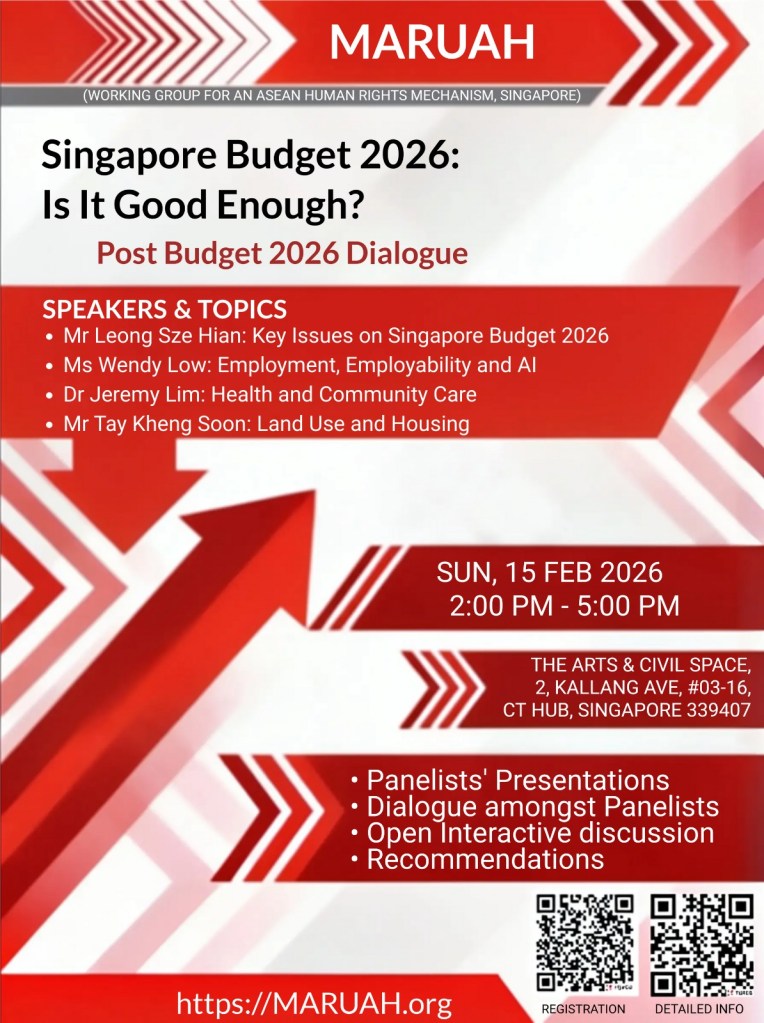
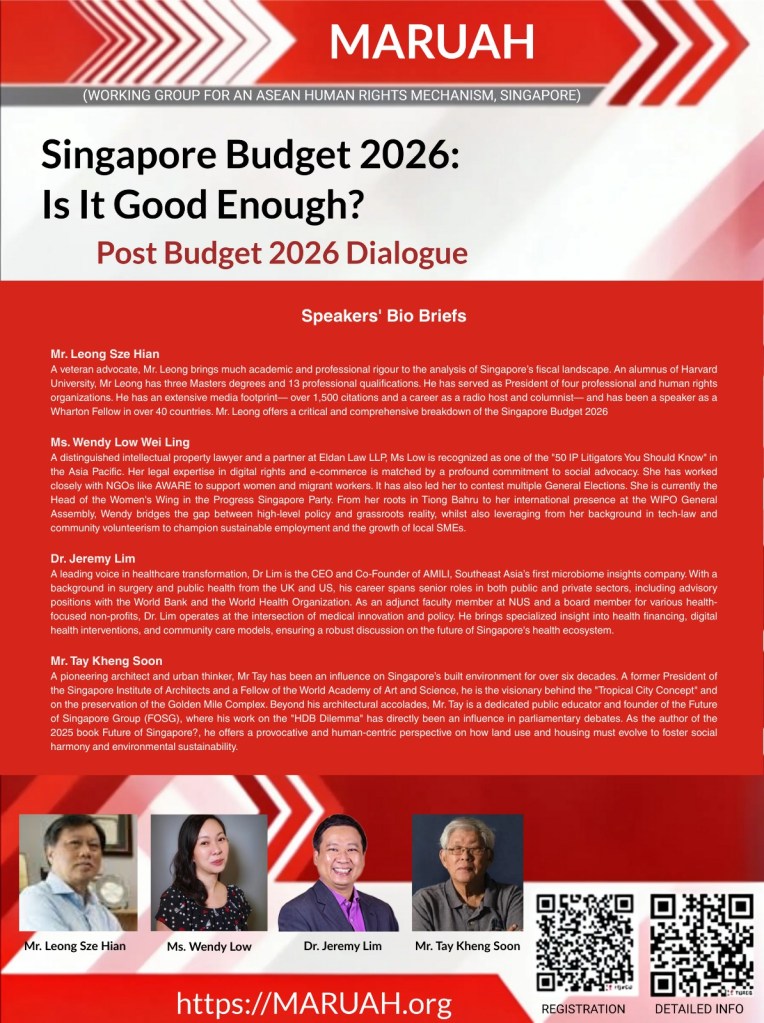
Please note that we will send you a confirmation via email at least three days before the event.
Thank you.
MARUAH
Please note that we will send you a confirmation via email at least three days before the event.
Thank you.
MARUAH
 Leave a Comment » |
  Budget | Tagged: 2026, Budget, human rights, maruah |
  Permalink
 Posted by jamestan2019
Myanmar on Friday rejected allegations of genocide against the Rohingya minority, telling the International Court of Justice (ICJ) that the Gambia’s case rests on “unsubstantiated allegations,” as public hearings continued in a landmark case on the application of the Genocide Convention.
Addressing judges in The Hague, Ko Ko Hlaing, speaking as Myanmar’s agent, said his country fully recognizes the importance of the 1948 Convention on the Prevention and Punishment of the Crime of Genocide but firmly denies breaching its obligations under international law.
“A finding of genocide would place an indelible stain on my country and its people,” he said, describing the proceedings as “of fundamental importance for my country’s reputation and future.”
Mr. Hlaing accused the applicant of relying on what he called rudimentary and partisan, including reports by a fact-finding mission, “which are neither reliable nor objective, and were a condemnation without trial of Myanmar.”
Myanmar also rejected claims that its military’s so-called “clearance operations” in northern Rakhine state in 2016 and 2017 were genocidal in intent, maintaining they were counter-terrorism operations launched in response to attacks by the armed groups.
“Obviously, Myanmar was not obliged to remain idle and allow terrorists to have free rein of northern Rakhine state,” Mr. Hlaing told the Court, while acknowledging that civilians were killed and large numbers of people fled to Bangladesh as a result of the clashes.
He further disputed allegations that Myanmar denies the existence or rights of the Muslim population in northern Rakhine state, arguing that questions of citizenship, terminology and identity “have nothing to do with genocide.”
Myanmar said it has complied with all procedural orders of the Court, including provisional measures issued in January 2020, and has submitted regular reports on steps taken.
It also reiterated its stated commitment to the repatriation of displaced people from Bangladesh, citing bilateral agreements and delays caused by the COVID-19 pandemic and natural disasters.
The case stems from an application filed by Gambia in November 2019, accusing Myanmar of violating the Genocide Convention through acts allegedly committed during military operations in Rakhine state.
Those operations escalated in 2017, forcing more than 700,000 Rohingya to flee to Bangladesh amid widespread killings, sexual violence and village burnings, according to UN investigations. Nearly one million Rohingya remain refugees in Bangladesh.
The hearings, which will continue through late January, mark the first time the Court is examining the merits of the case. The Court’s final judgment, which could take months after the hearings conclude, will be legally binding.
Source URL
Myanmar begins defence in landmark genocide case at UN World Court
Leave a Comment » | Conflicts and Peace | Tagged: ASEAN, burma, convention, genocide, human rights, myanmar, UN, united nations, world court | Permalink
Posted by jamestan2019
https://www.hrw.org/news/2026/01/12/irans-internet-blackout-concealing-atrocities
(Beirut) – Iranian authorities have significantly intensified their lethal crackdown on protesters since January 8, 2026, with credible reports that security forces are carrying out large-scale killings across the country. Since January 8, the authorities have imposed a country-wide internet blackout, which has caused severe restrictions on communications.
Iranian civil society organizations and the media have reported that the death toll has reached the thousands. However, the ongoing internet shutdown has severely hampered efforts to corroborate unlawful killings and other violations. Human Rights Watch is documenting emerging evidence of killings, including verifying video footage from morgues and hospitals, as well as witness accounts.
United Nations member countries should urgently demand that Iranian authorities stop the bloodshed, grant immediate and unhindered access to the UN-mandated Independent International Fact-Finding Mission on Iran, and restore access to the global internet.
A prevailing climate of systemic impunity has enabled Iranian authorities to repeatedly commit crimes under international law, including murder, torture, rape, and enforced disappearances to eliminate and punish dissent. This underlines the importance of international scrutiny as well as the collection and preservation of evidence to facilitate future criminal prosecutions, Human Rights Watch said.
The following quote can be attributed to Philippe Bolopion, executive director of Human Rights Watch:
“Reporting of Iranian security forces’ large-scale killings of protesters and other heinous violations and crimes has continued to emerge despite the internet blackout across the country. Those detained are at risk of secret, arbitrary executions as authorities have accused protesters of being ‘enemies of God,’ which carries the death penalty. The UN Security Council and Human Rights Council should urgently address the escalating atrocities and put Iranian officials and security forces on notice that justice will one day catch up to them.”
Leave a Comment » | Uncategorized | Tagged: human rights, iran, killings, protest, security council, UN, united nations | Permalink
Posted by jamestan2019
8 January 2026
The Delegation of the European Union issues the following statement, together with the diplomatic missions of the EU Member States and the diplomatic missions of Norway, Switzerland and the United Kingdom in Singapore.
The EU Delegation and the diplomatic missions of the EU Member States, Norway, Switzerland and the United Kingdom call on the Singapore authorities to halt the executions of Mr Ramdhan bin Lajis and any other persons who might have been served execution notices, and to commute their sentences to non-capital sentences.
We are saddened by the resumption of executions, which follows at least seventeen executions in 2025, the highest annual number in Singapore for more than twenty years.
In keeping with our consistent strong and principled stance against the death penalty, we oppose the use of capital punishment in all cases and in all circumstances.
The death penalty is incompatible with the inalienable right to life and the absolute prohibition of cruel, inhuman or degrading punishment. Moreover, imposing the death penalty for drug offences is incompatible with international law, as these offences do not meet the threshold of “most serious crimes”.
The available evidence does not support the use of capital punishment as a deterrent to crime and makes irreversible any possible miscarriages of justice. Furthermore, rehabilitation as an objective of modern criminal law is rendered impossible by the application of capital punishment.
Therefore, we will continue to work for the abolition of the death penalty in the few remaining countries that still apply it.
Leave a Comment » | Uncategorized | Tagged: capital punishment, death penalty, delegation, european union, execution, human rights, norway, right to life, singapore, switzerland, united kingdom | Permalink
Posted by jamestan2019
MARUAH is deeply disconcerted by the organised military attack on 3 January 2026 by the United States of America (“America”, or the “US”) on Venezuela. We are also deeply concerned over the American capture of Nicolás Maduro, the sitting president of Venezuela, to stand trial in America. These actions in all likelihood constitute violations of international law, including the UN Charter as well as America’s own Constitution as shown in expressed concerns within Congress. We are disturbed by the expressed intentions of America to run Venezuela and to control its oil resources.
As a human rights organisation we condemn the approach, intentions and actions taken by the US as these are violations which can also dangerously disrupt national, regional and international peace and security, jeopardise commitments to the rules-based international order and most importantly endanger civil population. This attack has killed and injured a number of Venezuelans.
We call upon the international community to consider this attack as a human rights violation and to show support to the people in this aftermath by prioritizing protection of human dignity, restoration of democratic rights and provision of humanitarian support. The Venezuelan people have already, for years, endured much suffering from widespread violence, repression and severe economic hardship.
We hope that changes to Venezuela’s political situation will lead to an end of human rights abuses and ensure protection for the people. We urge the international community to work together in addressing the urgent needs of Venezuelans that “everyone has the right to life, liberty and security of person” (Article 3 of the Universal Declaration of Human Rights (“UDHR”)) and to ensure that everyone, in due course, “has the right to take part in the government of his country, directly or through freely chosen representatives” (Article 21 of the UDHR).
We hope that Venezuelan President Maduro, like any individual, will be tried fairly and impartially by an independent and impartial tribunal. The recent events, without due process or international consensus, can dangerously set a wrong precedent on how political leaders are to be held accountable. We reiterate that “everyone is entitled in full equality to a fair and public hearing by an independent and impartial tribunal, in the determination of his rights and obligations and of any criminal charge against him” (Article 10 of the UDHR).
MARUAH stands in solidarity with the people of Venezuela.
Leave a Comment » | Conflicts and Peace | Tagged: america, human rights, international, international order, politics, president, rules-based, united states, USA, venezuela | Permalink
Posted by jamestan2019
 MARUAH Singapore
You must be logged in to post a comment.