[Repost] Myanmar begins defence in landmark genocide case at UN World Court

20 January 2026

https://www.ungeneva.org/en/news-media/news/2026/01/114937/myanmar-begins-defence-landmark-genocide-case-un-world-court

Myanmar on Friday rejected allegations of genocide against the Rohingya minority, telling the International Court of Justice (ICJ) that the Gambia’s case rests on “unsubstantiated allegations,” as public hearings continued in a landmark case on the application of the Genocide Convention.

Addressing judges in The Hague, Ko Ko Hlaing, speaking as Myanmar’s agent, said his country fully recognizes the importance of the 1948 Convention on the Prevention and Punishment of the Crime of Genocide but firmly denies breaching its obligations under international law.

“A finding of genocide would place an indelible stain on my country and its people,” he said, describing the proceedings as “of fundamental importance for my country’s reputation and future.”

Mr. Hlaing accused the applicant of relying on what he called rudimentary and partisan, including reports by a fact-finding mission, “which are neither reliable nor objective, and were a condemnation without trial of Myanmar.”

Myanmar acted against terrorists

Myanmar also rejected claims that its military’s so-called “clearance operations” in northern Rakhine state in 2016 and 2017 were genocidal in intent, maintaining they were counter-terrorism operations launched in response to attacks by the armed groups.

“Obviously, Myanmar was not obliged to remain idle and allow terrorists to have free rein of northern Rakhine state,” Mr. Hlaing told the Court, while acknowledging that civilians were killed and large numbers of people fled to Bangladesh as a result of the clashes.

He further disputed allegations that Myanmar denies the existence or rights of the Muslim population in northern Rakhine state, arguing that questions of citizenship, terminology and identity “have nothing to do with genocide.”

Myanmar said it has complied with all procedural orders of the Court, including provisional measures issued in January 2020, and has submitted regular reports on steps taken.

It also reiterated its stated commitment to the repatriation of displaced people from Bangladesh, citing bilateral agreements and delays caused by the COVID-19 pandemic and natural disasters.

The case before the ICJ

The case stems from an application filed by Gambia in November 2019, accusing Myanmar of violating the Genocide Convention through acts allegedly committed during military operations in Rakhine state.

Those operations escalated in 2017, forcing more than 700,000 Rohingya to flee to Bangladesh amid widespread killings, sexual violence and village burnings, according to UN investigations. Nearly one million Rohingya remain refugees in Bangladesh.

The hearings, which will continue through late January, mark the first time the Court is examining the merits of the case. The Court’s final judgment, which could take months after the hearings conclude, will be legally binding.

Source URL 

Myanmar begins defence in landmark genocide case at UN World Court


[Repost] Iran’s Internet Blackout Concealing Atrocities – Human Rights Watch

13 January 2026

https://www.hrw.org/news/2026/01/12/irans-internet-blackout-concealing-atrocities

(Beirut) – Iranian authorities have significantly intensified their lethal crackdown on protesters since January 8, 2026, with credible reports that security forces are carrying out large-scale killings across the country. Since January 8, the authorities have imposed a country-wide internet blackout, which has caused severe restrictions on communications.

Iranian civil society organizations and the media have reported that the death toll has reached the thousands. However, the ongoing internet shutdown has severely hampered efforts to corroborate unlawful killings and other violations. Human Rights Watch is documenting emerging evidence of killings, including verifying video footage from morgues and hospitals, as well as witness accounts.

United Nations member countries should urgently demand that Iranian authorities stop the bloodshed, grant immediate and unhindered access to the UN-mandated Independent International Fact-Finding Mission on Iran, and restore access to the global internet.

A prevailing climate of systemic impunity has enabled Iranian authorities to repeatedly commit crimes under international law, including murder, torture, rape, and enforced disappearances to eliminate and punish dissent. This underlines the importance of international scrutiny as well as the collection and preservation of evidence to facilitate future criminal prosecutions, Human Rights Watch said. 

The following quote can be attributed to Philippe Bolopion, executive director of Human Rights Watch: 

“Reporting of Iranian security forces’ large-scale killings of protesters and other heinous violations and crimes has continued to emerge despite the internet blackout across the country. Those detained are at risk of secret, arbitrary executions as authorities have accused protesters of being ‘enemies of God,’ which carries the death penalty. The UN Security Council and Human Rights Council should urgently address the escalating atrocities and put Iranian officials and security forces on notice that justice will one day catch up to them.”


[Joint statement] Laos: 11 years of government inaction on Sombath Somphone’s enforced disappearance

8 December 2023

On the 11-year anniversary of the enforced disappearance of Lao civil society leader Sombath Somphone, we, the undersigned civil society organizations and individuals, strongly condemn the Lao government’s continued failure to provide necessary information as to his fate and whereabouts and reiterate our calls to the authorities to deliver truth, justice and reparations to his family.

International concerns over Sombath’s case, expressed by international civil society, United Nations (UN) human rights experts, and UN member states on last year’s anniversary of Sombath’s enforced disappearance, have been ignored by the Lao government.

On 25 September 2023, in a submission to the UN Human Rights Committee as part of its follow-up review of Laos under the International Covenant on Civil and Political Rights, the Lao government repeated previous misleading statements and miserably failed to provide any additional information on the steps it said it had taken to find Sombath. The government claimed it “never stopped trying to find the truth” about Sombath’s fate “in order to bring the offender(s) to justice.” In reality, the Lao authorities have continued to disregard Sombath’s wife, Shui Meng Ng, and have not provided her with any updates on her husband’s case since 2017. The government then made the extraordinary assertion that its Task Force’s investigation had been “carried out on the basis of transparency, impartiality and accountability, including the use of modern investigative techniques consistent with international standards by the capable inquiry officials.” It concluded that the case of Sombath needed “more time for investigation” and added that the Task Force was “still active in the investigation” and had “not yet closed the case.”

These government statements are unequivocally false in suggesting any degree of transparency. Existing evidence is clear that the Lao government has been engaged in a continuous cover-up of the facts of Sombath’s case since he was forcibly disappeared in 2012, including providing misleading information about its actions to his family, the Lao public, and the international community, as stated above.

We deplore the unmistakable pattern of inaction, negligence, and obfuscation that various Lao authorities have repeatedly engaged in for more than a decade and we continue to resolutely stand in solidarity with Sombath’s family and all other victims of enforced disappearances in Laos.

We reiterate our calls on the Lao authorities to take real and effective measures to establish the fate or whereabouts of Sombath and all other victims of enforced disappearances in the country, identify the perpetrators of such serious crimes, and provide victims with an effective remedy and full reparations. We also urge the government to immediately ratify without reservations the International Convention for the Protection of all Persons from Enforced Disappearance, which it signed in 2008, and to fully implement it into national law, policies and practices.

As upcoming chair for the Association of Southeast Asian Nations (ASEAN), Laos will be placed in a strategic position to lead the regional efforts to strengthen, promote, and protect human rights. However, its continued failure to act on Sombath’s enforced disappearance sends a message of inadequacy to head the regional bloc and to fulfill ASEAN’s purpose under Article 1(7) of the ASEAN Charter, which is to strengthen democracy, enhance good governance, and the rule of law and to promote and protect human rights and fundamental freedoms.

We will continue to seek justice and accountability for Sombath. Until the truth is found and justice is delivered to his family, we will not stop demanding answers from the Lao government to the same question we have been asking for the past 11 years: “Where is Sombath?”

Background

Sombath Somphone, a pioneer in community-based development and youth empowerment, was last seen at a police checkpoint on a busy street of Vientiane on the evening of 15 December 2012. Footage from a traffic CCTV camera showed that police stopped Sombath’s vehicle at the checkpoint and that, within minutes, unknown individuals forced him into another vehicle and drove him away in the presence of police officers. CCTV footage also showed an unknown individual arriving and driving Sombath’s vehicle away from the city center. In December 2015, Sombath’s family obtained new CCTV footage from the same area and made it public. The video shows Sombath’s car being driven back towards the city by an unknown individual.

For further information, please visit: https://www.sombath.org/en/


[ASEAN Parliamentarians for Human Rights] Quotes: On ASEAN Envoy to Myanmar’s planned trip to the country next week

27 March 2022

Dear Members of the Press, 

Please see below quotes from Charles Santiago, APHR Chair and a Malaysian MP, on the planned visit to Myanmar by Prak Sokhonn, Cambodian Foreign Minister, Deputy Prime Minister and ASEAN Special Envoy on Myanmar, from 21 to 23 March 2022.

It is absolutely disgraceful that in a week when the United Nations Human Rights Commissioner has released such a damning first report on conditions in Myanmar since the coup, that the Cambodian government of Prime Minister Hun Sen is once again normalizing the illegal junta in Myanmar on multiple levels, having already invited a Myanmar military delegation to the country this week. Hun Sen and Min Aung Hlaing’s contempt for the collective will of ASEAN is seriously damaging the reputation of the bloc and the region.” 

“As ASEAN chair, it is in the Cambodian government’s best interests to strengthen its own, and ASEAN’s, credibility by remaining fully committed to the Five-Point Consensus. It should provide a roadmap to explain how it plans to progress the agreed action points. Instead, Prak Sokhonn’s visit, which comes without any conditions or demands on the junta to meet its obligations under the Five Point Consensus, is a betrayal of the collective decision of ASEAN, and the will of the Myanmar people. We all witnessed how PM Hun Sen’s similarly condition-free visit in January did nothing to deter, and possibly emboldened, the junta to undertake operations the very next day that may amount to crimes against humanity. Cambodia’s continued reckless departure from the ASEAN consensus puts more innocent Myanmar people’s lives at risk from this junta.”

“It is ridiculous that the ASEAN Special Envoy says his visit to Myanmar is aimed at “creating a favourable condition” to end the violence. It is way past time to stop holding hands with these accused war criminals. ASEAN and its Chair must demand the military junta cease all violence and attacks immediately against the people, in line with the five-point consensus agreed by the leaders of ASEAN Member States. Anything less risks giving the military council a licence to commit further crimes against humanity.”


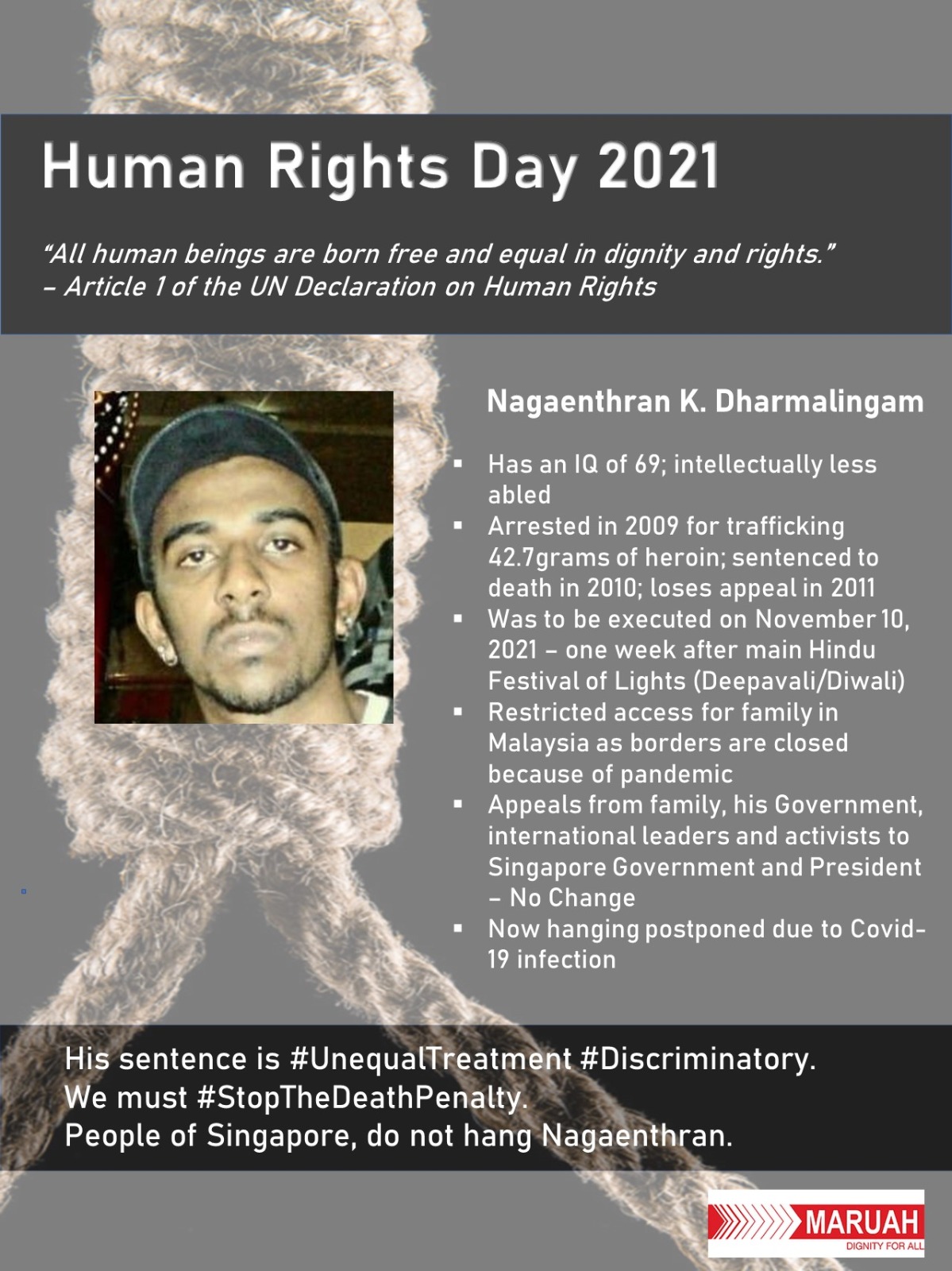
Human Rights Day 2021 – “All human beings are born free and equal in dignity and rights”

10 December 2021

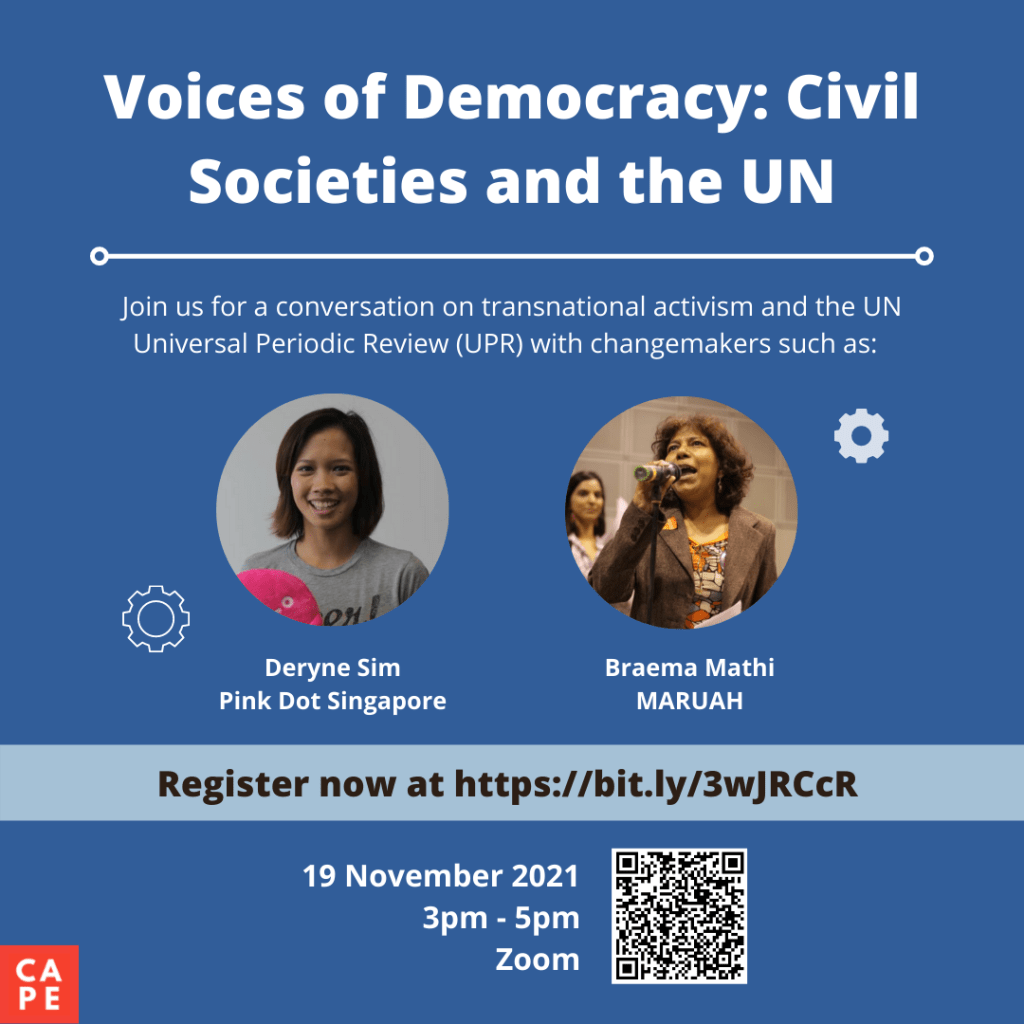
[Webinar] Voices of Democracy: Civil Societies and the UN

18 November 2021

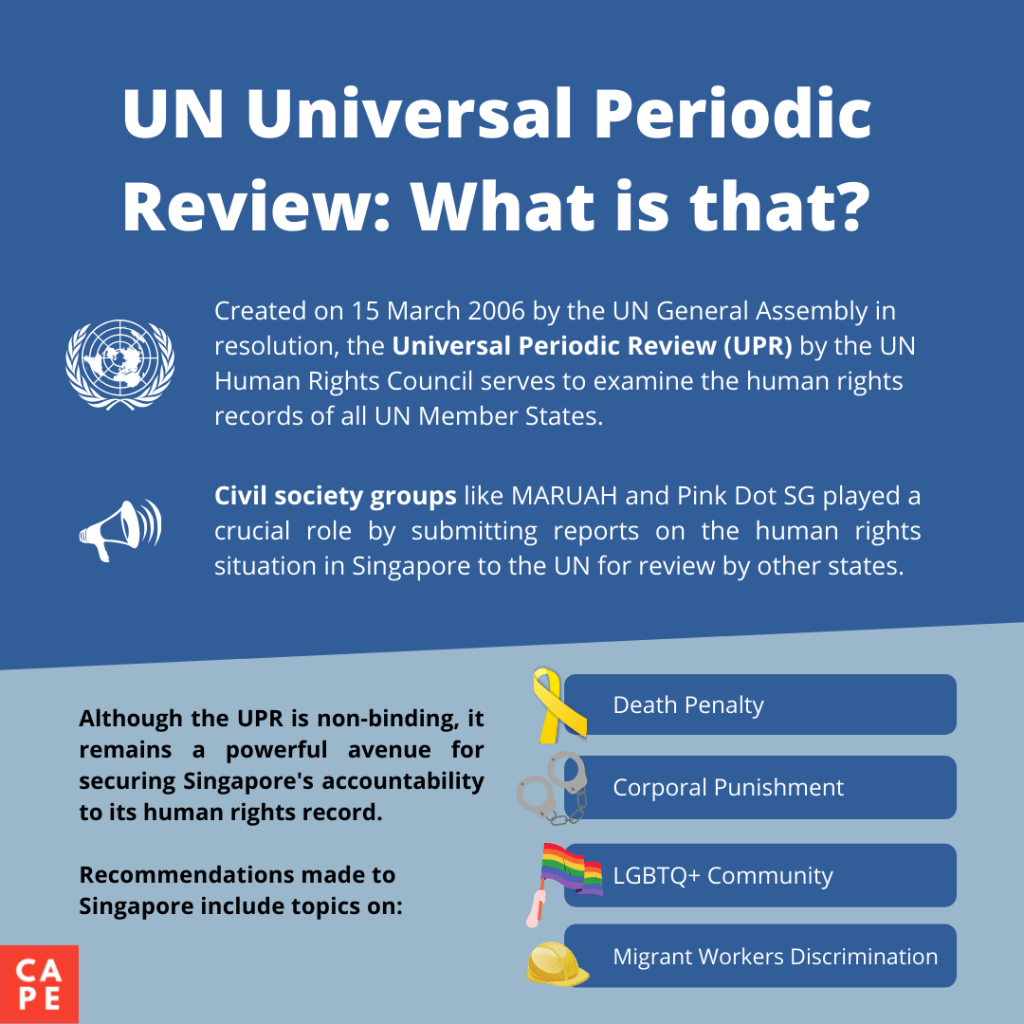
Ever wondered what the UPR was? Every few years, the Universal Periodic Review (UPR) by the United Nations Human Rights Council sets about examining the human rights records of all UN Member States. Join changemakers from Pink Dot and MARUAH for an online panel discussion about the role of the UPR in Singaporean advocacy, policymaking and discourse this Friday, Nov 19, from 3pm-5pm! Proudly organised by the Yale-NUS/NUS Community for Advocacy and Political Education (CAPE)


Sign up at bit.ly/UPRCAPE or scan the QR code


38th Session of the Universal Periodic Review – Review of Singapore [Wed 12 May 3 – 6.30pm (SG time)]

9 May 2021

The Review of Singapore will be broadcast live at http://webtv.un.org/.

Please click here to add a reminder to watch the review live on UN Web TV.


What is the Universal Periodic Review?

The Universal Periodic Review (UPR) is a unique process which involves a review of the human rights records of all UN Member States. The UPR is a State-driven process, under the auspices of the Human Rights Council, which provides the opportunity for each State to declare what actions they have taken to improve the human rights situations in their countries and to fulfil their human rights obligations. 

As one of the main features of the Council, the UPR is designed to ensure equal treatment for every country when their human rights situations are assessed. The ultimate aim of this mechanism is to improve the human rights situation in all countries and address human rights violations wherever they occur. Currently, no other universal mechanism of this kind exists.

Please click here for more information on the UPR.


Universal Periodic Review (The Third Cycle) – Stakeholders’ Report to the UN by MARUAH

27 March 2021

In October 2020, MARUAH submitted its Stakeholder’s Report for the third cycle of the Universal Periodic Review focusing on civil and political rights – Freedom of Expression, Freedom of Association, Censorship, Electoral System, Justice (incl minimum working age, corporal punishment, juvenile justice system & death penalty) and Discrimination (incl LGBTQIA, equality of races, women and income inequalities/job opportunities).

We also submitted recommendations in each section based on the SMART framework and draw upon the recommendations made by Human Rights Council to Singapore, our mid-term UPR report (2018), and the past UPRs we have submitted in 2011 and 2015.

Please click here to access the full report.


[Repost] Statement attributable to the Spokesperson for the Secretary General – on Myanmar

2 February 2021

The Secretary-General strongly condemns the detention of State Counsellor Daw Aung San Suu Kyi, President U Win Myint and other political leaders on the eve of the opening session of Myanmar’s new Parliament.  He expresses his grave concern regarding the declaration of the transfer of all legislative, executive and judicial powers to the military.  These developments represent a serious blow to democratic reforms in Myanmar.

The 8 November 2020 general elections provide a strong mandate to the National League for Democracy (NLD), reflecting the clear will of the people of Myanmar to continue on the hard-won path of democratic reform.  The Secretary-General urges the military leadership to respect the will of the people of Myanmar and adhere to democratic norms, with any differences to be resolved through peaceful dialogue. All leaders must act in the greater interest of Myanmar’s democratic reform, engaging in meaningful dialogue, refraining from violence and fully respecting human rights and fundamental freedoms.

The Secretary-General reaffirms the unwavering support of the United Nations to the people of Myanmar in their pursuit of democracy, peace, human rights and the rule of law.

Stéphane Dujarric, Spokesman for the Secretary-General

https://www.un.org/sg/en/content/sg/statement/2021-01-31/statement-attributable-the-spokesperson-for-the-secretary-general-myanmar


[Statement] The ongoing business of strengthening the UN human rights treaty bodies

17 January 2021