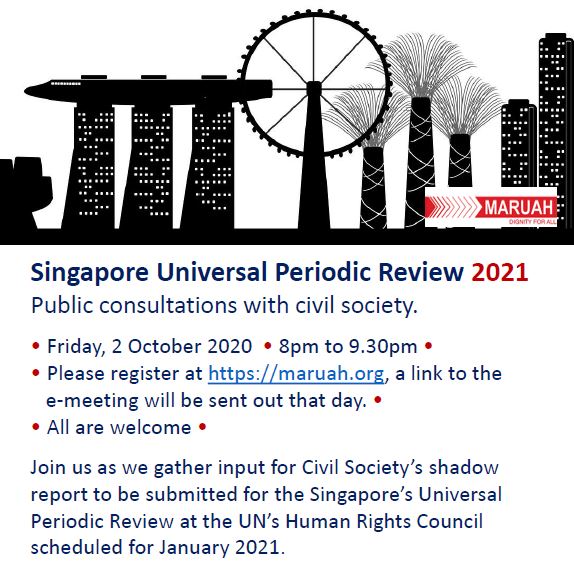
Please register at https://forms.gle/KL9dMieoWzu7P3Yb7before 11.59pm on Thursday, 1 October 2020. We will be sending the video conference link via email to all those who have registered.
We are pleased to share a publication published by the Penang Institute. The “Human Rights Derogations in Southeast Asian Countries during the Covid-19 Pandemic” was written by Braema Mathiaparanam(Visiting Senior Research Fellow, History and Regional Studies Programme).
The ASEAN Inter-Governmental Commission on the Promotion and Protection of Human Rights has issued a statement of concern and has reminded governments to continue observing human rights during the pandemic, and that even if some rights have to be restricted, this should not be done disproportionately.
All members of the Association of Southeast Asian Nations (ASEAN) have pre-existing forms of restriction on the freedom of expression and press freedom as well as censorship, which intensified in this pandemic.
It is challenging to contain Covid-19 infections while ensuring that human rights are not derogated. However, the lockdown measures imposed in some countries in Southeast Asia during the containment period became opportunities to intimidate, detain and arrest opposition party members, activists and journalists.
Countries have also taken a strict stance on fake news and disinformation, leading to many arrests across countries. Increased surveillance was also used to track threats to authority figures and the government, alongside gaining evidence on criminal activities such as drug-trafficking and money laundering.
Certain communities were overlooked in government policies and assistance especially in terms of food and supply, economic aid and information sharing. Prisons and detention centres are overcrowded, leading to more outbreaks of Covid-19 infections.
Countries have national, regional and international obligations and responsibilities that they have agreed to and breaches of these state obligations need to be addressed, especially when the actions taken cannot be justified even as emergency measures.
Covid-19 will not be the last crisis, and governments can use lessons learnt from Covid-19 to improve their responses for the next crisis and take counter-measures that also adhere to human rights principles.
1. We, the Heads of State/Government of ASEAN Member States, gathered for the 36th ASEAN Summit on 26 June 2020. Under the theme of Cohesive and Responsive ASEAN in 2020, we underscored the need to enhance ASEAN’s unity, cooperation and solidarity, economic integration, ASEAN awareness and identity, and emphasized the importance of promoting ASEAN pro-activeness and capacity in seizing opportunities as well as in addressing the challenges brought about by rapid changes in the regional and global landscape.
This report documents structural flaws that potentially prevent elections from being free and fair in Singapore. On page 22 of the report, APHR also makes certain recommendations to safeguard Singaporeans’ right to a free and fair election. These include:
Give significantly longer notice for election dates and more campaigning time to ensure an equal electoral competition and for voters to make their opinions;
Replacing the GRC system with one that ensures better respect for the principle of “one person, one vote”;
Immediately amend or repeal all laws that restrict the rights to freedom of expression, and peaceful assembly in Singapore; and
Delay the general election unless additional measures are taken to: ensure all eligible voters are able to vote, including the sick and those abroad; and ensure that opposition parties are able to campaign on an equal footing with PAP.
The annual Report to Congress on International Religious Freedom – the International Religious Freedom Report – describes the status of religious freedom in every country. The report covers government policies violating religious belief and practices of groups, religious denominations and individuals, and U.S. policies to promote religious freedom around the world. The U.S. Department of State submits the reports in accordance with the International Religious Freedom Act of 1998.
Prior to sharing this document with you, we have sent it to PM Lee and Ministers in the task force.
This document is being shared with you in your various capacities of interest on Covid-19 and Migrant Workers.
We hope that this document will bring more attention to the challenges of migrant workers and how we as Singaporeans and as a nation can do our part in mitigating the impact on their community.
Organised by MARUAH with technical support provided by Shape SEA
Please check back this post over the next couple of days as we upload additional presentation material.
Labour Day is special to all of us, as workers.
Have a Meaningful Labour Day as we remember those who have lost jobs, our dedicated front liners, all essential workers, healthcare workers and support staff, NGOs, union leaders, the civil service officers, multi-Ministry task force, government leaders and international leaders all and you and me…
Why meaningful? These are uneasy times, also very special as it makes us understand more on the types of jobs and the workers. What are the new norms? How do we value the work of each other? The invisibility of so many workers, some whom we have overlooked.
Thank you for your interest and time.
A Meaningful Ramadan to all Muslim views and to many Migrant Workers who are Muslims too.


 Posted by jamestan2019


 MARUAH Singapore
You must be logged in to post a comment.