After 50 years and 15 male secretaries-general, the time has come for ASEAN to break its longest-standing glass ceiling. As Indonesia prepares to nominate the next chief, a historic opportunity emerges to prove that the region’s future is both inclusive and ready for female leadership at the very top.
[Repost] In search of the first female ASEAN secretary-general – The Jakarta Post
30 March 2026
 Leave a Comment » |
  ASEAN | Tagged: ASEAN, female, glass ceiling, indonesia, secretary-general |
  Permalink
 Posted by jamestan2019
[Repost] [MODEL LEGISLATION] AI & Human Rights: A legislative blueprint for lawmakers and civil society – ASEAN Parliamentarians for Human Rights (APHR)
7 March 2026🌏 ASEAN Parliamentarians for Human Rights (APHR) works in a region that is impacted by a multitude of socio-political and environmental crises, a region witnessing a steady rise in right-wing authoritarianism, increased threats to human rights and backsliding of democracy. Civil society organizations, rights defenders and progressive lawmakers face surveillance, censorship and legal threats impacting their rights and freedoms. Operating within this context, there is an urgent need for APHR to put effort into envisioning and contributing to internet governance that safeguards our right to freedom of expression and opinion and translating this towards bolstering parliamentary expertise and oversight of the use of AI technologies in Southeast Asia.
In this light, we are happy to share with you this policy paper, entitled “AI and Human Rights: Model Legislation for Southeast Asian Lawmakers and Civil Society” that we have developed together with APHR member lawmakers and civil society technical experts.
A practical, human rights-centred policy model to help legislative bodies, oversight units and rights defenders prevent the misuse of artificial intelligence (AI) that threatens human rights, democratic processes and civic space across the Southeast Asia region.
WHAT THE MODEL LEGISLATION OFFERS
This resource (full text and legislative commentary) lays out a complete draft Act and operational provisions lawmakers can adapt and adopt:
- Clear definitions and scope, including extraterritorial coverage for systems whose outputs affect people inside the country.
- A prohibited practices chapter banning social scoring, untargeted scraping, predictive policing and abusive biometric surveillance.
- A risk-based compliance regime for high-risk systems with mandatory Fundamental Rights Impact Assessments (FRIAs) and bias-mitigation rules.
- Rights for individuals; transparency, meaningful explanations of automated decisions and routes for complaints and redress.
- Worker protections against intrusive algorithmic management and safeguards for platform-based workers.
- Provisions to protect civic space, elections and survivors of technology-facilitated gender-based violence (TfGBV).
- Institutional architecture; an independent National AI Oversight Body, whistleblower protection, liability regimes and dissuasive penalties.
- This Model Law was drafted to be interoperable with established frameworks and global best practice, including the principles reflected in the EU AI Act, while adapting those standards to regional realities.
Thank you very much and
we hope this will be useful to your civic and policy advocacy endeavors to safeguard digital rights, strengthen human rights protections and uphold democratic principles in the governance of emerging technologies.
In solidarity always.
Leave a Comment » | ASEAN | Tagged: aphr, ASEAN, civil society, human rights, legislation, model, parliamentarians, TfGBV | Permalink
Posted by jamestan2019
[Repost] ASEAN Foreign Ministers’ Statement on the Situation in the Middle East
5 March 20264 March 2026
- We follow closely the situation and express serious concern over the escalation of conflict in the Middle East following the attacks initiated by Israel and the United States against the Islamic Republic of Iran on 28 February 2026 and the subsequent retaliatory attacks by the Islamic Republic of Iran against several countries in the region, including the Kingdom of Bahrain, Hashemite Kingdom of Jordan, State of Kuwait, Sultanate of Oman, State of Qatar, Kingdom of Saudi Arabia, Syrian Arab Republic, and the United Arab Emirates, which continue to heighten tensions in the Middle East, and pose a grave threat to the lives and safety of civilians, as well as to regional and global peace and stability. We call on all countries to respect international law, including the Charter of the United Nations (UN Charter).
- This escalation is particularly regrettable as it occurred amid ongoing diplomatic efforts, including mediation initiatives led by the Sultanate of Oman aimed at advancing a negotiated solution.
Download the full statement here.
Leave a Comment » | ASEAN, Conflicts and Peace | Tagged: human rights, united nations, united states, iran, conflict, middle east, attacks | Permalink
Posted by jamestan2019
[Repost] ASEAN Declaration on the Right to a Safe, Clean, Healthy and Sustainable Environment
29 October 202526 October 2025
WE, the Association of Southeast Asian Nations (ASEAN) namely Brunei Darussalam, the Kingdom of Cambodia, the Republic of Indonesia, the Lao People’s Democratic Republic, Malaysia, the Republic of the Union of Myanmar, the Republic of the Philippines, the Republic of Singapore, the Kingdom of Thailand, and the Socialist Republic of Viet Nam, on the occasion of the 47th ASEAN Summit and Related Summits in Kuala Lumpur, Malaysia on 26-28 October 2025;
COGNISANT of the growing and pressing need to address global and transboundary environmental concerns, in particular, the triple planetary crisis of climate change, biodiversity loss and environmental pollution, and to advance the right to a safe, clean, healthy, and sustainable environment;
Download the full statement here.
Leave a Comment » | ASEAN | Tagged: ASEAN, brunei, cambodia, clean, climate change, environment, human rights, lao, malaysia, singapore, sustainable, thailand, Vietnam | Permalink
Posted by jamestan2019
[Repost] Myanmar: Rohingya repatriation ‘catastrophic’ under existing conditions in northern Rakhine State – Amnesty International
24 October 202529 September 2025
Rohingya communities in Myanmar’s northern Rakhine State are facing forced labour, food and health crises, severe restrictions on movement and escalating armed conflict, Amnesty International said today as it warned against dangerously premature decisions to repatriate refugees from Bangladesh.
Tomorrow the UN General Assembly will convene a High-level Conference on the Situation of Rohingya Muslims and Other Minorities in Myanmar. The conference aims to formulate a plan under which the more than one million Rohingya refugees living in Bangladesh can return home to Myanmar after the majority were violently driven from the country by the military in 2016 and 2017.
Amnesty International conducted interviews with 15 Rohingya refugees who arrived in Bangladesh within the past year, as recently as July 2025. The refugees came from both Maungdaw and Buthidaung Townships, which were both captured from the Myanmar military by the Arakan Army in 2024. The organization also spoke with UN agency staff, diplomats, researchers and international humanitarian organizations.
In addition, Amnesty International met with representatives from the political and humanitarian wings of the Arakan Army: the United League of Arakan (ULA) and the Humanitarian and Development Coordination Office (HDCO).
“Existing conditions in Myanmar’s northern Rakhine State are nowhere near ready for Rohingya to return safely,” Amnesty International’s Myanmar Researcher Joe Freeman said. “The Arakan Army has, to many Rohingya, replaced the Myanmar military as their oppressor. The military are using Rohingya civilians as cannon fodder to fight against the Arakan Army, and Rohingya armed groups are launching new attacks into the territory. The dramatic reduction of US aid has further contributed to a humanitarian crisis in which supplies are scarce and prices are skyrocketing.
“While it is vitally important to put an international spotlight on the Rohingya crisis with this conference, any attempt to push ahead with repatriation without addressing the acute dangers facing all communities – Rohingya, Rakhine and other ethnic minorities in Bangladesh and in Myanmar – could be catastrophic.”
‘This is not your country’
The northern part of Myanmar’s Rakhine State, which borders Bangladesh, is now under the control of the Arakan Army, while the Myanmar military still controls the state capital Sittwe, a key entry point for aid and transportation.
In November 2023, the Arakan Army, which is also loosely aligned with myriad opposition armed groups fighting against the Myanmar military since a coup in 2021, began an offensive that drove the military out of much of the northern part of the state. It now has effective control of Myanmar’s entire border with Bangladesh.
Long-standing tensions between the ethnic Rakhine Buddhist population of Rakhine State and the Rohingya Muslim population have been exploited by the Myanmar military, which worked with Rohingya armed groups and forcibly recruited Rohingya civilians to fight against the mostly Buddhist Arakan Army.
Due to the armed conflict, Rohingya and Rakhine civilians have been caught between the Arakan Army and the Myanmar military, which has blocked the delivery of humanitarian aid via the state capital Sittwe, and carried out deadly indiscriminate air strikes. Earlier this month, in one such attack, a military air strike reportedly killed at least 19 Rakhine students while they slept.
Hundreds of thousands of Rohingya are internally displaced, and more than 150,000 Rohingya men, women and children have fled across the border to the Bangladesh camps in the last 20 months, according to the UN refugee agency, bringing the total number of refugees to an estimated 1.2 million.
Amnesty International and other groups have documented violations of international humanitarian law and mounting abuses against civilians by the Arakan Army, including indiscriminate attacks and arbitrary detention.
For Rohingya civilians, life under Arakan Army rule in Rakhine State feels painfully similar to life under the Myanmar military. Many allege it is worse, as they are constantly under suspicion of being tied to Rohingya militant groups. A report by the Office of the United Nations High Commissioner for Human Rights on 2 September said that “restrictions on the rights and freedoms of Rohingya imposed by previous Governments remained in place,” and that similar to the Myanmar military, the Arakan Army denied Rohingya identity by referring to them only as Bengalis or Muslims.
Arakan Army representatives argue the group is the victim of a propaganda campaign fuelled by Rohingya activists and armed groups.
According to testimony gathered by Amnesty International, Rohingya communities in northern Rakhine state face severe restrictions on movement by the Arakan Army, discriminatory bans on fishing or other livelihood options, forced labour and inadequate access to healthcare, education and humanitarian aid. They also continue to die or be seriously injured in the ongoing conflict.
One man in his 20s said that while Arakan Army soldiers were leading him and members of his family to a camp for Internally Displaced Persons (IDPs), he saw at least four people lose limbs from stepping on landmines.
A 60-year-old man who fled Myanmar with his family in July 2025 described life in an IDP camp in Buthidaung Township, where he was moved after the Arakan Army took Buthidaung from the Myanmar military in May 2024. He said the Arakan Army were searching for members of Rohingya armed groups at the camp and that they “randomly took people from the crowd and disappeared them”.
People living in the camp were also forced to work, including in frontline conflict areas.
“They would make us carry stones and bricks to their checkpoints and stack them there while we were hungry. Since I was old, they did not make me do all of that work, but my children had to do it more than 10 times…if we refused to work, [members of the Arakan Army] would beat us severely, forcing us to lie face down while they beat us.”
People who lived in IDP camps in Myanmar before fleeing to Bangladesh said they ate infrequently, relying on rice and water from a muddy well, and that children died after getting diarrhea.
“They [the Arakan Army] did not provide anything; instead, they seemed happy when anyone died,” the 60-year-old man said. “They would say, ‘This is not your country. This is our country, our land, our water, our air – nothing here belongs to you. Get out of our country.’”
People were told by the Arakan Army that if they did not follow their rules or refused to work, they would be kicked out of Myanmar.
‘No school, no medicine and no aid’
A 25-year-old who spent eight months displaced from his home in Buthidaung Township before arriving in Bangladesh in January of this year said conditions in the IDP camp where he lived were “terrible”.
“We had no school, no medicine, no food and no aid. Occasionally, we secretly brought back some rice from unburnt villages. We used water from a single pond and needed Arakan Army permission to go anywhere.”
He said his brother was shot and injured by the Arakan Army when soldiers were trying to forcibly relocate large groups of people and they were not moving fast enough. On another occasion, the man said the Arakan Army suspected him of being part of a Rohingya armed group and began beating him for information. When the man’s pregnant wife asked them to stop, he said they hit her as well, which the couple believe caused developmental problems with their baby after the birth.
“The Arakan Army treated us worse than the Myanmar military. Whenever fighting occurred between the two forces, they forced us to clean the aftermath, picking up bodies and debris, then dumping them in the river. I was forced to do this over 10 times without pay. Every family was required to send someone aged 15 to 70 for forced labour. If anyone refused, they were beaten,” he said.
A 35-year-old woman, who also arrived in Bangladesh in January 2025 after walking for five days across mountainous terrain with her children, said farmers had to pay tax in rice to the Arakan Army, and Rohingya had to make paid applications to seek permission to travel.
“Under Arakan Army control, every household was forced to provide night guards, boys from as young as 10 years old up to men in their 70s, and to send family members for forced labour at least five times per month,” she said, adding that young men were also forcibly recruited to fight. “If anyone refused, we were told to leave this country or face punishment.”
The descriptions of restrictions on movement imposed by the Arakan Army match details of travel documents obtained by Amnesty International that show the permissions needed to move from place to place. One interviewee said mandatory travel documents had to be paid for, and some were only good for two days. Another said that the Arakan Army would allow only a limited number of people to leave their homes for basic errands and only for one hour.
Under international law, forced labour is defined as any work or service which is exacted from any person under the menace of any penalty, and for which the person has not offered himself voluntarily.
Responding to these allegations, Arakan Army representatives told Amnesty International that it did not practise forced labour against civilians, but that detainees such as convicted criminals or prisoners of war would sometimes be put to work, or given tasks as “exercise”. They said that any clean-up activities following the conflict were voluntary community work, and that while there were fees for travel authorization documents, they were around 2,000 to 3,000 Myanmar kyats, equivalent to $1 to $1.50 USD.
‘We were not allowed to fish’
The World Food Programme said in August that “a deadly combination of conflict, blockades, and funding cuts is driving a dramatic rise in hunger and malnutrition”. It added that in central Rakhine State, the number of families unable to meet basic food needs was up to 57 percent, compared to 33 percent in December 2024. It said the situation in northern Rakhine state, where international organizations are not active, was likely “much worse”.
A 45-year-old man who arrived in Bangladesh in July 2025 said that ethnic Rakhine people in Buthidaung Township were allowed to fish and move around freely, while Rohingya were not.
“We were not allowed to fish or go to the river. We could not work or buy food. The Arakan Army began demanding money from us, used us as forced labour without pay and banned movement between villages. Anyone who refused was punished harshly,” he said, adding that this included being detained and denied food.
“One day, I tried to go fishing for survival. The Arakan Army caught me, beat me with a rifle…and took away the fish I had caught.”
Arakan Army representatives told Amnesty International that movement and livelihood restrictions were not discriminatory and applied to Rakhine communities too. They said due to the armed conflict the restrictions were necessary for the security of the community. They also added that the Rohingya – whom they referred to as Muslims – were given jobs and that their rights and freedoms would be fulfilled and protected, pointing to the recent opening of a long-closed mosque in Maungdaw.
“We welcome any steps by the Arakan Army to provide the Rohingya communities with long-denied rights, and we hope that their public commitments to inclusivity, justice and accountability match the situation on the ground. They must avoid presenting one face to the international community and another to the Rohingya,” Freeman said.
Leave a Comment » | ASEAN | Tagged: ASEAN, bangladesh, human rights, myanmar, rakhine, refugees, repost, rohingya | Permalink
Posted by jamestan2019
Statement by the Representative of Thailand to the ASEAN Commission on the Promotion and Protection of the Rights of Women and Children on the Escalation of Violence at the Thailand-Cambodia Border
27 July 2025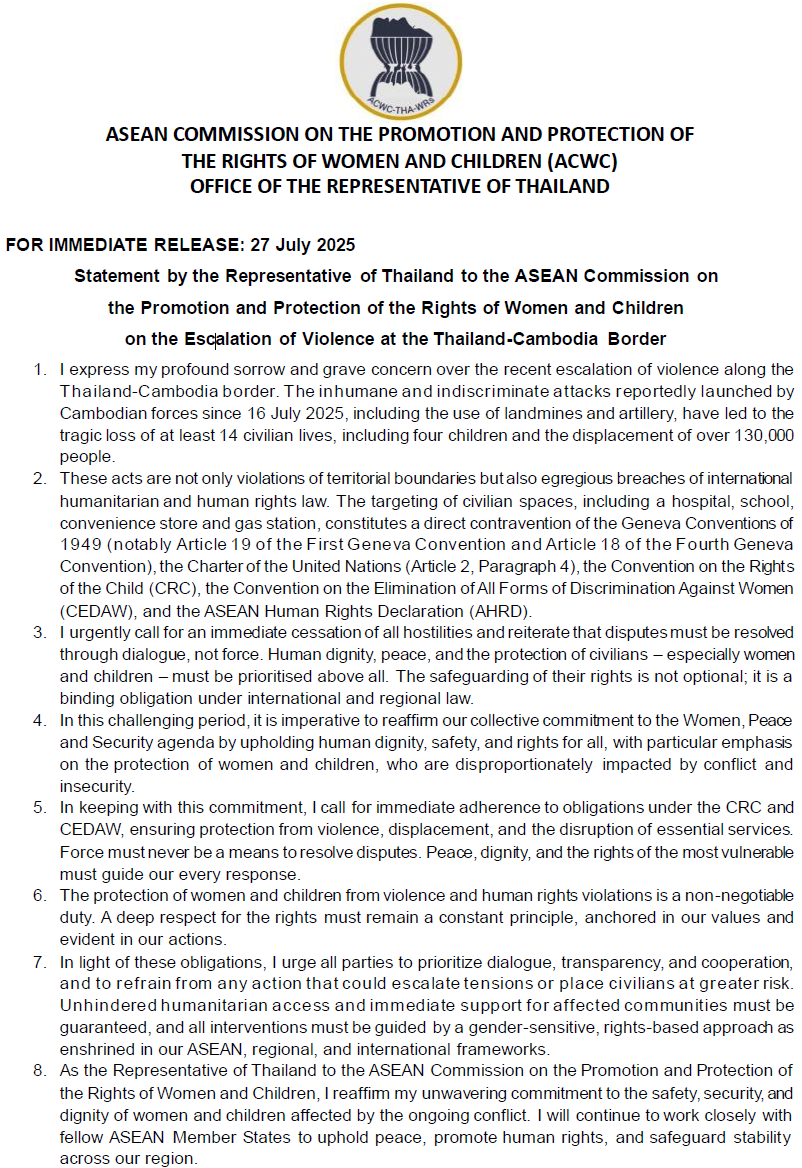
Leave a Comment » | ASEAN, Conflicts and Peace | Tagged: AHRD, ASEAN, cambodia, CEDAW, children, CRC, dispute, geneva convention, human rights, thailand, women | Permalink
Posted by jamestan2019
Statement by the Minister of Foreign Affairs of Malaysia H.E. Dato’ Seri Utama Haji Mohamad Haji Hasan on Thailand – Cambodia border dispute
27 July 2025Malaysia, as Chair of ASEAN, is following with deep concern the clashes between Thailand and Cambodia’s military troops at the disputed border on 24 July 2025 which has resulted in casualties. We urge both parties to exercise utmost restraint and to take immediate steps to de-escalate tensions.
Malaysia wishes to underscore the importance of resolving the border dispute through dialogue and diplomacy in the spirit of ASEAN solidarity and good neighbourliness.
The Prime Minister of Malaysia, Dato’ Seri Anwar Ibrahim, has reached out to H.E. Hun Manet, the Prime Minister of Cambodia, and H.E. Phumtham Wechayachai, Acting Prime Minister of Thailand, and appealed directly to both leaders for an immediate ceasefire to prevent further hostilities and to create space for peaceful dialogue and diplomatic resolution. Malaysia stands ready to offer the assistance of the good offices of the ASEAN Chair in facilitating an amicable way forward to address the issue that is acceptable to both parties.
H.E. DATO’ SERI UTAMA HAJI MOHAMAD HAJI HASAN
PUTRAJAYA
25 JULY 2025
Leave a Comment » | ASEAN, Conflicts and Peace | Tagged: ASEAN, cambodia, ceasefire, diplomatic, dispute, foreign affairs, human rights, malaysia, thailand | Permalink
Posted by jamestan2019
[Amnesty] Myanmar: Military onslaught in eastern states amounts to collective punishment
13 June 2022May 31, 2022 – https://www.amnesty.org/en/latest/news/2022/05/myanmar-military-onslaught-in-eastern-states-amounts-to-collective-punishment/
- Post-coup military assault in Kayin and Kayah States includes war crimes and likely crimes against humanity
- More than 150,000 displaced, with entire villages emptied and burned
- Amnesty International interviewed almost 100 people and visited border area
Myanmar’s military has been systematically committing widespread atrocities in recent months, including unlawfully killing, arbitrarily detaining and forcibly displacing civilians in two eastern states, Amnesty International said today in a new report.
The report, “Bullets rained from the sky”: War crimes and displacement in eastern Myanmar, found that Myanmar’s military has subjected Karen and Karenni civilians to collective punishment via widespread aerial and ground attacks, arbitrary detentions that often result in torture or extrajudicial executions, and the systematic looting and burning of villages.
The violence in Kayin and Kayah States reignited in the wake of last year’s military coup and escalated from December 2021 to March 2022, killing hundreds of civilians and displacing more than 150,000 people.
“The world’s attention may have moved away from Myanmar since last year’s coup, but civilians continue to pay a high price. The military’s ongoing assault on civilians in eastern Myanmar has been widespread and systematic, likely amounting to crimes against humanity,” said Rawya Rageh, Senior Crisis Adviser at Amnesty International.
“Alarm bells should be ringing: the ongoing killing, looting and burning bear all the hallmarks of the military’s signature tactic of collective punishment, which it has repeatedly used against ethnic minorities across the country.”
Post-coup surge in violence
For decades, ethnic armed organizations in Myanmar, including in Kayin and Kayah States, have been engaged in struggles for greater rights and autonomy. Fragile ceasefires in place in both states since 2012 broke down after the February 2021 coup, and new armed groups have emerged. In its operations, the military has relentlessly attacked civilians.
Some attacks appear to have directly targeted civilians as a form of collective punishment against those perceived to support an armed group or the wider post-coup uprising. In other cases, the military has fired indiscriminately into civilian areas where there are also military targets. Direct attacks on civilians, collective punishment, and indiscriminate attacks that kill or injure civilians violate international humanitarian law and constitute war crimes.
Attacks on a civilian population must be widespread or systematic to amount to crimes against humanity; in Kayin and Kayah States, they are both, for crimes including murder, torture, forcible transfer, and persecution on ethnic grounds.
Unlawful strikes
In its ongoing operations, Myanmar’s military has repeatedly fired explosive weapons with wide-area effects into populated civilian areas. Dozens of witnesses told Amnesty International about barrages that lasted days at a time. The organization documented 24 attacks by artillery or mortars between December 2021 and March 2022 that killed or injured civilians or that caused destruction to civilian homes, schools, health facilities, churches, and monasteries.
For example, on 5 March 2022, as families were at dinner, the military shelled Ka Law Day village, Hpapun Township, Kayin State, killing seven people, including a woman who was eight months pregnant. A close family member of four of the people who were killed said he had to sit in his house all night looking at the bodies, for fear of being injured by further shelling, before burying them in the morning.
Many people described the military’s use of fighter jets and attack helicopters as particularly terrifying. Witnesses described not being able to sleep at night out of fear of air strikes, or fleeing to seek shelter in bunkers and caves.
Amnesty International documented eight air strikes on villages and an internally displaced persons (IDP) camp in eastern Myanmar in the first three months of 2022. The attacks, which killed nine civilians and injured at least nine more, destroyed civilian homes and religious buildings. In almost all documented attacks, only civilians appear to have been present.
In one case, at around 6pm on 23 February 2022, a fighter jet fired on Dung Ka Mee village, Demoso Township, Kayah State, killing two civilian men and injuring several others. Amnesty International interviewed two witnesses and a relative of one of the deceased as well as an aid worker who responded after the attack. They said there was no fighting that evening and that the nearest armed group base was a mile or more away.
A local resident, a 46-year-old farmer who witnessed the attack, said the military aircraft made three passes, firing guns and a rocket:
“When that fighter jet was flying toward us in a nose-down position, I was numb… When they fired the rocket, I got myself together and realized I had to run [to a bunker]… We were shocked to see the dust and debris come towards us… There is a two-story building… The family lives upstairs and the downstairs is a mobile phone store. This building collapsed and it was also on fire.”
Another witness, a 40-year-old farmer, saw the remains of a neighbour’s body:
“We couldn’t even put them in a coffin, we put them in a plastic bag and buried them. People had to pick up the body pieces and put them in a bag.” In another incident, the military carried out an air strike on Ree Khee Bu IDP camp at around 1am on 17 January 2022, killing a man in his 50s as well as 15- and 12-year-old sisters.
Extrajudicial executions
The report documents how Myanmar’s military carried out arbitrary detentions of civilians on the basis of their ethnicity or because they were suspected of supporting the anti-coup movement. Often, detainees were tortured, forcibly disappeared or extrajudicially executed.
In one of many cases where soldiers extrajudicially executed civilians who ventured out from displacement sites to collect food or belongings, three farmers from San Pya 6 Mile village in Kayah State went missing in January 2022. Their decomposed bodies were found in a pit latrine around two weeks later.
The brother of one of the victims said he identified the men by their clothes and the state of their teeth. Soldiers fired on him and others as they tried to retrieve the bodies; they could only return to finish the burial a month later.
In a massacre that prompted rare international condemnation, soldiers near Mo So village in Kayah State’s Hpruso Township reportedly stopped at least 35 women, men and children in multiple vehicles on 24 December 2021, and then proceeded to kill them and burn their bodies. Doctors who examined the bodies reportedly said many of the victims had been tied up and gagged, bearing wounds suggesting they were shot or stabbed.
Amnesty International maintains that the incident must be investigated as a case of extrajudicial executions. Such killings in armed conflict constitute war crimes.
Witnesses also described Myanmar’s military shooting at civilians, including those attempting to flee across a river along the border with Thailand.
Looting and burning
Following a pattern from past military operations, soldiers have systematically looted and burned large sections of villages in Kayin and Kayah States. Witnesses from six villages reported having items including jewellery, cash, vehicles and livestock stolen, before homes and other buildings were burned.
Four men who fled Wari Suplai village, on the border of Shan and Kayah States, said they watched from nearby farmland as houses went up in flames after most villagers fled on 18 February 2022. They told Amnesty International that the burning went on for days, destroying well over two-thirds of the houses there.
“It’s not a house anymore. It’s all ashes — black and charcoal… It’s my life’s savings. It was destroyed within minutes,” said a 38-year-old farmer and father of two young children.
Amnesty International’s analysis of fire data and satellite imagery shows how villages were burned, some of them multiple times, in parts of Kayah State. The burning directly tracks military operations from village to village in February and March 2022.
A defector from the military’s 66th Light Infantry Division, who was involved in operations in Kayah State until October 2021, told Amnesty International that he witnessed soldiers looting and burning homes: “They don’t have any particular reason [for burning a specific house]. They just want to put the fear in the civilians that ‘This is what we’ll do if you support [the resistance fighters].’ And another thing is to stop the supply and logistics for the local resistance forces… [Soldiers] took everything they could [from a village] and then they burned the rest.”
The violence has caused the mass displacement of more than 150,000 people, including between a third and a half of Kayah State’s entire population. In some cases, entire villages have been emptied of their populations; at times, civilians have had to flee repeatedly in recent months.
Displaced people are enduring dire conditions amid food insecurity, scant health care — including for the conflict’s enormous psychosocial impact — and ongoing efforts by the military to obstruct humanitarian aid provision. Aid workers spoke of growing malnutrition and increasing difficulties in reaching displaced people due to the ongoing violence and military restrictions.
“Donors and humanitarian organizations must significantly scale up aid to civilians in eastern Myanmar, and the military must halt all restrictions on aid delivery,” said Matt Wells, Amnesty International’s Crisis Response Deputy Director – Thematic Issues.
“The military’s ongoing crimes against civilians in eastern Myanmar reflect decades-long patterns of abuse and flagrant impunity. The international community — including ASEAN and UN member states — must tackle this festering crisis now. The UN Security Council must impose a comprehensive arms embargo on Myanmar and refer the situation there to the International Criminal Court.”
Methodology
The report is based on research carried out in March and April 2022, including two weeks on the Thailand-Myanmar border. Amnesty International interviewed 99 people, including dozens of witnesses or survivors of attacks and three defectors from Myanmar’s military.
The organization also analysed more than 100 photographs and videos related to human rights violations — showing injuries, destruction and weapon use — in addition to satellite imagery, fire data, and open-source military aircraft flight data.
Leave a Comment » | ASEAN, Conflicts and Peace | Tagged: ASEAN, atrocities, coup, human rights, junta, killings, myanmar, repost | Permalink
Posted by jamestan2019
[UN News] Myanmar: ‘Meaningful action’ needed to stop the slaughter’ 
6 February 20221 February 2022
https://news.un.org/en/story/2022/02/1110992
“Now is not the time for more rhetoric, it is time for meaningful action”, said Tom Andrews, Special Rapporteur on the situation of human rights in Myanmar.
“The international community must take strong, meaningful steps to cut the junta’s access to weapons, funds and legitimacy”.
People ‘deserve better’
The UN expert reiterated the urgent need for the Security Council to impose an arms embargo on the Myanmar military and significantly increase financial pressure on the junta.
“The fact that one year has elapsed with no Security Council Resolution imposing a comprehensive arms embargo – as arms continue to flow to the junta and kill innocent people – is unacceptable”, he stated.
“The people of Myanmar deserve better from the United Nations”.
‘Criminal enterprise’
The Special Rapporteur said that he would soon release a report identifying the weapons in the junta’s arsenal and where they came from.
Mr. Andrews pointed out that the military junta is functioning as “a criminal enterprise”, committing murder, torture, abductions and forced displacement – while stealing revenue and seizing assets of the people of Myanmar.
“What is worse, they appear to be getting away with it. Their attacks continue unabated. The suffering of the Myanmar people is steadily increasing”, he continued.
Recent months have seen an even further escalation of violence, and a campaign of terror now widespread across the country.
“I have received more reports of mass killings, attacks on hospitals and humanitarian targets, and the bombing and burning of villages”, he added.
Unwavering commitment
“I am amazed at the resilience of the Myanmar people. In the face of aerial assaults, and mass arrest and torture, they continue to strike, to protest, to speak out and to defend themselves. They need and deserve stronger support from the international community”, he said. “The best and worst of humanity is unfolding in Myanmar”.
Special Rapporteurs are appointed by the Geneva-based UN Human Rights Council to examine and report back on a country situation. The positions are honorary and they are not paid for their work.
New UN humanitarian response plan
Meanwhile, Jens Laerke, Deputy Spokesperson for the UN humanitarian office, OCHA, noted that the newly published 2022 Humanitarian Response Plan (HRP) for Myanmar requests a record $826 million to assist 6.2 million people in need.
The 2022 plan represents double the amount requested last year, reflecting a growing crisis that has plunged an estimated 14.4 million people into humanitarian need.
Since the military coup, conflict and insecurity has continued, displacing more than 400,000 people to camps, displacement sites and with host communities. Many others have crossed into Thailand and India or sought refuge in the jungle, lacking adequate food, shelter, sanitation and medical care.
Sick and hungry
The economic and political turmoil of 2021, combined with the devastating impact of COVID-19, have driven half the population into poverty, with many unable to feed their families.
Over 13 million people are moderately or severely food insecure and malnutrition is expected to worsen among children, unless parental support is increased.
“Our ability to save lives and reduce suffering on this scale will depend on increased funding, improved access and removal of bottlenecks such as visa delays and banking restrictions”, said Mr. Laerke.
“Humanitarian agencies must be allowed access to displacement sites to conduct needs assessments and deliver lifesaving aid including food, water and health care”, he added.
Leave a Comment » | ASEAN, Conflicts and Peace | Tagged: 2021, abuse, embargo, human rights, international, junta, military, myanmar, repost, security council, united nations, world | Permalink
Posted by jamestan2019
[Amnesty International] Myanmar: World must act now to prevent another year of intolerable ‘death and misery’
6 February 202227 January 2022
If the international community continues to drag its feet on the grave human rights violations including lethal violence targeted at protestors that we have seen in Myanmar this past year, many more people will suffer and this human rights crisis could worsen, Amnesty International said today ahead of the one-year anniversary of the 1 February, 2021 coup.
“Enough is enough, the 55 million people of Myanmar cannot afford another year of wavering and sitting on the sidelines by many governments around the world. Concrete action aimed at holding the military accountable and preventing their access to weaponry used to commit widespread human rights abuses must be taken now or the shocking death and misery that have defined life in Myanmar since the coup is likely to persist,” said Ming Yu Hah, Amnesty International’s Deputy Regional Director for Campaigns.
“As the anniversary of the coup draws near, the military has launched indiscriminate air strikes that have killed civilians in the southeast, blocked life-saving aid, and kept up a bloody campaign against activists and journalists, who have been detained and killed in custody. Too many governments continue turning a blind eye to all these atrocities, as they did following the gross violations of human rights against the Rohingya people. As a result, the military has been increasingly brazen, acting with impunity in its efforts to wipe out any resistance to its rule.
“The Myanmar people are desperate and have become disillusioned about help from the international community. But there are clear steps that need to be taken to prevent the Myanmar military from maintaining its dystopian campaign of terror and persecution. The UN Security Council must stop dragging its feet, and instead impose a global arms embargo and targeted sanctions against military leaders, and urgently refer the situation in Myanmar to the International Criminal Court.
“In addition, all local and foreign companies in business partnerships with the military or military-owned businesses need to responsibly disengage, cutting the flow of funds that the military uses to prop up its lethal operations.
“Closer to home, the Association of Southeast Asian Nations (ASEAN) must present a unified front on Myanmar and demand the military to immediately stop the violence against civilians. The ASEAN should also exert pressure on the military to stop blocking humanitarian access and expand on and implement with a clear timeline its five-point consensus adopted last year, which has proved a failure.
“The new year must bring new approaches to Myanmar, placing human rights for the people of Myanmar, accountability, and a zero tolerance to human rights violations and abuses at the forefront.”
Background:
Myanmar’s military seized power in a coup in the early hours of 1 February, 2021. Since then it has killed more than 1,400 people and arrested more than 11,000, with over 8,000 currently in detention, according to the Assistance Association for Political Prisoners. The shocking violence fits into a long history of well-documented crimes under international law against ethnic minorities in the country, including the Kachin, Shan and Rohingya.
The UN Fact-Finding Mission on Myanmar has previously called for Senior General Min Aung Hlaing and other senior officials to be investigated and prosecuted for war crimes, crimes against humanity, and genocide.
The former civilian leader Aung San Suu Kyi has been sentenced to six years on bogus charges and faces more than 100 years if convicted on all the counts against her. Many of her closest allies, including President Win Myint, have also been convicted on similarly trumped-up charges.
Following the violent crackdown on peaceful protesters, some opponents of the military authorities have established the armed People’s Defense Force, which claims to have killed hundreds of soldiers through shootings, bombs and ambushes.
On top of the chaos that has gripped major cities and towns across the country in the aftermath of the coup, economic and food insecurity as well as pandemic-related challenges have caused millions to face hunger. Hundreds of thousands have also been internally displaced while thousands have fled across the border to Thailand.
Leave a Comment » | ASEAN, Conflicts and Peace | Tagged: 2021, abuse, ASEAN, coup, human rights, junta, myanmar, repost, singapore, world | Permalink
Posted by jamestan2019
 MARUAH Singapore
You must be logged in to post a comment.