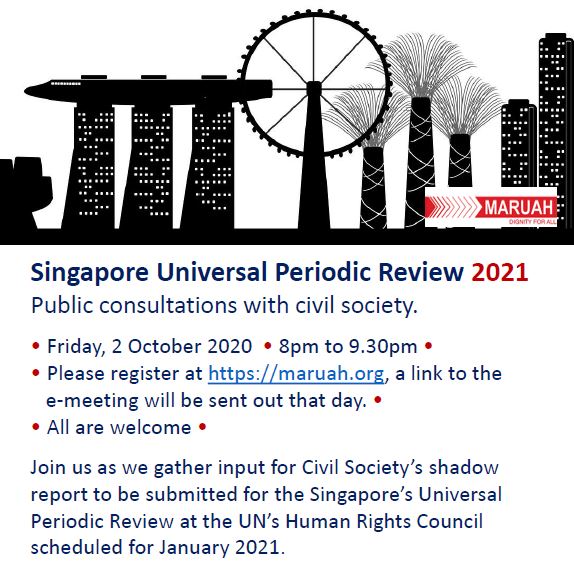
Public Consultation by MARUAH – Singapore Universal Periodic Review 2021 [Fri 2 Oct, 8pm (SG time)]

27 September 2020

Please register at https://forms.gle/KL9dMieoWzu7P3Yb7 before 11.59pm on Thursday, 1 October 2020. We will be sending the video conference link via email to all those who have registered.

Read more about:

MARUAH’s UPR submissions to the UN Human Rights Council: https://maruah.org/upr/

Singapore Ministry of Foreign Affairs on UPR: https://www.mfa.gov.sg/SINGAPORES-FOREIGN-POLICY/Key-Issues/Singapore-Universal-Periodic-Review

UN Human Rights Council’s UPR process: https://www.ohchr.org/EN/HRBodies/UPR/Pages/BasicFacts.aspx

Thank you.


2020 International Day of Older Persons: “Pandemics: Do They Change How We Address Age and Ageing?”

24 September 2020

The year 2020 marks the 75th Anniversary of the United Nations and the 30th Anniversary of the International Day of Older Persons (UNIDOP). This year has also seen an emergence of  COVID-19, that has caused an upheaval across the world. Considering the higher risks confronted by older persons during the outbreak of pandemics such as COVID-19, policy and programmatic interventions must be targeted towards raising awareness of their special needs. Recognizing older persons contributions to their own health and the multiple roles they play in the preparedness and response phases of  current and  future pandemics is also important.

This year has also been recognised as the “Year of the Nurse and Midwife”. UNIDOP 2020 will highlight the role of the health care workforce in contributing to the health of older persons, with special recognition of the nursing profession, and a primary focus on the role of women- who are relatively undervalued and in most cases inadequately compensated.

The UNIDOP 2020 event will also promote the Decade of Healthy Ageing (2020-2030) and help bring together UN experts, civil society, government and the health professions to discuss the five strategic objectives of the Global Strategy and Action plan on Ageing and Health while noting the progress and challenges in their realization. The global strategy is well integrated into the Sustainable Development Goals (SDGs), while ageing issues cut across the 17 goals, especially Goal 3 which aims to “ensure healthy lives and promote well-being of all at all ages”. As stated by Dr. Tedros Adhanom Ghebreyesus (Director-General, WHO)  “acting on the strategy, is a means for countries to implement the 2030 Agenda for Sustainable Development and ensure that every human being regardless of age will have an opportunity to fulfill their potential in dignity and equality”

The objectives of UNIDOP 2020 are to:

  1. Inform participants about the strategic objectives for the Decade of Healthy Ageing
  2. Raise awareness of the special health needs of older persons and of their contributions to their own health and to the functioning of the societies in which they live
  3. Increase awareness and appreciation of the role of the health care workforce in maintaining and improving the health of older persons, with special attention to the nursing profession
  4. Present proposals for reducing the health disparities between older persons in the developed and developing countries, so as to “Leave no one behind”
  5. Increase understanding of the impact of COVID-19 on older persons and its impact on health care policy, planning, and attitudes.

The event is co-organized by the NGO Committee on Ageing, New York and DESA, and co-sponsored the Permanent Mission of Argentina to the United Nations, in collaboration with the Group of Friends of Older Persons. The event will bring diverse participants from NGOs, Member States, academia and civil society.

The commemorative event will be held virtually on, 1 October 2020 from 9am to 12 pm (New York time).

The International Association of Gerontology and Geriatrics is also holding a companion event that will be held virtually on the same day from 1pm to 3pm (New York time).

For more information, please contact ageing@un.org  @UN4Ageing @UNDESASocial #UNUNIDOP2020

[Webinar] Online Forum on the Impact of Covid-19 on the Rights of Migrant Workers in ASEAN (18 September 2020 10am)

18 September 2020

[Update] Recording of the online forum is now available! Please click on link below to watch this on YouTube.


[Repost] Penang Institute Monographs – Human Rights Derogations in Southeast Asian Countries during the Covid-19 Pandemic

5 September 2020

We are pleased to share a publication published by the Penang Institute. The “Human Rights Derogations in Southeast Asian Countries during the Covid-19 Pandemic” was written by Braema Mathiaparanam (Visiting Senior Research Fellow, History and Regional Studies Programme).

The full publication can be found at: https://penanginstitute.org/wp-content/uploads/2020/09/Human-Rights-Derogations-in-Southeast-Asian-Countries-during-the-Covid-19-Pandemic.pdf

EXECUTIVE SUMMARY

  • The ASEAN Inter-Governmental Commission on the Promotion and Protection of Human Rights has issued a statement of concern and has reminded governments to continue observing human rights during the pandemic, and that even if some rights have to be restricted, this should not be done disproportionately.
  • All members of the Association of Southeast Asian Nations (ASEAN) have pre-existing forms of restriction on the freedom of expression and press freedom as well as censorship, which intensified in this pandemic.
  • It is challenging to contain Covid-19 infections while ensuring that human rights are not derogated. However, the lockdown measures imposed in some countries in Southeast Asia during the containment period became opportunities to intimidate, detain and arrest opposition party members, activists and journalists.
  • Countries have also taken a strict stance on fake news and disinformation, leading to many arrests across countries. Increased surveillance was also used to track threats to authority figures and the government, alongside gaining evidence on criminal activities such as drug-trafficking and money laundering.
  • Certain communities were overlooked in government policies and assistance especially in terms of food and supply, economic aid and information sharing. Prisons and detention centres are overcrowded, leading to more outbreaks of Covid-19 infections.
  • Countries have national, regional and international obligations and responsibilities that they have agreed to and breaches of these state obligations need to be addressed, especially when the actions taken cannot be justified even as emergency measures.
  • Covid-19 will not be the last crisis, and governments can use lessons learnt from Covid-19 to improve their responses for the next crisis and take counter-measures that also adhere to human rights principles.

Post GE2020 Webinar: “Our Youth, Our Future” on 5 September 2020 (via Zoom)

5 September 2020

MARUAH hosted the GE2020 Post election webinar entitled “Our Youth, Our Future” this morning (5 September).

We would like to thank all our speakers, Discussant Prof Kenneth Paul Tan and Moderator Ms Braema Mathi for taking time to share their thoughts and contributing to a lively discussion. We also would like to thank all Zoom participants and viewers who watched the webinar via the Facebook livestream.

The video from the webinar has been uploaded to MARUAH YouTube channel at https://youtu.be/glRSVAvrdqE, please feel free to share this with all your contacts.

If you would like to join MARUAH as a volunteer, please fill in this form – https://bit.ly/3jLdqx6.

Thank you and we look forward to having you at our next online discussion. 

MARUAH Secretariat