ASEAN human rights body to rely on ‘peer pressure’

29 July 2008

Agence France-Presse (AFP) has a news report, providing details of the proposed ASEAN human rights body

22nd July 2008
ASEAN human rights body to rely on ‘peer pressure’
A South-East Asian human rights body expected to come into force next year will have no power to impose sanctions and will rely on ‘peer pressure’ to bring members into line, officials said on Monday.

A panel drafting the terms of reference for the Association of South-east Asian Nations (ASEAN) human rights body is to submit its first report to foreign ministers at the bloc’s 2008 summit in Bangkok, a statement said.

A final draft could be in place in 2009, paving the way for the human rights organisation to begin its work.

‘We aim to achieve a result that is realistic, balanced and credible, and which would be in the best collective interest of ASEAN,’ the panel’s chairman, Bilahari Kausikan, said after it met foreign ministers on Monday.

Mr Kausikan said the panel would convene monthly before meeting ASEAN ministers again in December. An interim report is to be completed in September.

One South-east Asian official privy to the negotiations said however that the body would likely end up powerless to punish rights violators, including Myanmar which has ignored international calls to institute democratic reforms.

‘The body will not be empowered to have sanctions,’ the official said. ‘It will work on peer pressure, will measure progress and will seek periodic explanations for non-progress.’ A database on human rights violations will also be created, the official said.

The Philippines, Malaysia, Indonesia and Thailand want the rights body to have a monitoring and enforcement capacity modelled on the United Nations, the official said.

Singapore, Myanmar, Cambodia, Laos and Vietnam are pressing to water down the terms of reference to ensure the human rights body is largely an advisory panel. Brunei has not stated its position, the official said.

ASEAN leaders, during a summit in Singapore last year, signed a charter which committed member states to notions of democracy and human rights and for the first time set out principles and rules for the group.

Under the charter, a human rights body would be established in a region that includes countries with poor human rights records, such as military-run Myanmar, which is subject to international sanctions.

Activists fear that ASEAN, which cherishes a policy of non-interference in members’ internal affairs, will establish a rights mechanism that is toothless and ineffective.


SYINC conference

20 July 2008


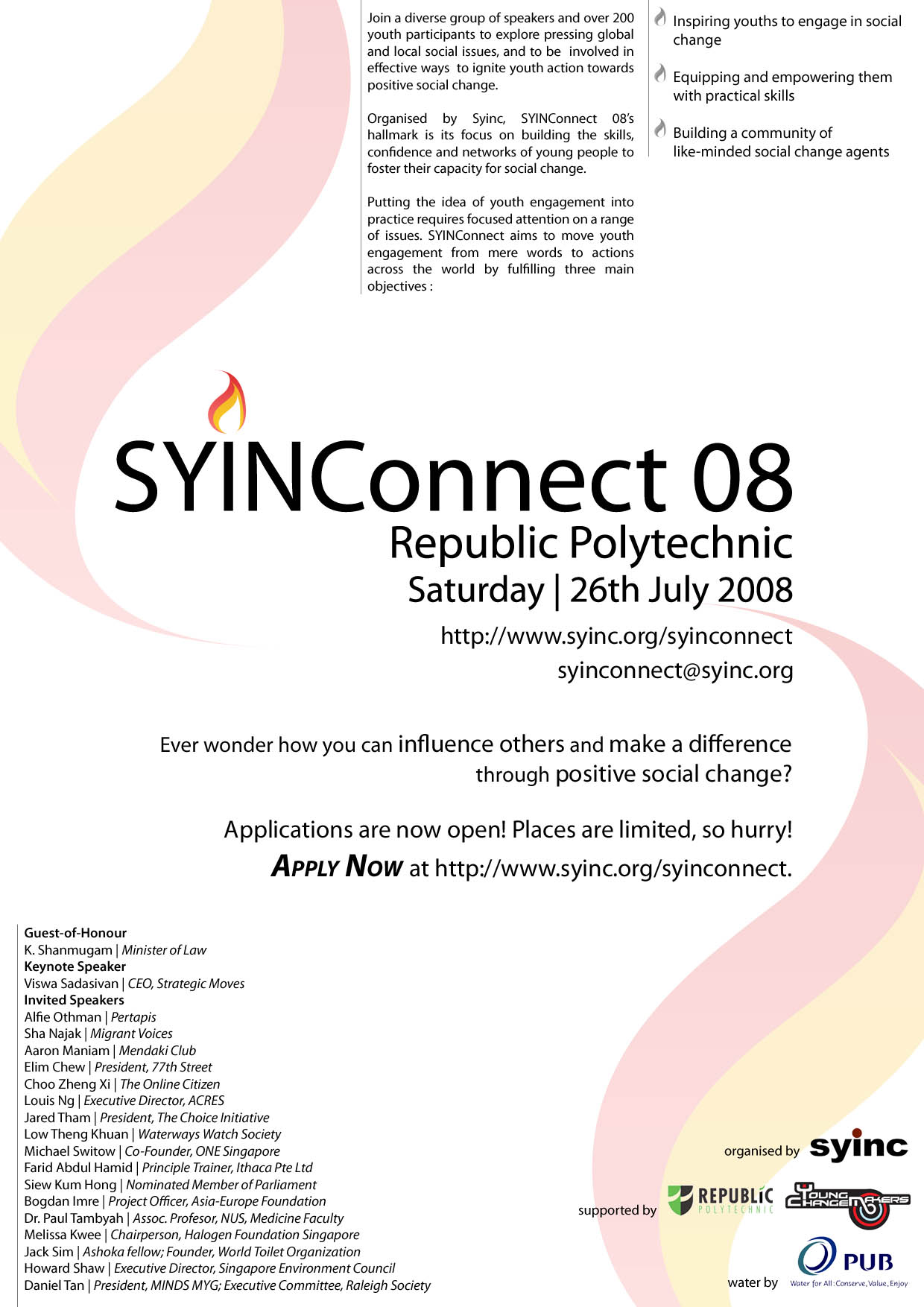
SYINC is organising a conference for youths named SYINConnect. 3 MARUAH members will be speaking at SYINConnect. More details below.

Want to meet like-minded people who are passionate about making a difference?
Want to learn from respected and experienced community leaders and social entrepreneurs?

SYINConnect is a one-day youth conference that connects participants to urgent social issues, and what people are doing about them in Singapore. Participants will get the opportunity to meet the community leaders making change in our society today, and build the skills, networks and confidence to be effective agents of change.

Saturday, 26th July 2008
8.00 am – 6.30 pm
Republic Polytechnic

If you have any further queries, do not hesitate to contact us at syinconnect@syinc.org


ASEAN meets in Singapore

17 July 2008

Singapore is hosting the 41st ASEAN Ministerial Meeting (AMM), the Post Ministerial Conferences (PMC) and the 15th ASEAN Regional Forum (ARF) in Singapore from 17 July – 24 July 2008.

Of specific concern to MARUAH is the anticipated announcement of the members of the High Level Panel on the Establishment of the ASEAN Human Rights Body (HLP). The HLP will be tasked with drafting the Terms of Reference (TOR) of the proposed ASEAN Human Rights Body.

The programme schedule also includes a meeting with the Working Group for ASEAN Human Rights Mechanism (Working Group).

MARUAH has been working closely with the Working Group on this issue. Ms Braema Mathiaparanam, co-ordinator of MARUAH and the Singapore focal point of the Working Group, is expected to be part of that meeting.


The ThinkBox by AWARE presents “Sex, Power and Office Politics”

10 July 2008


Our partner, the Association of Women for Action and Research (AWARE) is organising a public forum on sexual harassment in the workplace, and MARUAH member, Mr Siew Kum Hong will be chairing the session.

Details below
– Date and Time: Monday, 14 July 2008, 7:00 PM – 9:30 PM
– Venue: The Box at SMU (Li Ka Shing Library, 70 Stamford Road, Basement One)
– FREE Admission

The ThinkBox by AWARE is a public forum series that encourages open dialogue between professionals, academics, and students about current events. The upcoming session, “Sex, Power, and Office Politics,” will cover how sex can make or break you in the workplace, and why that’s a bad thing. Professional panelists will review the recent findings of an AWARE report on workplace sexual harassment, and discuss how companies, the government, organizations, and individuals can work together to overcome this problem. The goal of this ThinkBox is to give the public an opportunity to become part of the solution to eradicating sexual harassment from Singapore.


Singapore falls short on rights: lawyers’ group

9 July 2008

Agence France-Presse (AFP) has highlighted a report(PDF) by the International Bar Association’s Human Rights Institute (IBAHRI).

IBAHRI’s press release “expressed concern about limitations on the freedoms of expression, assembly, and the press, and of the independence of the judiciary in Singapore.”

18 recommendations are made in the report, which are reproduced below.

  1. Singapore should ratify the ICCPR without reservations and implement its provisions at the earliest opportunity.
  2. Singapore should immediately bring its restrictions on free expression in line with recognised international customary law.
  3. Singapore should immediately abolish defamation as a criminal offence, or in the alternative and should abolish heavy sanctions for defamation offences; prohibit public officials from instituting criminal defamation; and review the existing defences to ensure they are in line with international standards.
  4. The Singapore Government should pass legislative limits on civil defamation pay-outs, and certainly on cases initiated by government officials.
  5. A defence of qualified privilege for comments made about government officials should be made available and enforced by the courts in appropriate cases.
  6. The Singapore Government should take steps to encourage, not discourage, opposition participation and debate.
  7. Singapore Government officials should stop initiating defamation claims for criticisms made in the course of political debate.
  8. The Singapore Government should increase the freedom of the press – both domestic and foreign – to report on political issues impacting on the people of Singapore.
  9. The Newspaper and Printing Presses Act should be amended so as to ensure that there are checks and balances on the decision to restrict the circulation of publications under the Act.
  10. The Newspaper and Printing Presses Act should be amended to allow reasonable comment on the domestic politics of Singapore by foreign publications.
  11. Singapore should remove personal responsibility for internet hosts for information published on their hosted sites or should clarify the limitations on material that may not be posted.
  12. Steps should be taken to ensure that internet bloggers are free to make reasonable statements in the public interest.
  13. Security of tenure should be granted to all judges.
  14. Transfer of judges between executive and judicial roles should be abolished.
  15. The situations in which demonstrations may take place should be expanded to include all peaceful assemblies.
  16. Limitations on penalties for peaceful assembly should be introduced as a matter of urgency.
  17. The Singapore Government should respect the right of the Singapore Law Society to engage in debate on law reform and should immediately repeal the prohibition on the Singapore Law Society commenting on legislation.
  18. The Singapore Law Society should ensure that it is actively participating in law reform debates on a wide range of issues, as that is its responsibility as a law society.

UPDATE: The Ministry of Law has issued a response. Both the Straits Times and TODAY have reported on the response.


Singapore’s draft report on the Convention on the Rights of the Child (CRC)

4 July 2008

Several newspapers have reported on the 2nd report to be submitted to the United Nations (UN) Committee on the Rights of the Child. Regular submissions are one of the obligations of countries who are a party to the Convention on the Rights of the Child (CRC). Singapore ratified the CRC in 1995, together with the Convention on the Elimination of All Forms of Discrimination against Women (CEDAW).

The Straits Times report (“S’pore kids better off now than in 2002: MCYS report”) mentions

Improvements seen in schooling, health and crime rates; but STD, abuse cases up

The TODAY report (“Kids’ rights: Plan of action”) highlighted discussions at a closed-door forum, specifically

Educating youth workers on children’s rights and developing a national plan of action for children

The newspaper report also spelled out some of the government’s reservations to the CRC, namely on free primary education, corporal punishment, and special protection of refugee children.

The Zaobao report (“少儿权利草拟报告书:本地青少年自杀率上升”, translated as “Draft report for CRC: Rise in adolescent suicide rate in Singapore”) focused on the issue of teenage suicides, with the rate climbing from 2.7 per 10,000 youths in 2004, to the current rate of 4.6. The newspaper report also informed of a MCYS public consultation which will close by the end of this month.

The official press release provided (among other items) a list stating the key areas of progress in the area of child rights, like changes to legislation, providing more choices in education, and help for dysfunctional families, etc.

Do access the draft report and provide your feedback and comments.


Singapore Hosts 7th Workshop on ASEAN Human Rights Mechanism

18 June 2008

The Working Group for an ASEAN Human Rights Mechanism has put up a report of the 7th workshop on the ASEAN Human Rights Mechanism.

From the Working Group website, a short explanation of what the Workshop is about.

The Workshop is the seventh in a series that is annually organized by the Working Group. Co-organized by the ministry of foreign affairs and the national human rights institution (if any) of a host ASEAN member-state, it has become a platform for stakeholders to dialogue on the establishment of a regional human rights mechanism.

Scroll down to the end of that webpage for the summary of proceedings.


TWC2 Capacity Building Workshop

18 June 2008

Our partner, Transient Workers Count Too (TWC2) will be holding a free workshop on 29th June 2008, 9am till 6pm. This is a workshop as part of their public education programme.

Download the workshop details from their website HERE.


Philippine president appeals for passage of ASEAN Charter

15 June 2008

The Asean Charter, which was signed by all 10 Asean countries last November, does not come into effect until all 10 member countries have ratified it.

President Gloria Macapagal-Arroyo is appealing to the Philippine Congress to ratify the Charter. She also said, Asean “must accept its responsibility to advance the cause of economic and social justice within its membership.”

Some congressmen have argued that the Philippines should hold back ratification until the Myanmar government demonstrates concrete steps to restore democracy.

Xinhua
13 June 2008

Philippine president appeals for passage of ASEAN Charter

MANILA, June 13 (Xinhua) — Philippine President Gloria Macapagal-Arroyo is appealing for the passage of ASEAN Charter for further economic integration within the Association of South East Asian Nations, the Philippine government said in a statement on Friday. Read the rest of this entry »


Asean human rights body: Progress made, but more work lies ahead

14 June 2008

This is the Straits Times’ concluding report on the 7th Workshop, held June 12 – 13, 2008 in Singapore.

Straits Times
14 June 2008

ASEAN HUMAN RIGHTS BODY
Progress made, but more work lies ahead

Workshop participants agree broad consultation needed, but no consensus reached on powers proposed body should have
By Kor Kian Beng

ASEAN’S goal of setting up a human rights body is shaping up well, but human rights experts and government officials who ended a meeting here were under no illusions about the mountain of work that lies ahead.

The 60 or so participants who met at a two-day workshop agreed, among other things, that the high-level panel which will draw up terms of reference for the human rights commission must consult broadly with government and civil society groups alike. Read the rest of this entry »