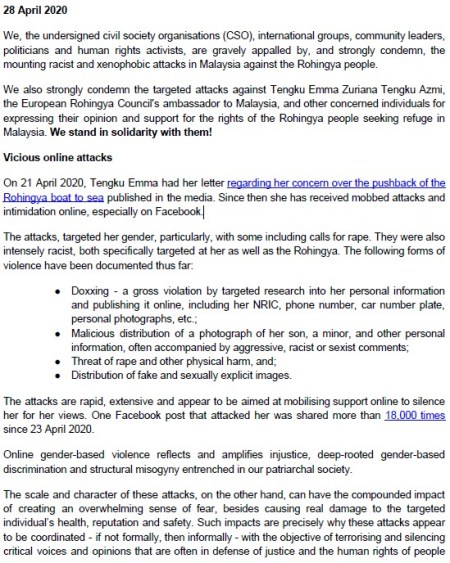

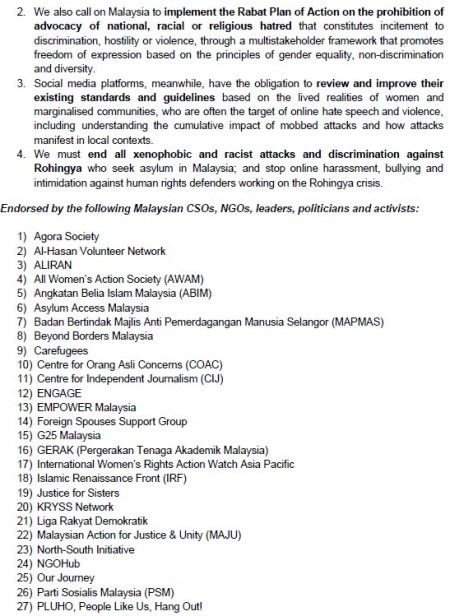
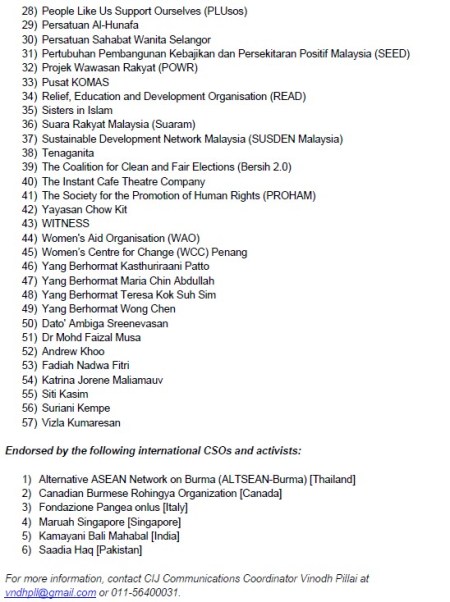
CSOs Stand in Solidarity with Women Human Rights Defender Tengku Emma Zuriana and Condemn Online Gender-Based Attacks
28 April 2020
 Leave a Comment » |
  Uncategorized |
  Permalink
 Posted by jamestan2019
International Workers’ Memorial Day Statement – Mourn for dead, Fight for the living
28 April 2020Mere Remembrance of Dead Workers without Enacting New Laws to ensure future safety of the Living is Meaningless
On the occasion of the International Workers’ Memorial Day or Workers’ Mourning Day, celebrated annually on April 28, we, the 40 undersigned groups and trade unions lament the fact that workers’ death at worksites, have not resulted in the Malaysian government’s enactment of laws, regulations and standards that will prevent future deaths or injury in a similar situation.
International Workers’ Memorial Day or Workers’ Mourning Day is the international day of remembrance and action for workers killed, disabled, injured or made unwell by their work. The slogan for the day is Mourn for the dead, Fight for the living.
While we mourn the loss of lives and injuries of workers, we struggle and fight for the living with the object of reducing risk of future loss of life and injury at the work place.
In Malaysia, in 2018, there were 611 fatal accident cases. In 2017, there were 711 fatal accident cases. (Bernama, 11/07/2018; Star, 7/1/2020). Interestingly, the Department of Occupational Safety and Health (DOSH) records of fatal accident cases investigated in 2017 and 2018, are only 206 and 260 respectively, which means that investigations are yet to be completed even in so cases that resulted in death.
The construction sector records one of the highest number of fatalities. The Occupational Safety and Health Department’s (DOSH) statistics recorded 169 deaths and 3,911 accidents in the construction sector for 2018.( NST, 15/2/2020) The rate of fatality per 100,000 workers in the construction sector is 13.44 in 2018, as compared to 14.57 in 2017.
Malaysia’s Fatal Accident Rate (FAR) was not only 10 times worse than that of the United Kingdom but had in fact deteriorated by 20 per cent since the turn of the century, according to a Construction Industry Development Board report.
Deaths by reason of trench collapses – death by being buried alive
Jalmi, an Indonesian worker in his 20s, died after he was buried in a three-metre drain during excavation works in Shah Alam, Selangor in October 2015. (NST, 5/10/2015).
In March 2015, it was reported that 2 construction workers in Machang, Kelantan, a local man and a Myanmar national were killed when earth collapsed and buried them in the hole whilst they were working on a water supply pipe project .(NST, 30/3/2015).
In September 2015, A Bangladeshi construction worker was killed in Kuala Lumpur after he was buried in a pile of soil, after the victim and his colleague had earlier dug a hole about three-meters deep to install underground pipes.(NST, 30/9/2015)
Nicholas anak Jawan, a 33-year-old worker, was killed in Sarawak after he was buried alive while building a deep monsoon drain (Malay Mail, 3/12/2019)
Md Shoriful, 43, and Julhas Rahman, 27, were killed when they were buried by mounds of falling earth at a housing project construction site in Mentakab, Temerloh where they were carrying out sewage pipe installation works. (BERNAMA/New Straits Times, 6/3/2020)
There will be much more similar cases, which unfortunately not all would have been reported by the media. Sadly, media reports also fails to respectfully name the workers who died, and also fails to make mention of the names of the companies and/or employers who may be responsible for these fatal accidents.
In the commemoration of this year’s IWMD, we call upon the Malaysian government to:
- Enact and enforce laws and regulations that impose mandatory obligations to prevent further deaths in the future
Death by such trench collapses in Malaysia, and also all over the world, have been happening for years, and the question is why are there still no specific laws and regulations in place that will prevent such deaths in similar situations in the future.
What ought to be in such laws could be the requirement for needed supports and/or battering to prevent the soil from collapsing on workers working in such pits or trenches. The requirement for the need for safety inspection of the site by a competent person, before a worker is asked to enter any hole or trench of more than 1 meter depth, noting that safety will also be affected by type of soil, weather on that day, vibration caused by machines operating nearby or other reasons.
Specific regulations and standards are needed, rather than vague general laws that simply talk about ‘so far as practicable’ general obligations of safety and health. In some other countries, there are already laws that specifically deal with this like The Construction (Design and Management) Regulations 2015 in United Kingdom, and
There are so many employers and companies involved in construction works in Malaysia, and it absurd to expect them to know of all the dangers and risks involved in the various different aspects of their work. Employers and companies, may not be aware of the risks discovered at other worksites following some accidents, and as such may still be carrying out work in the same risky life-threatening manner through ignorance.
Thus, it is only reasonable and incumbent for the government, who has the data and expertise with regard to occupational safety and health issues, to do the needful through the making of needed regulations and/or laws, which includes steps to be taken by employers to ensure safety.
Every worksite incident that results in an accident, injury and/or death of a worker, ought to teach us what need to be done now to prevent future mishaps that may result in death of workers. The government is duty bound to take steps to ensure similar accidents do not recur anywhere, and the best solution is the enactment of clear laws, rules and regulations that will not only highlight the dangers, but will also make sure that employers and companies do the needful to reduce risk of death and injury. Mere guidelines or advisories are insufficient.
- Make public and create awareness of Laws, Regulations and Standard Operating Procedures (SOP)
It is often that government mentions about SOPs and other legal requirements, but sadly many of these are not even known to workers and the public, thus making it impossible for people to even highlight actions and/or situations when employers and companies do not follow the law.
All applicable laws, regulations and SOPs must be made available to the public, including all websites of agencies, departments and Ministries having the responsibility for occupational safety and health.
- Ensure deterrent sentences to reduce non-compliance, and reduce death and injury of workers
Worker lives and wellbeing are of primary importance, and as such penalty for employers and companies that breach laws that protect the safety and health of workers must be deterrent if Malaysia is truly concerned about human lives.
Currently penalties for violation of Occupational Safety and Health laws are fines, and a maximum of 2 years imprisonment. However, there seem to be no employers or Directors of companies that have been sent to prison, even when their failings have resulted in death and injury to workers. It is Directors and owners of companies that sometimes, to save cost, who choose to negate duties and obligations to do the needful to ensure worker safety and health.
Kevin Otto, owner of Atlantic Drain Services, a company in US was recently sentenced to two years imprisonment after being found guilty of two counts of manslaughter for the deaths of two employees, Robert Higgins and Kelvin Mattocks, who drowned in October 2018 in an unprotected, 14’ deep trench following a water main break. He was further penalized with three years’ probation following his sentence, and he can never again employ anyone in a job that involves excavation. (ISHN, 17/12/2019).
In other jurisdictions, stringent laws with higher penalties, including new offences, are being enacted with the object of reducing risk of life and injury to workers. In Australia, Industrial Manslaughter laws have been introduced.
LET NOT THE DEATH OF WORKERS NOT BE IN VAIN. PREVENT SIMILAR ACCIDENTS TO REDUCE FUTURE RISK OF LIVES OF OTHER WORKERS.
Charles Hector
Apolinar Tolentino
For and on behalf of the following 40 groups
ALIRAN
WH4C(Workers Hub For Change)
Associated Labour Union, Philippines
Association of Human Rights Defenders and Promoters- HRDP in Myanmar
Building and Wood Workers International (BWI) Asia Pacific Region
Building and Wood Workers’ Federation of Myanmar
Center for Orang Asli Concerns(COAC)
Clean Clothes Campaign(CCC) South East Asian Coalition
Confederation of Trade Unions Myanmar – CTUM
Electrical Trades Union of Australia
IMA Research Foundation, Bangladesh
International Black Women for Wages for Housework
Kesatuan Pekerja Atlas Edible Ice Sdn Bhd
Kesatuan Sekerja Industri Elektronik Wilayah Selatan, Semenanjung Malaysia (KSIEWSSM)/Electronic Industry Employees Union Southern Region Peninsular Malaysia(EIEUSRPM)
Labour Behind the Label
MADPET (Malaysians Against Death Penalty and Torture)
MARUAH, Singapore
Marvi Rural Development Organization (MRDO), Pakistan
Migrant Care, Indonesia
NAMM (Network of Action for Migrants in Malaysia)
National Union of Transport Equipment & Allied Industries Workers (NUTEAIW)
National Union of Flight Attendants Malaysia (NUFAM)
North South Initiative (NSI)
Odhikar, Bangladesh
Persatuan Sahabat Wanita Selangor
Safety and Rights Society (SRS), Bangladesh
Tenaganita, Malaysia
Timber Employees Union of Peninsula Malaysia
Union Network International- Malaysia Labour Centre (UNI-MLC)
Women of Color/Global Women’s Strike, United Kingdom
Bangladesh Group THE Netherlands
Persatuan Kesedaran Komuniti Selangor (EMPOWER)
Sabah Timber Industry Employees Union (STIEU)
African Resources Watch (Afrewatch)
Association Of Home And Maquila Workers, ATRAHDOM- Guatemala.
Parti Sosialis Malaysia(PSM)
AMMPO-SENTRO – Asosasyon ng mga Makabayang Manggagawang Pilipino Overseas – Sentro ng mga Nagkakaisa at Progresibong Manggagawa (Association of Nationalist Filipino Workers- Sentro a labor center in the Philippines)
Payday Men’s Network UK
Payday Men’s Network US
Workers Assistance Center, Inc. Philippines
Datuk Dr Ronald McCoy
Leave a Comment » | Uncategorized | Permalink
Posted by jamestan2019
(updated with webinar recording) Labour Day Special Webinar – Migrant Workers and the Pandemic in Singapore (1 May 2020)
27 April 2020Organised by MARUAH with technical support provided by Shape SEA
Please check back this post over the next couple of days as we upload additional presentation material.
Labour Day is special to all of us, as workers.
Have a Meaningful Labour Day as we remember those who have lost jobs, our dedicated front liners, all essential workers, healthcare workers and support staff, NGOs, union leaders, the civil service officers, multi-Ministry task force, government leaders and international leaders all and you and me…
Why meaningful? These are uneasy times, also very special as it makes us understand more on the types of jobs and the workers. What are the new norms? How do we value the work of each other? The invisibility of so many workers, some whom we have overlooked.
Thank you for your interest and time.
A Meaningful Ramadan to all Muslim views and to many Migrant Workers who are Muslims too.
– Braema Mathi, MARUAH Secretary
Recording of the webinar
Speaker’s presentations:
- “The dorms are not the problem”, text version of presentation made by Mr Alex Au of Transient Workers Count Too (TWC2)
- “Co-creating solutions with migrant workers”, presentation slides used by Dr Satveer Kaur-Gill
- “Workers’ Housing In Context – Regulations, Reconsiderations, and Re-contextualisations”, presentation slides used by Dr Imran bin Tajudeen
- Presentation slides used by Ms Braema Mathi

Leave a Comment » | Events, Uncategorized | Tagged: ASEAN, covid, covid-19, discussion, event, fdw, foreign domestic workers, foreign workers, human rights, labour day, maruah, migrant, migrant workers, pandemic, rights, singapore, webinar | Permalink
Posted by jamestan2019
Amnesty International: Human rights defenders: We need them more than ever! States worldwide must protect Human Rights Defenders in the current COVID-19 crisis
9 April 2020At a time when some of our human rights have been restricted in order to implement public health measures, human rights defenders are more crucial than ever in our struggle to overcome the COVID-19 pandemic and ensure that no one is left behind. The doc includes recommendations to states on the protection and recognition of HRDs and the key role they play in the current crisis worldwide.
Leave a Comment » | Uncategorized | Permalink
Posted by jamestan2019
Joint Statement: States use of digital surveillance technologies to fight pandemic must respect human rights
2 April 2020The COVID-19 pandemic is a global public health emergency that requires a coordinated and large-scale response by governments worldwide. However, States’ efforts to contain the virus must not be used as a cover to usher in a new era of greatly expanded systems of invasive digital surveillance.
We, the undersigned organizations, urge governments to show leadership in tackling the pandemic in a way that ensures that the use of digital technologies to track and monitor individuals and populations is carried out strictly in line with human rights.
Technology can and should play an important role during this effort to save lives, such as to spread public health messages and increase access to health care. However, an increase in state digital surveillance powers, such as obtaining access to mobile phone location data, threatens privacy, freedom of expression and freedom of association, in ways that could violate rights and degrade trust in public authorities – undermining the effectiveness of any public health response. Such measures also pose a risk of discrimination and may disproportionately harm already marginalized communities.
These are extraordinary times, but human rights law still applies. Indeed, the human rights framework is designed to ensure that different rights can be carefully balanced to protect individuals and wider societies. States cannot simply disregard rights such as privacy and freedom of expression in the name of tackling a public health crisis. On the contrary, protecting human rights also promotes public health. Now more than ever, governments must rigorously ensure that any restrictions to these rights is in line with long-established human rights safeguards.
This crisis offers an opportunity to demonstrate our shared humanity. We can make extraordinary efforts to fight this pandemic that are consistent with human rights standards and the rule of law. The decisions that governments make now to confront the pandemic will shape what the world looks like in the future.
We call on all governments not to respond to the COVID-19 pandemic with increased digital surveillance unless the following conditions are met:
- Surveillance measures adopted to address the pandemic must be lawful, necessary and proportionate. They must be provided for by law and must be justified by legitimate public health objectives, as determined by the appropriate public health authorities, and be proportionate to those needs. Governments must be transparent about the measures they are taking so that they can be scrutinized and if appropriate later modified, retracted, or overturned. We cannot allow the COVID-19 pandemic to serve as an excuse for indiscriminate mass surveillance.
- If governments expand monitoring and surveillance powers then such powers must be time-bound, and only continue for as long as necessary to address the current pandemic. We cannot allow the COVID-19 pandemic to serve as an excuse for indefinite surveillance
- States must ensure that increased collection, retention, and aggregation of personal data, including health data, is only used for the purposes of responding to the COVID-19 pandemic. Data collected, Fed, and aggregated to respond to the pandemic must be limited in scope, time-bound in relation to the pandemic and must not be used for commercial or any other purposes. We cannot allow the COVID-19 pandemic to serve as an excuse to gut individual’s right to privacy.
- Governments must take every effort to protect people’s data, including ensuring sufficient security of any personal data collected and of any devices, applications, networks, or services involved in collection, transmission, processing, and storage. Any claims that data is anonymous must be based on evidence and supported with sufficient information regarding how it has been anonymized. We cannot allow attempts to respond to this pandemic to be used as justification for compromising people’s digital safety.
- Any use of digital surveillance technologies in responding to COVID-19, including big data and artificial intelligence systems, must address the risk that these tools will facilitate discrimination and other rights abuses against racial minorities, people living in poverty, and other marginalized populations, whose needs and lived realities may be obscured or misrepresented in large datasets. We cannot allow the COVID-19 pandemic to further increase the gap in the enjoyment of human rights between different groups in society.
- If governments enter into data sharing agreements with other public or private sector entities, they must be based on law, and the existence of these agreements and information necessary to assess their impact on privacy and human rights must be publicly disclosed – in writing, with sunset clauses, public oversight and other safeguards by default. Businesses involved in efforts by governments to tackle COVID-19 must undertake due diligence to ensure they respect human rights, and ensure any intervention is firewalled from other business and commercial interests. We cannot allow the COVID-19 pandemic to serve as an excuse for keeping people in the dark about what information their governments are gathering and sharing with third parties.
- Any response must incorporate accountability protections and safeguards against abuse. Increased surveillance efforts related to COVID-19 should not fall under the domain of security or intelligence agencies and must be subject to effective oversight by appropriate independent bodies. Further, individuals must be given the opportunity to know about and challenge any COVID-19 related measures to collect, aggregate, and retain, and use data. Individuals who have been subjected to surveillance must have access to effective remedies.
- COVID-19 related responses that include data collection efforts should include means for free, active, and meaningful participation of relevant stakeholders, in particular experts in the public health sector and the most marginalized population groups.
Signatories:
7amleh – Arab Center for Social Media Advancement
Access Now
African Declaration on Internet Rights and Freedoms Coalition
AI Now
Algorithm Watch
Alternatif Bilisim
Amnesty International
ApTI
ARTICLE 19
Asociación para una Ciudadanía Participativa, ACI Participa
Association for Progressive Communications (APC)
ASUTIC, Senegal
Athan – Freedom of Expression Activist Organization
Barracón Digital
Big Brother Watch
Bits of Freedom
Center for Advancement of Rights and Democracy (CARD)
Center for Digital Democracy
Center for Economic Justice
Centro De Estudios Constitucionales y de Derechos Humanos de Rosario
Chaos Computer Club – CCC
Citizen D / Državljan D
Civil Liberties Union for Europe
CódigoSur
Coding Rights
Coletivo Brasil de Comunicação Social
Collaboration on International ICT Policy for East and Southern Africa (CIPESA)
Comité por la Libre Expresión (C-Libre)
Committee to Protect Journalists
Consumer Action
Consumer Federation of America
Cooperativa Tierra Común
Creative Commons Uruguay
D3 – Defesa dos Direitos Digitais
Data Privacy Brasil
Democratic Transition and Human Rights Support Center “DAAM”
Derechos Digitales
Digital Rights Lawyers Initiative (DRLI)
Digital Security Lab Ukraine
Digitalcourage
EPIC
epicenter.works
European Digital Rights – EDRi
Fitug
Foundation for Information Policy Research
Foundation for Media Alternatives
Fundación Acceso (Centroamérica)
Fundación Ciudadanía y Desarrollo, Ecuador
Fundación Datos Protegidos
Fundación Internet Bolivia
Fundación Taigüey, República Dominicana
Fundación Vía Libre
Hermes Center
Hiperderecho
Homo Digitalis
Human Rights Watch
Hungarian Civil Liberties Union
ImpACT International for Human Rights Policies
Index on Censorship
Initiative für Netzfreiheit
Innovation for Change – Middle East and North Africa
International Commission of Jurists
International Service for Human Rights (ISHR)
Intervozes – Coletivo Brasil de Comunicação Social
Ipandetec
IPPF
Irish Council for Civil Liberties (ICCL)
IT-Political Association of Denmark
Iuridicum Remedium z.s. (IURE)
Karisma
La Quadrature du Net
Liberia Information Technology Student Union
Liberty
Luchadoras
Majal.org
Masaar “Community for Technology and Law”
Media Rights Agenda (Nigeria)
MENA Rights Group
Metamorphosis Foundation
New America’s Open Technology Institute
Observacom
Open Data Institute
Open Rights Group
OpenMedia
OutRight Action International
Pangea
Panoptykon Foundation
Paradigm Initiative (PIN)
PEN International
Privacy International
Public Citizen
Public Knowledge
R3D: Red en Defensa de los Derechos Digitales
RedesAyuda
SHARE Foundation
Skyline International for Human Rights
Sursiendo
Swedish Consumers’ Association
Tahrir Institute for Middle East Policy (TIMEP)
Tech Inquiry
TechHerNG
TEDIC
The Bachchao Project
Unwanted Witness, Uganda
WITNESS
World Wide Web Foundation
Leave a Comment » | Uncategorized | Permalink
Posted by jamestan2019
ICJ: COVID-19: Use of digital surveillance technologies must be human rights compliant
2 April 2020Today, the ICJ joined more than 100 other organizations to urge States to ensure that any use of digital technologies to track and monitor individuals and populations as part of measures to tackle the COVID-19 pandemic is fully human rights compliant.
The organizations warned that efforts to contain the virus must not be used as a cover to impose greatly expanded systems of invasive digital surveillance that are likely to be abused, unless adequate safeguards are put in place to protect freedom of expression, the right to privacy and other rights.
Technology can and should play an important role in the midst of the current crisis to protect the rights to health, life and security.
Deploying non-consensual State digital surveillance powers however can risk violations of the rights to privacy, freedom of expression, information and association. If implemented in an arbitrary or discriminatory way, and without adequate oversight, these measures risk damaging public trust in state authorities and undermining the effectiveness of any public health response. Non-consensual digital surveillance measures may also disproportionately exacerbate discrimination against already marginalized communities.
The organizations called on all governments to ensure that increased digital surveillance measures meet the following conditions:
- Surveillance measures adopted to address the pandemic must be lawful, necessary and proportionate. Governments must be transparent about the measures they are taking so that they can be scrutinized and, if appropriate, later modified, retracted, or overturned.
- Expansion of monitoring or surveillance measures must be time-bound, and only continue for as long as necessary to address the current pandemic.
- States must ensure that increased collection, retention, and aggregation of personal data, including health data, is only used for the purposes of responding to the COVID-19 pandemic. Data collected, retained, and aggregated to respond to the pandemic must be limited in scope, time-bound in relation to the pandemic and must not be used for commercial or any other purposes.
- Governments must take every effort to protect people’s data, including ensuring sufficient security of any personal data collected and of any devices, applications, networks, or services involved in collection, transmission, processing, and storage. Any claims that data is anonymous must be based on evidence and supported with sufficient information regarding how it has been anonymized.
- Any use of digital surveillance technologies in responding to COVID-19, including big data and artificial intelligence systems, must address the risk that these tools will facilitate discrimination and other rights abuses against racial minorities, people living in poverty, and other marginalized populations, whose needs and lived realities may be obscured or misrepresented in large datasets.
- If governments enter into data sharing agreements with other public or private sector entities, they must be based on law, and the existence of these agreements and information necessary to assess their impact on privacy and human rights must be publicly disclosed – in writing, with sunset clauses, public oversight and other safeguards by default. Businesses involved in efforts by governments to tackle COVID-19 must undertake due diligence to ensure they respect human rights, and ensure any intervention is firewalled from other business and commercial interests.
- Any response must incorporate accountability protections and safeguards against abuse. Increased surveillance efforts related to COVID-19 should not fall under the domain of security or intelligence agencies and must be subject to effective oversight by appropriate independent bodies. Individuals must be given the opportunity to know about and challenge any COVID-19 related measures to collect, aggregate, and retain, and use data.
- COVID-19 related responses that include data collection efforts should include means for free, active, and meaningful participation of relevant stakeholders, in particular experts in the public health sector and marginalized population groups.
Link to joint statement here.
Leave a Comment » | Uncategorized | Permalink
Posted by jamestan2019
Joint Statement: Make COVID-19 an Occupational Disease under Law to ensure social protection for all workers and their families (co-signed by MARUAH)
2 April 2020We, the 51 undersigned groups, organizations and trade unions, in response to the advent of Covid-19, an infectious disease that can easily be transmitted to other human persons, including workers, urge that the Malaysian government immediately recognize and make Covid-19 an occupational disease.
By so doing, workers who are infected by Covid-19 at their workplace, even during this period, will become entitled to social protection accorded by social security schemes and laws.
For those who die, by reason of getting infected by Covid-19 at the workplace, will also be easily entitled to compensations, and their spouses/children/elderly parents will also become entitled to survivor benefits including pensions.
Employers have a duty in law to ensure a safe working environment, and will also now be required to ensure that the workplace is safe from Covid-19 and/or any other dangerous communicable diseases, especially those can result in death or other permanent disabilities.
With the movement control order in place, which still requires workplaces that provide for essential services to operate, workers traveling to and from work, and at these workplace are everyday at risk of being infected by the Covid-19 virus, which to date has also resulted in many deaths worldwide, and as such workers need protection, and this can be done by specifically classifying Covid-19 as an occupational disease.
Now, recently even workers in charge of Human Resources, are required to travel and return to their workplaces for the purposes of arranging the monthly payment of salaries to workers.
Workers who are also needed (or forced) to stay in particular accommodation by employers, should also be covered. This also ought to be considered an ‘occupational disease’, and be accorded all the needed social protection.
While the Covid-19 pandemic highlights the inadequacies in occupational safety and health laws, and also social security laws for workers, it is time to remedy these failings.
One must note, that in the past, there has also been allegations of some workers forced to house together or work together has ended up contracting life threatening ailments like tuberculosis from other workers they are made to stay and/or work with.
All such ailments, not just Covid-19, which can cause death or other disabilities that may impact these workers future employment and income, ought to be specifically classified as occupational diseases, and workers should be accorded all benefits under social protection laws.
These laws should apply to all workers, including migrant workers and domestic workers.
In Malaysia, local workers are generally covered by the Employees’ Social Security Act 1969, which provides better protection to workers and/or their families compared to the Workmen’s Compensation Act 1952 that generally covered migrant workers. There must be equal protection for all workers, even domestic workers.
For now, The Human Resource Minister, can use the powers conferred by subsection 32(2) of the Occupational Safety and Health Act 1994 [Act 514], and declares that Covid-19 be recognized as an occupational diseases. Other changes and/or amendments to law to ensure equal protection to all workers may require Parliament.
Therefore, we
– Call on Malaysia to immediately make Covid-19 an occupational disease, especially if it is contracted at the workplace, on journey to and from work, and in worker accommodations provided by the employer;
– Call on Malaysia to amend all relevant worker social security law, to ensure appropriate just remedy to workers, their families and/or dependents especially in the event of death, or disability impacting future capacity to work and/or earn an income;
– Call on Malaysia to ensure that employers are legally bound to provide a safe working environment, including safety from infection from human to human contact at the workplace for diseases like Covid-19,
– Call on Malaysia and all employers to ensure that occupational safety and health of all workers are always prioritized and protected.
Charles Hector
Apolinar Tolentino
For and on behalf of the following 51 groups
WH4C(Workers Hub For Change)
Malaysian Trade Union Congress (MTUC)
Clean Clothes Campaign Network (CCC)
Building and Wood Workers International (BWI) Asia Pacific Region
Labour Behind the Label, United Kingdom
Odhikar, Bangladesh
National Union of Transport Equipment & Allied Industries Workers (NUTEAW), Malaysia
Persatuan Kesedaran Komuniti Selangor (EMPOWER)
Timber Industry Employee Union Sarawak (TIEUS)
MADPET (Malaysians Against Death Penalty and Torture)
North South Initiative(NSI)
Kesatuan Sekerja Industri Elektronik Wilayah Selatan, Semenanjung Malaysia (KSIEWSSM)
Sarawak Banking Employees Union
MTUC Sarawak (Malaysian Trade Union Congress – Sarawak)
Malayan Technical Services Union
Timber Employees Union of Peninsula Malaysia
Malay Forest Officers Union
PKNS Union
Sabah Timber Industry Employees Union
National Union of Flight Attendants Malaysia (NUFAM)
Legal Action for Women, United Kingdom
Global Womens Strike, United Kingdom
Malaysian Automotive Industry Workers Union Federation
Saya Anak Bangsa Malaysia (SABM)
National Union of Banking Employees(NUBE)
Persatuan Sahabat Wanita Selangor
Single Mothers’ Self-Defence, United Kingdom
Association of Human Rights and Defenders and Promoters- HRDP(Myanmar)
Banglar Manabadhikar Suraksha Mancha (MASUM), India
MARUAH, Singapore
IMA Research Foundation, Bangladesh
Legal Awareness Watch (LAW), Pakistan
Asociación de Trabajadoras del Hogar a Domicilio y de Maquila–Atrahdom, Guatemala
Programme Against Custodial Torture & Impunity (PACTI), India
Marvi Rural Development Organization (MRDO), Pakistan
Onward Consulting, Malaysia
Women of Colour Global Women Strike, United Kingdom
Payday, United Kingdom
Women Against Rape (UK)
Bangladesh Group Netherlands
International Black Women for Wages for Housework
International Jewish Anti-Zionist Network, UK
Asosasyon ng mga Makabayang Manggagawang Pilipino Overseas in Malaysia (AMMPO-SENTRO)
European Rohingya Council
WinVisible (women with visible & invisible disabilities)
Campaign Abiti Puliti (Italian CCC)
Collectif Etique sur l’etiquette, France
Network of Action for Migrants in Malaysia(NAMM)
Gender Alliance for Development Center, Albania
Sudwind, Austria
Radanar Ayar Association, Myanmar
* When intially released, there were 47, but now there are 51 groups who jointly issued this statement
Leave a Comment » | Uncategorized | Permalink
Posted by jamestan2019
Joint Statement: Southeast Asian states should heed call for global ceasefire, ensure conflict sensitivity and human rights in responding to COVID19 crisis (co-signed by MARUAH)
2 April 2020
Leave a Comment » | Uncategorized | Permalink
Posted by jamestan2019
Joint Statement: ASEAN must uphold human rights in responding to the COVID‐19 pandemic
20 March 2020Please click on link below to view the joint statement which MARUAH has endorsed with 35 other organizations:
Leave a Comment » | Uncategorized | Permalink
Posted by jamestan2019
2019 Country Reports on Human Rights Practices
12 March 2020The annual Country Reports on Human Rights Practices – the Human Rights Reports – cover internationally recognized individual, civil, political, and worker rights, as set forth in the Universal Declaration of Human Rights and other international agreements. The U.S. Department of State submits reports on all countries receiving assistance and all United Nations member states to the U.S. Congress in accordance with the Foreign Assistance Act of 1961 and the Trade Act of 1974.
The 2019 Singapore country report is available at https://www.state.gov/wp-content/uploads/2020/02/SINGAPORE-2019-HUMAN-RIGHTS-REPORT.pdf
Leave a Comment » | Uncategorized | Permalink
Posted by jamestan2019
 MARUAH Singapore
You must be logged in to post a comment.